

Table of Contents
Every novel has a world. Yes, even yours. If you write contemporary romance, your world includes the coffee shop where your leads meet, the unspoken social rules of their friend group, and whether rent in their city is a plot point or a fantasy. If you write historical fiction, you're worldbuilding every time you decide what your character eats for breakfast.
Worldbuilding isn't reserved for authors who draw maps. It's the foundation of every story that feels real — and every story that doesn't.
We'll cover practical worldbuilding tips for writers in any genre, why most writers get it wrong, and how Sudowrite's Story Bible turns scattered setting notes into a system that actually improves your drafting.
What Is Worldbuilding, Really?
Worldbuilding is the process of constructing the internal logic, physical environment, social structures, and lived texture of a story's setting. In fantasy, that might mean magic systems. In literary fiction, it means the specific economic reality of a small Midwestern town.
Here's the thing: if your reader can feel the world, you've built it. If they can't, you haven't. Genre doesn't matter. Intention does.
"I never thought of my contemporary novels as needing 'worldbuilding' until I organized my setting details in Sudowrite's Story Bible. Suddenly my small-town series had actual consistency." — Sudowrite user, contemporary fiction author
Why Worldbuilding Matters for Every Genre
Most writers underinvest in worldbuilding because they associate it with epic fantasy. That's a mistake.
Consistency Keeps Readers Inside the Story (Pattern A)
The problem: You mentioned the bar is on Fifth Street in chapter 3 and Main Street in chapter 17. Your beta reader flagged it. Your editor flagged it. You lost three hours fixing ripple effects.
Why it fails: Human memory is terrible at tracking spatial and temporal details across 80,000 words. You're not bad at this. You're just human. It happens to all of us.
The solution: A centralized worldbuilding system — not scattered sticky notes. Sudowrite's worldbuilding cards let you create entries for settings, items, lore, factions, and rules. When you draft with Sudowrite's Write feature, it reads your Story Bible data alongside up to 20,000 words of manuscript context and 25 linked chapters. Your world stays consistent because the AI references the same source of truth you do.
"I used to keep a Google Doc with all my setting details but I'd forget to check it. Having it built into where I actually write changed everything." — Sudowrite user, thriller author
Depth Creates Emotional Resonance (Pattern B)
Fiction that feels lived-in outsells fiction that feels sketched. Readers consistently rank "immersive world" among their top reasons for recommending novels, across genres from romance to literary fiction to mystery.
This means your small details matter. The brand of beer in the fridge. Whether the house smells like pine cleaner or cigarettes. These aren't decoration — they're characterization through environment.
Sudowrite's Describe feature helps here: select a passage and generate sensory details that match your established world. It pulls from your Story Bible, so descriptions stay consistent with what you've already built.
"The Describe tool gave me three options for a room description and one of them referenced the faction rivalry I'd set up in my worldbuilding cards. I didn't ask for that. It just knew." — Sudowrite user, fantasy author
How to Start Worldbuilding (Without Losing Your Mind)
Start from Your Protagonist's Experience Outward (Pattern C)
Imagine your protagonist wakes up on page one. What do they see? What do they hear? What do they dread about today? Now: what in their environment makes those feelings concrete?
That's your starting point. Not a full encyclopedia. Not a timeline of your world's geopolitical history. Your character, in a room, dealing with a problem. Build outward from there.
"I spent six months worldbuilding before writing a single chapter. With Sudowrite I started writing immediately and filled in my Story Bible cards as the world revealed itself. I finished my draft in three months." — Sudowrite user, sci-fi author
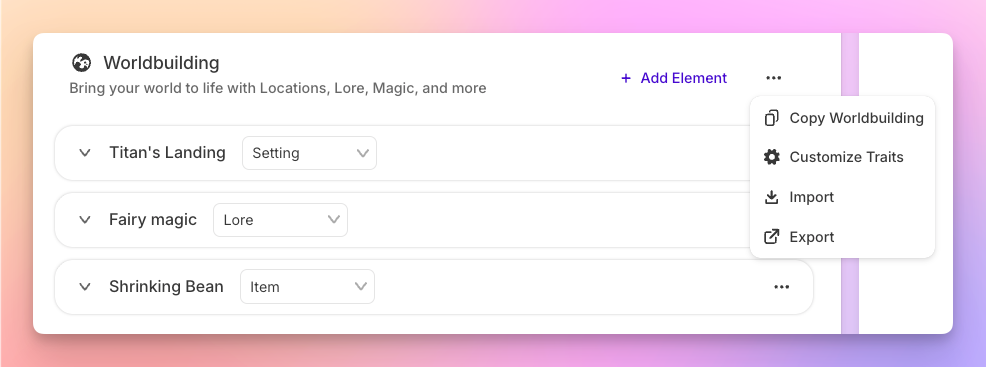
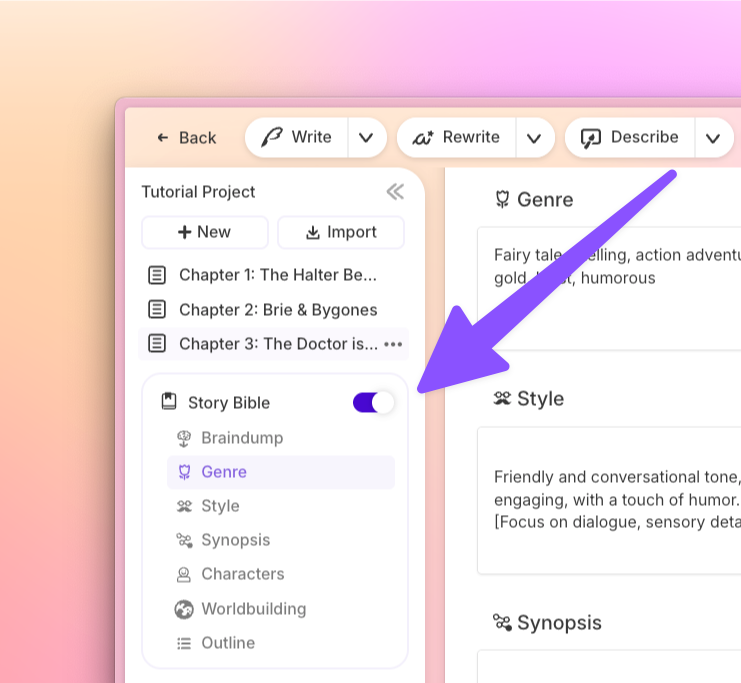
In Sudowrite, open the Story Bible, click the Worldbuilding section, and create your first card. Settings cards are the natural starting point — where does your story open? Add the sensory details, the social dynamics, the rules of that place. You can add Items, Lore, Factions, and Rules cards as they become relevant.
Build Only What the Story Needs (Pattern A)
The problem: You've written 40,000 words of lore and zero chapters. Your world is spectacular. Your novel doesn't exist.
Why it fails: Worldbuilding feels like writing. It's creative, it's fun, and it gives you the dopamine of productivity without the terror of actually drafting scenes.
The solution: Tie every worldbuilding element to a story function. Ask: does this detail create conflict, reveal character, or advance the plot? If not, it's a footnote, not a story element. Sudowrite's Brainstorm feature can help you pressure-test whether a worldbuilding detail earns its place by generating story implications for any element you've created.
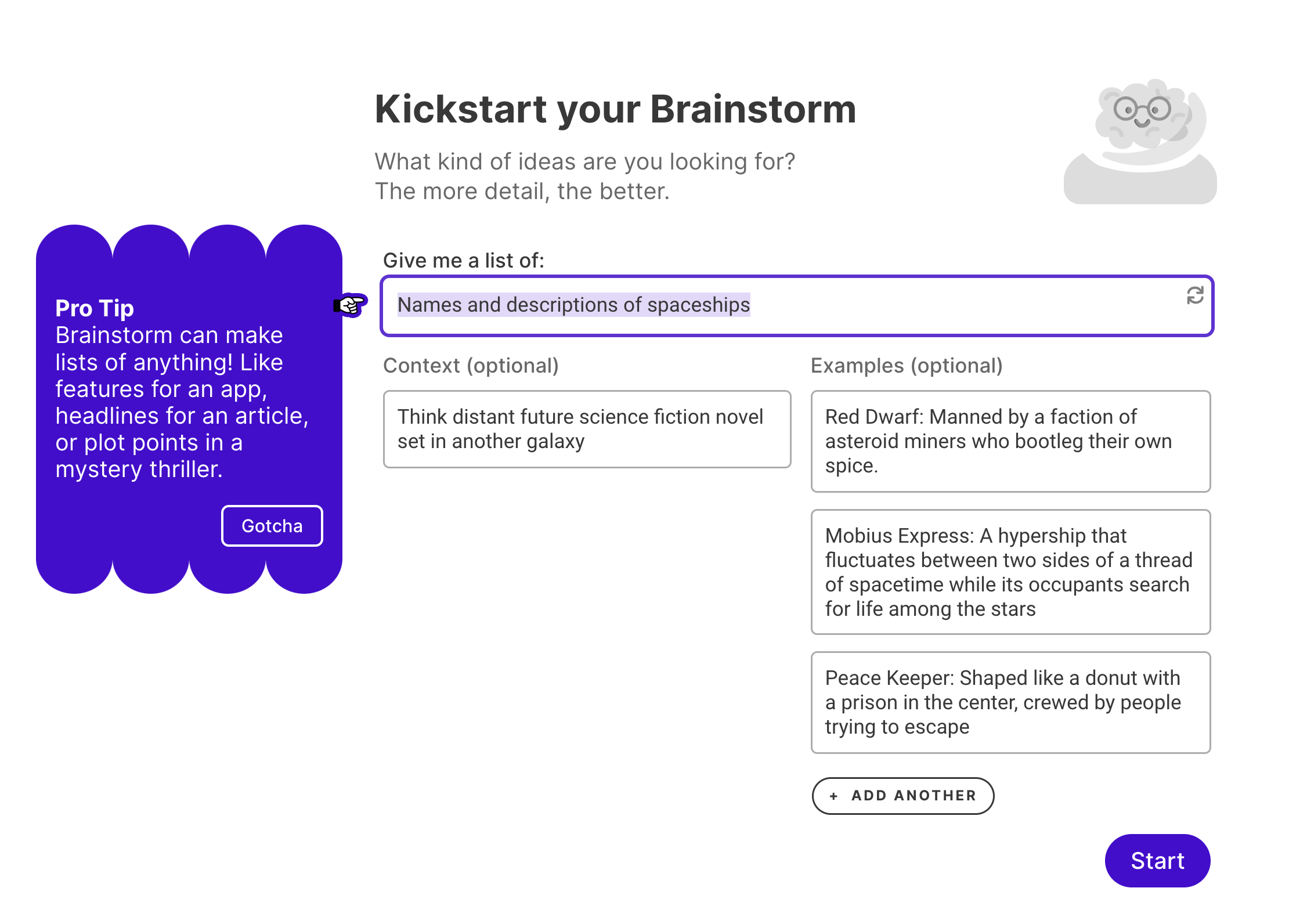
"Brainstorm showed me that the religious order I'd created could drive my entire B-plot. I'd been treating it as background flavor for three drafts." — Sudowrite user, historical fantasy author
Best Practices for Fiction Worldbuilding
Use Worldbuilding Cards, Not Loose Documents (Pattern B)
Writers who organize setting details in structured, accessible formats report fewer continuity errors and faster revision cycles. The card-based system in Sudowrite's Story Bible is designed for this — each card type (Settings, Items, Lore, Factions, Rules) maps to a functional category of world detail.
The key advantage: these cards don't just sit there. When you use Sudowrite's Write feature, powered by their fiction-trained Muse 1.5 model, it reads your worldbuilding cards and integrates them into AI-generated prose. Your world details shape the output automatically.
"I set up faction cards for three rival families. When I used Write to draft a dinner scene, the dialogue reflected the tensions I'd described. That's when I stopped being skeptical." — Sudowrite user, literary fiction author
Layer Details Across Drafts (Pattern C)
Picture your first draft: the room is "dark." Your second draft: the room is "dark, with a single overhead bulb that buzzes when the heat kicks on." Third draft: the buzzing bulb is the one the landlord promised to fix six months ago, and it drives your character insane every night.
That's worldbuilding through revision. You don't need everything on day one. Sudowrite's Expand feature lets you select thin passages and enrich them with layered detail pulled from your existing Story Bible context.
"I write fast first drafts, then use Expand to deepen the world details. It's like having a co-writer who actually read my notes." — Sudowrite user, urban fantasy author
Common Worldbuilding Mistakes
- Info-dumping in chapter one. Your reader doesn't need a history lesson. They need a character with a problem in a place that feels real.
- Building world before story. World serves story, not the other way around. If you can't explain how a detail creates narrative tension, cut it.
- Inconsistency across the manuscript. This is where centralized tools earn their keep. Sudowrite's Story Bible solves this structurally — your worldbuilding lives where you write, and the AI references it during drafting.
Worldbuilding Approaches Compared
| Approach | Best For | AI Integration | Consistency Support | Time Investment |
|---|---|---|---|---|
| Spreadsheets/Docs | Planners who won't draft with AI | None | Manual cross-reference | High |
| Wiki tools (Notion, World Anvil) | Elaborate secondary worlds | None native | Good for reference | Very High |
| Scrivener notes | Writers in Scrivener ecosystem | None native | Moderate (same app) | Medium |
| Sudowrite Story Bible | Fiction writers drafting with AI | Cards feed directly into Write, Describe, Expand | Automatic — AI reads your world | Low to Medium |
| No system | Nobody (seriously) | N/A | None | Infinite (in revision) |
FAQ
How many worldbuilding details do I need before I start writing?
Enough to write your first scene. Seriously. You need your opening setting, your protagonist's immediate context, and one or two rules of the world that create tension. Everything else can be built as you draft. Sudowrite's Story Bible lets you add cards at any point — they'll integrate into AI suggestions going forward.
Does worldbuilding matter for contemporary/realistic fiction?
Absolutely. Every story has a world. A contemporary romance set in Brooklyn has different worldbuilding than one set in rural Montana — social norms, economics, physical environment, slang. If you don't build it deliberately, you build it accidentally, and accidents create inconsistencies.
Can AI help with worldbuilding without making everything generic?
Only if the AI knows your world. Generic AI tools produce generic output because they have no context. Sudowrite's approach is different: your worldbuilding cards, Story Bible, and manuscript context feed directly into every AI feature. The output reflects your world, not a default template.
Related Reading
More on building fantasy worlds and series with AI:
- How to Build a Magic System That Doesn't Break — Worldbuilding cards as enforceable rules
- How to Write a Fantasy Series with AI — lore continuity across multiple installments
- AI for Romantasy Writers — fantasy-romance crossover workflows
- Writing Multiple Timelines with AI — parallel threads and branching storylines
Building a world from scratch and fixing one that has grown unwieldy are two different problems. This guide to worldbuilding tips for fiction writers focuses on the second scenario: what to do when your magic system has more rules than your story can use, and how to build up-front in a way that serves the narrative rather than competing with it.
Key Takeaways
- Worldbuilding is for every genre, not just fantasy and sci-fi
- Start from your protagonist's immediate experience and build outward
- Every world detail should serve the story — create conflict, reveal character, or advance the plot
- Centralized, structured systems prevent continuity errors across long manuscripts
- Sudowrite's Story Bible with worldbuilding cards (Settings, Items, Lore, Factions, Rules) feeds directly into AI drafting via the Write feature, keeping your world consistent automatically
Ready to build your world? Start worldbuilding free — Sudowrite's Story Bible and worldbuilding cards are available on all plans.