

Table of Contents
Multiple timelines are the narrative equivalent of juggling chainsaws. You've got a 1943 thread where your protagonist's grandmother is hiding documents in a floorboard, a present-day thread where your protagonist just found those documents, and somewhere around Chapter 14, you realize the grandmother already died in Chapter 6 of the other timeline. Your readers will notice. They always notice.
Here's the thing: your brain wasn't built to track two (or three, or five) timelines simultaneously. But AI built specifically for fiction writers can do exactly that. Tools like Sudowrite give you persistent memory across chapters, automatic cross-referencing between timelines, and per-chapter voice settings so you can write a dual-timeline novel without losing your mind or your continuity.
TL;DR: Multiple timelines fail when details contradict across threads. AI tools with persistent story memory, like Sudowrite's Story Bible and Chapter Continuity, track timeline-specific details so you don't have to. Writers who set up timeline-tagged entries before drafting catch continuity errors before their beta readers do. 92% of Sudowrite users report completing manuscripts faster.
In this article:
- What multiple timelines actually mean
- Why they trip writers up
- How AI tracks what you can't
- Getting started with your first dual-timeline draft
- Best practices and common mistakes
- FAQ
What Are Multiple Timelines in Fiction?
Multiple timelines means your story operates across two or more distinct time periods, each with its own narrative thread. This includes dual-timeline structures (past and present running in parallel), braided narratives (three or more threads weaving together), and extended flashback architectures where past sequences carry their own arc rather than serving as brief interludes.
Think The Time Traveler's Wife, Cloud Atlas, or Kate Atkinson's Life After Life. Each timeline has its own internal logic, its own cause-and-effect chain, and its own set of details that must stay consistent not just within that thread but across every thread they touch.
According to the Written Word Media 2025 Indie Author Survey, structural complexity is the number-one reason multi-timeline manuscripts stall during drafting. The problem isn't ambition. It's bookkeeping.
Why Multiple Timelines Trip Writers Up
Your Past Self Contradicts Your Present Self
You're 40,000 words into a dual-timeline thriller. Your 1943 chapter has a character arriving in Lisbon by train. Your present-day chapter references her "flight into Lisbon." You wrote those chapters three weeks apart. You didn't notice. Your beta reader did, in paragraph two of their feedback.
This is the fundamental problem with multiple timelines. Every detail exists in at least two contexts, and your working memory can only hold one context at a time. The According to Gotham Ghostwriters (2025), 60% of fiction authors who use AI say it improves the quality of their writing, and 87% say it boosts their productivity.
Readers Notice What You Don't
"Publishing my AI-assisted novel on KDP was identical to publishing my previous books. No extra hoops. I disclosed honestly and moved on.", Erwin T. Hurst Sr, Published Author
Spreadsheets Won't Save You
How AI Tracks What You Can't
Story Bible Captures Timeline-Specific Details
Sudowrite's Story Bible acts as persistent memory for your manuscript. You tag entries by timeline ("1943 Thread," "Present Day") and the system stores character states, locations, and plot details per era. When your grandmother character is alive in 1943 and dead in the present, Story Bible holds both states without conflating them.
Chapter Continuity Checks Across Timelines
Chapter Continuity is where it gets powerful. The feature pulls up to 25 linked documents and reads up to 20,000 words of your story before continuing when you're writing a new chapter. So when you're drafting a present-day scene that references 1943 events, Continuity automatically surfaces the relevant details from those earlier chapters. It's not guessing. It's reading your actual manuscript.
As sci-fi author Joe Vasicek puts it, Sudowrite "saves me roughly 15 hours a week." For multi-timeline work, most of those hours are the ones you'd spend manually checking your notes against your draft.
Canvas Maps the Visual Structure
Canvas gives you a visual overview of your entire timeline architecture. You can see where threads intersect, where gaps exist, and where the pacing between timelines has drifted out of balance. It's the bird's-eye view that spreadsheets try to provide but can't maintain dynamically.
Getting Started: Your First Dual-Timeline Draft
Set up your Story Bible with timeline anchors. Before drafting, create Story Bible entries for each timeline. Tag them clearly: era, key characters in that era, and the state of shared elements (locations, objects, relationships). This gives Sudowrite the foundation to track divergences.
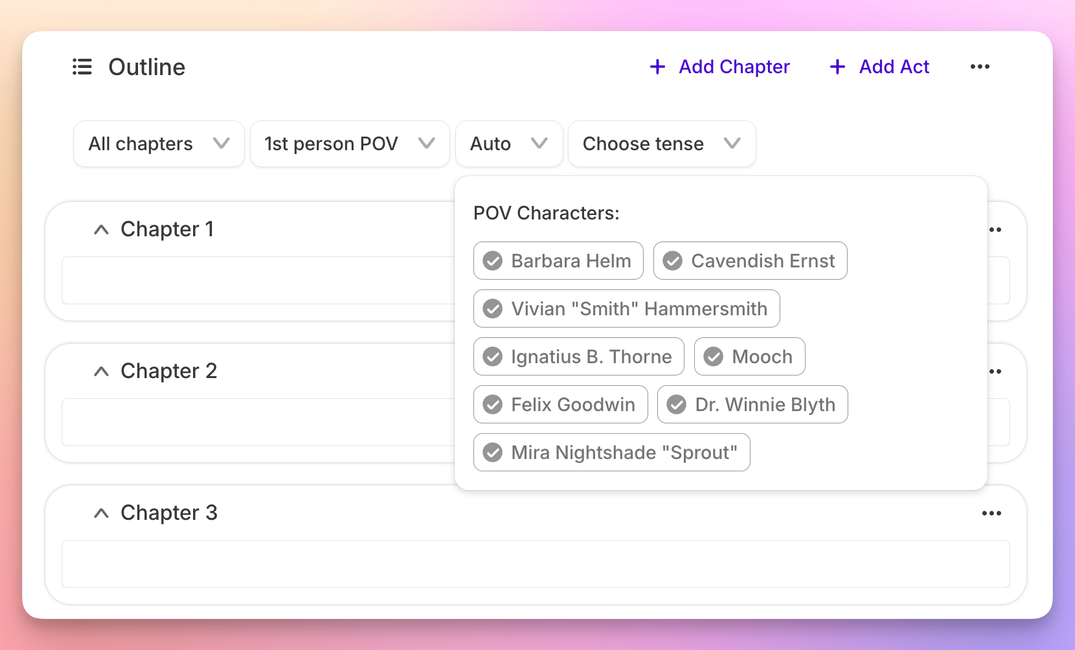
Configure POV and tense per chapter. Many dual-timeline novels use different POV or tense per thread (past tense third person for the historical thread, present tense first person for the modern thread). Sudowrite's POV and Tense settings let you lock this per chapter so your AI-assisted prose stays in the right voice for each timeline.
Draft with Muse while Continuity watches. Write your chapters using Muse 1.5, Sudowrite's fiction-trained prose model. As you draft, Chapter Continuity pulls from your Story Bible and previous chapters. "It felt very much like something I would have written," notes Agatha Award-winner Liese Sherwood-Fabre about Sudowrite's output, because the AI is trained on your context, not generic templates.
Use Canvas to spot structural gaps. After your first full draft, pull up Canvas and review the architecture. Are your timelines converging at the right pace? Does the 1943 thread drop information the present-day thread needs but hasn't received yet? Canvas makes these structural questions visual and answerable.
Best Practices for AI-Assisted Timeline Writing
- One Story Bible entry per timeline, not per character. Characters exist across timelines. Timelines contain distinct states. Organize by era and let Continuity handle the rest.
- Draft timelines in sequence, not alternation. Write all of one timeline first, then the other. Let AI handle the interweaving consistency checks. You can restructure chapter order afterward using Canvas.
- Treat continuity flags as revision prompts. When Continuity surfaces a contradiction, it's showing you a potential problem. You decide whether it's an error or an intentional narrative choice. Francisco, a Sudowrite user, describes Story Bible as "a great brainstorming partner," and that framing applies here too: partner, not author.
Common Mistakes
- Dumping all timelines into one Story Bible blob. If your AI can't distinguish between "grandmother in 1943" and "grandmother's legacy in 2024," neither can its suggestions. Tag by timeline.
- Ignoring POV/Tense settings between chapters. Switching from past-tense third person to present-tense first person mid-draft without updating settings produces jarring voice mismatches. Configure once per chapter.
- Over-relying on AI for plot decisions. AI tracks details. It doesn't decide which details matter to your story. That's still your job.
FAQ
Can AI really keep track of multiple timelines in a novel?
Yes, if the AI has persistent memory across chapters. Sudowrite's Story Bible and Chapter Continuity maintain timeline-specific details across your entire manuscript, pulling from up to 25 linked documents per chapter.
What's the best AI tool for writing multiple timelines?
Sudowrite is built specifically for fiction writers and includes Story Bible, Chapter Continuity, Canvas, and per-chapter POV/Tense settings, all designed for structural complexity like multi-timeline narratives. General-purpose AI tools like ChatGPT lack persistent story memory.
How do I prevent continuity errors between timelines?
Set up your Story Bible with timeline-tagged entries before drafting. Use Chapter Continuity to automatically surface relevant details from other timelines as you write each chapter. Review the full structure in Canvas after drafting.
Does AI change my writing voice across timelines?
Not if you configure it correctly. Sudowrite's POV and Tense settings let you lock voice parameters per chapter, and Muse 1.5 adapts to your style rather than imposing a generic tone.
Can I use AI for braided narratives with three or more timelines?
Yes. The story memory system scales to however many timelines you need. Each gets its own tagged entries, and Continuity checks all of them when building context for any given chapter.
Is AI-assisted timeline writing considered cheating?
No more than using Scrivener's corkboard or a wall of sticky notes. AI for writing multiple timelines is a structural tool. It tracks details so you can focus on the creative decisions that actually make your story work.
Key Takeaways
- Multiple timelines fail because of detail contradictions, not lack of ambition.
- AI with persistent story memory (Story Bible + Chapter Continuity) tracks cross-timeline details automatically.
- Configure POV/Tense per chapter to maintain distinct voices across timelines.
- Use Canvas for structural overview. Use Continuity for chapter-level consistency.
- The AI handles bookkeeping. You handle the storytelling.
Ready to write your multi-timeline novel without the continuity nightmares? Try Sudowrite free and let Story Bible keep your timelines straight while you focus on the story.