

Table of Contents
Your protagonist hit Copper realm in chapter 12. By chapter 47, after a brutal training arc and a near-death encounter with a Lord-tier opponent, they should be solidly Iron. Except your AI just wrote a scene where they struggle against a Copper-tier bandit. That's a downgrade. Readers of Cradle, Mother of Learning, and He Who Fights with Monsters will close the tab before you can fix it.
Progression fantasy and LitRPG have rules. Hard rules. Numbered tiers, named cultivation realms, skill trees with prerequisites, mana costs that have to balance against character level. The AI doesn't get to vibe its way through this. It has to track the math.
Here's how to set up Sudowrite so your AI respects the system you built, keeps power scaling consistent across 80 chapters and three books, and never accidentally weakens your MC because it forgot what realm they were in.
Why progression fantasy breaks generic AI writing tools
Most AI writing tools treat your story like vibes. They generate prose that feels right based on the last few paragraphs. That works fine for literary fiction where the rules are mood and theme. It collapses the moment you write a genre with explicit mechanical scaffolding.
Progression fantasy operates on bookkeeping. A reader of Will Wight's Cradle series can tell you the exact moment Lindon advanced from Foundation to Copper, what abilities he gained, and which characters out-rank him at any given chapter. Miss that math and your reader notices instantly.
The same is true for LitRPG. If your character is level 23 with 47 skill points, the AI can't suddenly write a fight where they use a level 30 ability. If your magic system runs on mana and a fireball costs 40, you can't write a scene where the MC casts twelve fireballs from a 200-point pool and is somehow fine.
Three failure modes show up constantly when writers try to draft these genres with generic tools:
- Accidental downgrade. The AI writes the MC struggling with enemies they should crush, because it forgot the last training arc.
- Skill amnesia. A power gained in chapter 15 never appears again, because the AI doesn't track abilities across chapters.
- System drift. Mana costs, cooldowns, tier names, or class mechanics shift slightly each scene. By book two, the rules contradict book one.
The fix isn't a better prompt. It's giving the AI persistent memory of your system. That's what Sudowrite's Story Bible is for.
Story Bible as your progression tracking system
The Story Bible is where Sudowrite stores everything the AI needs to remember about your project. Characters, Worldbuilding, Style, Outline, Synopsis, Braindump. For progression fantasy, two of those sections do the heavy lifting: Worldbuilding for system rules, Characters for power tracking.
The key thing to understand. Story Bible isn't optional context the AI maybe consults. It's persistent memory that loads into every generation. When you call Write, Rewrite, or Expand, your system rules ride along. The AI knows your character is currently Iron-tier with three forged techniques. It writes accordingly.
Worldbuilding cards for system rules
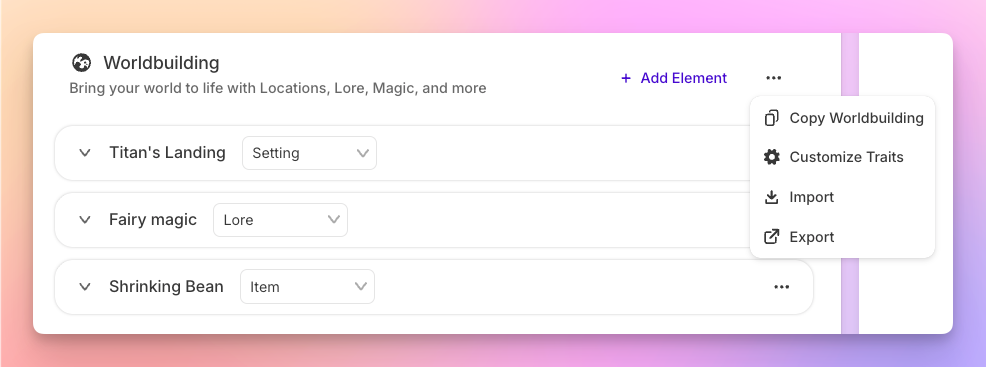
Open Worldbuilding in your Story Bible. Create cards for every mechanical rule in your magic or progression system. Don't write a wiki article. Write the rules tight and specific so the AI can apply them.
If you're writing a cultivation novel in the vein of Cradle, your Worldbuilding cards might look like:
- Tier System: Foundation, Copper, Iron, Jade, Lord, Herald, Sage, Monarch. Advancement requires breakthrough conditions and madra refinement. Each tier roughly 10x stronger than previous. Tier name is visible to others through madra sense.
- Madra Refinement: Characters cycle madra through their core. Pure madra advances faster but costs more focus. Cycling at higher tiers requires environmental aura or pills.
- Techniques: Each tier unlocks new technique slots. Foundation = 1 technique. Copper = 2-3. Iron = 4-5. Techniques are not interchangeable between paths.
- Advancement Cost: Time, training intensity, breakthrough materials. No shortcuts without major cost (corruption, lifespan loss).
Each card should be 50-200 words. Specific. Mechanical. No flowery worldbuilding prose. The AI doesn't need atmosphere here, it needs the rules.
For LitRPG, the cards get even more structured. Class definitions with stat allocations. Skill trees with prerequisites. XP curves. Loot tier rarities. Mana cost tables. If it's a number in your system, it lives on a Worldbuilding card.
Character cards for power level tracking
Characters are where you track who's at what level, what abilities they have, and how they evolve. For progression fantasy this is non-negotiable. You need a card for every named character with combat relevance and the cards need to update as the story advances.
A character card for a progression fantasy protagonist should include:
- Current tier/level: Iron-tier, cycle 3 (advancing toward Jade). Or for LitRPG: Level 23 Battlemage, 47 unspent skill points.
- Known techniques/skills: Each ability by name with current mastery. "Striker technique: Hollow Domain (advanced). Enforcer technique: Steelborn Skin (basic)."
- Stat profile: For LitRPG, the actual stat block. For cultivation, qualitative descriptions of madra capacity, refinement quality, body forging stage.
- Voice and personality: How they talk, what drives them, their flaws. Same as any character card.
- Progression arc: Where they started, where they are, where they're going. This is what makes them a progression fantasy character rather than just a fantasy character.
Update these cards after major advancement beats. When your MC breaks through to a new tier, edit the card before writing the next chapter. The AI uses what's in the card, not what you wrote three chapters ago.
The right model for progression fantasy
Sudowrite's prose-modes matrix matches models to genres. For progression fantasy and LitRPG, Claude 3.7 Sonnet is the recommended default. It handles structured magic systems well, follows mechanical rules consistently, and writes the kind of clear action prose these genres demand.
Claude 3.7 Sonnet is strong at tracking the cause-effect logic of fight scenes. If your MC has 80 mana and you've established a fireball costs 40, the model respects that math. It also handles the genre's signature pacing: training montages, breakthrough moments, escalating power scaling.
For darker progression fantasy with graphic combat, body horror, or morally bleak themes, you can swap to Muse. Muse is Sudowrite's fiction-trained model that won't refuse explicit or dark content and writes like a novelist. If you're doing something in the territory of Super Minion or the bleaker end of Cradle's arc with Reigan Shen, Muse handles weight and consequence without flinching.
For sweeping, mythic, sci-fi-adjacent progression fantasy (think The Wandering Inn or a more literary register), Claude 3 Opus can hit a different texture. Test both on a 500-word fight scene from your draft and see which one sounds more like your book.
A Cradle-style setup walkthrough
Let me show you what this looks like in practice. Imagine you're writing a cultivation novel called Pale Iron. Your MC, Tessen Vire, is a Foundation-realm orphan in a sect-dominated city. The plot: she discovers a hidden cycling technique that lets her advance faster than her tier suggests, drawing the attention of her sect's enforcers.
Here's how the Story Bible setup goes.
Worldbuilding cards. You write four cards. Cultivation Tiers: Foundation through Sovereign, eight tiers, each requiring a specific breakthrough trial. Madra Cycling: pure vs. mixed paths, environmental aura zones, side effects of forcing breakthroughs. Sect Hierarchy: Outer disciples (Foundation), Inner disciples (Copper), Elders (Iron+). Forbidden Techniques: cycling methods that draw aura unnaturally fast, creating madra corruption.
Character cards. Tessen Vire starts as Foundation, cycle 2. Her card lists her single technique (a stolen cycling pattern she doesn't fully understand), her physical stats (underfed, fast reflexes), her voice (terse, sarcastic, hides fear behind contempt). Her sect-rival enforcer, Yael Korr, gets a card listing him as Iron-tier, three Striker techniques, and a personality built around procedural loyalty to sect law.
Outline. You sketch the first ten chapters. Chapter 3: Tessen discovers the forbidden cycling pattern. Chapter 7: she breaks through to Copper unexpectedly fast. Chapter 9: Yael Korr is dispatched to investigate. Each beat ties to a mechanical change in her tier or technique count.
Now you write. You open chapter 7, type a few sentences of Tessen feeling the breakthrough, and hit Write with Guided direction: "Tessen pushes through to Copper realm. Describe the physical sensation, the change in her madra core, what new techniques become available."
The AI generates 300-500 words of breakthrough prose. It knows the tier system because it's in Worldbuilding. It knows Tessen's starting state because it's on her Character card. It knows the breakthrough is suspiciously fast because Outline flags it. The scene fits.
After the chapter, you update Tessen's Character card. Tier: Copper, cycle 1. Available technique slots: 3 (2 unfilled). Madra refinement: irregular, possibly corrupted from forbidden cycling. Now every subsequent chapter the AI writes treats her as Copper. No accidental downgrades.
Training arcs without skipping the work
Progression fantasy lives on training arcs. The reader wants to watch the work. They want the cycling sessions, the body forging, the technique drills, the brutal sparring matches that teach a hard lesson. Skipping the work is the cardinal sin. Mother of Learning built an entire series around showing the work, repeatedly, with variations.
Sudowrite handles training arcs well if you give it the right scaffolding. Three tools matter:
- Expand for stretching a training sequence. Write the broad strokes ("Tessen drilled the new cycling pattern for three weeks") and use Expand to flesh out specific sessions, mistakes, breakthroughs, exhaustion.
- Describe for the sensory texture of training. Madra surging through meridians, the burn of body forging, the specific sounds of a sparring hall. Describe pulls 5-sense detail without you having to pause and brainstorm.
- Tone Shift to vary the pacing. A training arc shouldn't be one register. Hit Tone Shift with Conflicted for self-doubt sessions, Fast-Paced for combat drills, Authoritative for master-figure scenes.
The structural trick most successful progression fantasy authors use: each training segment ends with a measurable change. A new technique unlocked. A tier breakthrough. A specific mistake corrected. Don't let the AI write training without consequence. After each montage, update the Character card with what changed.
Series Folder for multi-book progression
Progression fantasy almost always becomes a series. Cradle is twelve books. The Beginning After the End spans an entire web fiction archive. Dungeon Crawler Carl is racing toward double digits.
Sudowrite's Series Folder shares your Story Bible across multiple books in a series. The same Worldbuilding cards for your magic system carry over. The same Character cards continue evolving from book one to book three. You don't have to re-explain your tier system every time you start a new manuscript.
This matters more than it sounds. Without a Series Folder, every new book is a cold start. You either retype your worldbuilding or trust the AI to remember from context (it won't). With one, your book three chapter one already knows that Tessen is now Jade-tier, that Yael Korr was killed in book two, that the forbidden cycling pattern came from a long-dead Monarch named Vesh.
Pair Series Folder with Chapter Continuity, Sudowrite's cross-chapter consistency check. It catches contradictions across chapters. If you wrote in book one that Tessen's master uses a fire-aspect madra and you accidentally write a flashback in book three where he uses ice, Chapter Continuity flags it. For a long-running progression fantasy series, this is the difference between a coherent saga and a wiki nightmare.
System rules that don't break under pressure
The hardest part of progression fantasy is keeping your system honest when the plot wants to cheat. Your MC needs to lose a fight for emotional reasons but they're three tiers above the opponent. Your villain needs a surprise reveal but their power level should already be known. The temptation to fudge is constant.
Two practices keep the system honest:
- Write the constraints into Worldbuilding as immutable. If breakthroughs require specific conditions, state that explicitly. The AI will then need plot-justified reasons for any deviation, which forces you to actually think about it instead of vibing.
- Use Chat to stress-test scenes before writing. Sudowrite's Chat reads your Story Bible. Ask it: "Given Tessen is Copper-tier and Yael is Iron, can she realistically defeat him? What would she need?" It'll surface the mechanical gaps in your premise before you've spent 4,000 words on the scene.
Brandon Sanderson's first law of magic: "An author's ability to solve conflict with magic is directly proportional to how well the reader understands said magic." Progression fantasy lives or dies on that principle. Your AI tools need to enforce it, not undermine it.
The Creativity Dial during breakthrough scenes
One last tactical note. Progression fantasy has two kinds of scenes: rule-following scenes where the system must be respected, and breakthrough scenes where strange, ineffable things happen. The Creativity Dial in Sudowrite lets you tune this.
For mechanical fight scenes, training drills, and system explanations, keep the dial low. 2-4. You want the AI conservative. Following rules.
For breakthrough moments, visions during cultivation, contact with higher-tier beings, dial it up. 7-9. Let the prose get weird. Cradle's breakthrough scenes are some of the most evocative writing in the genre because Will Wight stops being mechanical for two pages and goes full mystical. Your AI can do the same if you let it.
Progression fantasy rewards writers who treat the system like a contract with the reader. Build the Story Bible to enforce that contract. Track power levels on Character cards. Codify system rules in Worldbuilding. Run multi-book arcs through a Series Folder. Let Chapter Continuity catch the mistakes you missed. Sudowrite's free trial gives you enough credits to set up a full Story Bible and draft a few thousand words. That's plenty to see if your system survives contact with the page.