

Table of Contents
Urban fantasy lives or dies on a single trick. The reader has to believe that werewolves hunt in Phoenix suburbs, that wizards rent apartments in Chicago, that vampires file taxes. Break that contract by writing a high fantasy info-dump or by treating magic like background flavor, and the whole thing collapses.
This subgenre asks more of your prose than most. You need a city that feels real enough to Google. You need magic that follows rules you've actually decided on. You need a protagonist who can pay rent and stake a vampire in the same afternoon.
Generic AI tools choke on this balance. Sudowrite was built for fiction, and urban fantasy is where that distinction shows up fast.
Why urban fantasy is its own beast
Urban fantasy is not low-magic fantasy with a coffee shop. It's a specific tradition with rules. Jim Butcher built the Dresden Files on the idea that magic exists in our world and most people don't notice. Patricia Briggs's Mercy Thompson novels treat shapeshifter politics with the same weight as small-town gossip. Ilona Andrews stacks magic flares over post-apocalyptic Atlanta.
The craft demands are different from epic fantasy. You're not building Roshar or the Stormlight Archive's spren ecology. You're answering smaller, weirder questions. How does a vampire get a driver's license. Where does a sorcerer buy reagents when the magic shop downtown is a tourist trap that sells crystals to college students.
Compare two openings. A high fantasy book might start with a kingdom on the brink of war and a prophesied heir. An urban fantasy opens with a PI wizard taking a phone call about a missing cat that turns out to be a familiar that turns out to be a murder. The stakes scale up. The world stays grounded.
The conventions you have to know
Readers of this subgenre have expectations. Some are flexible. Some are not.
- First person, present or past tense. Dresden, Mercy, Kate Daniels, October Daye. The intimate POV is almost a default. Third person works but it's the harder sell.
- A protagonist with an inhuman edge. Wizard, half-fae, necromancer, mediator, mechanic who happens to be a coyote. They're functional in the human world and they have one foot somewhere else.
- A masquerade or a known reveal. Either magic is hidden from regular people (the Dresden model) or it came out publicly and society adjusted (the Sookie Stackhouse model). Pick one. Mixing them sloppily destroys reader trust.
- A specific city, treated like a character. Chicago. New Orleans. Atlanta. Tri-Cities, Washington. The setting is not a backdrop. It has weather, neighborhoods, traffic, and a history.
- Mystery or case-of-the-week structure. Even in long arcs, individual books often follow a noir-flavored investigation shape. Raymond Chandler's bones under Anne Rice's skin.
Skip these and you're writing something else. Call it paranormal romance or contemporary fantasy and target a different shelf.
Pick the right prose engine
Sudowrite runs multiple models, and the CX prose-modes matrix points fantasy writers toward Claude 3.7 Sonnet. There's a reason. Sonnet handles the genre's specific cadence well. It can move from a snarky internal monologue to a ghoul tearing through a parking garage without whiplash. It respects subtext and doesn't over-explain magic systems when the scene wants tension.
For darker urban fantasy that leans into horror or explicit content, switch to Muse. Muse is Sudowrite's fiction-trained model that won't refuse the bloody, the romantic, or the morally ambiguous. If your protagonist is sleeping with a vampire by chapter four or your antagonist is a serial killer who eats memories, Muse will not flinch.
A practical rule. If your urban fantasy reads close to Jim Butcher or Seanan McGuire, Sonnet is your default. If it reads close to Anne Rice or Laurell K. Hamilton's later Anita Blake, Muse. You can switch mid-project and the Story Bible carries over.
The Creativity Dial in practice
Urban fantasy rewards a middle setting. Push the Creativity Dial too low (zero to two) and your prose flattens into competent but lifeless beats. Push it past seven and the model starts inventing magic rules you never agreed to. Your wizard suddenly has a familiar he never had before. Continuity breaks.
The sweet spot is four to six. High enough to get prose with bite, low enough to keep your established rules intact. Push to seven for a wild dream sequence or a magic-flare set piece. Drop to three for a procedural scene where the protagonist questions a witness.
Worldbuilding magic that fits in our world
This is the make-or-break craft problem in urban fantasy, and it's where Sudowrite's Worldbuilding cards earn their keep. You need rules consistent across three hundred pages. They need to constrain your protagonist enough to create tension and stay flexible enough for plot.
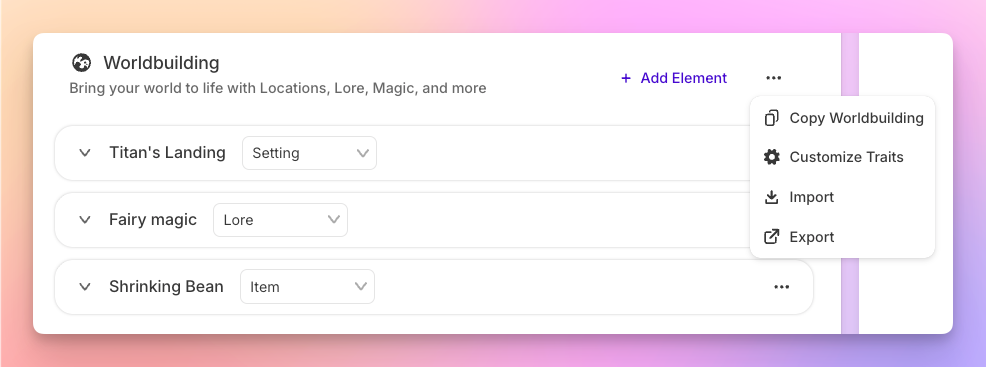
Build your magic system in the Story Bible before you write a chapter. Use cards for Rules, Lore, Factions, Settings, and Items. The Rules card is the most important. Be specific.
A weak Rules card. Magic is real but most people don't know about it. Wizards can do spells.
A working Rules card. Magic exists. Practitioners manipulate the four classical elements through focused will and a verbal or somatic component. Casting cold iron is impossible. Casting near electronics shorts them out. Practitioners are bound by the Unseelie Accords, which forbid killing humans with magic. Breaking them brings the Wardens. The masquerade is enforced by the White Council. Roughly 4,000 practitioners in North America.
That second version gives Sudowrite something to work with. When you ask the model to write a confrontation, it knows your wizard can't pull out a phone to call backup. It knows there are consequences for killing a mortal opponent. The masquerade becomes a real constraint, not a vague suggestion.
Factions, settings, and the city itself
Build a Worldbuilding card for each major supernatural faction. The vampire court. The werewolf pack. The fae court if you have one.
Each card should answer four questions. Who leads them. What do they want. What are they forbidden from doing. How do they interact with normal society.
Build Setting cards for the neighborhoods that recur. The protagonist's apartment. The bar where supernaturals drink. The morgue where they know the medical examiner. The forest preserve where bodies get dumped.
These aren't just locations. They're stages with their own rules.
One trick that works. Write a Setting card called "The City's Magic" and describe how magic interacts with the specific geography. Chicago has the lake, which damps water magic. The El trains run on iron, so practitioners avoid them. Now your city has texture specific to your book.
Characters who balance human and supernatural
The urban fantasy protagonist has to function in two worlds. They pay rent. They argue with landlords. They also banish demons on Tuesday. Make the human stuff specific and the supernatural stuff will feel grounded by contrast.
In Sudowrite's Characters section, build your protagonist with both layers. The voice card should capture how they talk in human contexts and how they shift in supernatural ones.
Dresden's voice is a perfect study. He sounds like a hard-boiled detective when talking to clients. He sounds like a tired wizard when talking to faerie queens. The diction shifts and the cadence shifts. The reader stays oriented because the underlying personality stays consistent.
A working Character card for an urban fantasy protagonist includes the basics (age, appearance, personality traits) plus genre-specific layers.
- Power profile. What can they do magically. What are the costs. What can they not do that other practitioners can.
- Day job. The thing that pays rent. PI, bartender, librarian, mechanic. The day job should constantly intersect with the supernatural plot.
- Social network. Cop friend. Medical examiner. Mentor figure. Supernatural ally. Romantic interest. Each one should have their own card.
- Voice tics. Specific phrases, swear patterns, references they make. Dresden quotes Star Wars. Mercy thinks in mechanic metaphors. Voice tics are how readers feel they know a character.
- The wound. Almost every urban fantasy lead carries trauma. A dead mentor. A betrayal by their faction. A family they failed. This drives the long arc.
Run your supporting cast through the same process. Your werewolf alpha is not just "tough alpha guy." They have a job, a problem with their pack, and a thing they want that your protagonist can help with or stand in the way of.
Using Chapter Continuity to keep characters consistent
Urban fantasy series can run twenty books. Characters evolve, powers change, relationships shift.
Chapter Continuity catches the contradictions that ruin reader trust. If you said in chapter three that your wizard can't cast on consecrated ground, and in chapter eleven you have him throwing fireballs in a church, the continuity check flags it. That's the kind of error readers will email you about for years.
Tone Shift for the urban fantasy register
This subgenre needs tonal range. A single chapter might move from a wisecracking interrogation to a body horror reveal to tenderness with a love interest. Tone Shift is the lever for that.
Practical applications.
- Fantastical for the actual magic. Spell-casting scenes, faerie encounters, the moment a god shows up at a diner.
- Ominous for the case-of-the-week mystery beats. The discovery of a body. The phone call from the wrong person. The sense something is hunting your protagonist.
- Fast-Paced for action. Chase scenes, fights, the protagonist running from a thing they should not have antagonized.
- Sensual for the romantic subplot. Most urban fantasy has one. Don't pretend it doesn't.
- Conflicted for the moral cost moments. The protagonist who had to do something they'll regret. The mentor who turns out to be compromised.
Drop these into the Tone Shift selector as you write. Don't ride one for a whole book. The subgenre's pleasure is in the cycling.
A walkthrough: writing a confrontation scene
Say your wizard protagonist, Asha Reyes, is confronting a vampire in a Phoenix nightclub. She suspects him of feeding on a missing waitress. She can't kill him without White Council approval. He knows it.
Step one. Open the chapter in the document editor. Make sure your Story Bible is loaded with Asha's Character card, the Worldbuilding card for the vampire courts, and a Setting card for Sangria, the nightclub where Phoenix vampires congregate.
Step two. Write the first paragraph yourself. Establish where she is, what she's wearing (something with iron buttons, because she's not stupid), and the sensory hook. Smell of cigarettes and something underneath, sweeter, that she can't identify. Bass thumping through her chest.
Step three. Use Write in Guided mode. Tell it: Asha approaches Cassian at the back booth. She's testing whether he killed the waitress, can't accuse him directly. He's amused and dangerous. End with him asking her to dance.
Step four. Set Tone Shift to Ominous. Creativity Dial at five. Run the generation.
You'll get a draft that knows the constraints. The Council rules apply. Iron buttons matter because Cassian can't grab her without burning. He's amused because his Character card says he's a 400-year-old hedonist who finds modern wizards entertaining.
Step five. Rewrite any paragraph that feels generic. Use the Show Don't Tell mode if the model summarizes too much. Use More Inner Conflict if Asha feels too composed (she shouldn't be, she's bluffing).
Step six. After the scene, run a Describe pass on the moment where Cassian's hand brushes hers. Five-sense expansion catches what you missed. The smell of his cologne layered over something colder. The dry warmth that's wrong for skin.
That's how a working urban fantasy scene gets built. Not one click. Six passes, each using a specific tool. The Story Bible carries the rules through every generation.
The series problem and how to solve it
Urban fantasy is a series genre. Mercy Thompson is at fourteen books. October Daye is past eighteen. Dresden Files is at seventeen. Continuity across that many books is brutal.
The Series Folder shares your Story Bible across every book. Character growth carries forward. Worldbuilding decisions made in book one stay locked in book seven. When a side character dies in book four, they stay dead.
The Canvas visual workspace is where most urban fantasy writers plan series arcs. Lay out the overarching mystery (who killed the protagonist's mentor) across multiple books, plotting clues into specific chapters. Map relationships and how they evolve. See where the big reveal needs to land in book five and work backward.
This is the difference between a series that holds together and one where book eight contradicts book three. Readers track everything. They make wikis. They will catch you.
Where to start your first urban fantasy
Build the Rules card first. Be specific about what magic can and can't do. Build your protagonist's Character card second, with both human and supernatural layers. Build three Setting cards for the locations you'll return to most. That's the foundation.
Pick Claude 3.7 Sonnet as your default prose model. Switch to Muse for any scene that needs darkness, sex, or moral weight that other models will sanitize. Keep the Creativity Dial in the four-to-six range. Cycle Tone Shift to match the scene.
Write the first chapter as a self-contained mystery hook. Even in a series, that opening case needs to satisfy on its own while seeding the larger arc. Dresden's Storm Front is a murder investigation that also introduces the White Council. Briggs's Moon Called is a hit-and-run that opens the door to pack politics.
Sudowrite was built for this. Not for blog posts. Not for marketing emails. For the specific craft of fiction, including the awkward, beautiful, rule-bound work of putting magic in a city and making it feel real.
The free trial gets you into the Story Bible and the prose tools. Start there. Build your rules. Write your wizard. See what happens when the AI actually knows the genre you're working in.