

Table of Contents
You decided fire magic costs blood on page 12. By page 247, your protagonist is throwing fireballs like confetti at a parade. No blood. No cost. No consequences. Your beta reader catches it. Or worse, nobody catches it until the one-star reviews roll in.
Magic-system contradictions are the number one bug in fantasy fiction. Not weak prose. Not flat characters. Broken rules. According to the AI and the Writing Profession survey by Gotham Ghostwriters (2025), 60% of fiction authors who use AI say it improves the quality of their writing, and 87% say it boosts their productivity. The gap widens for writing magic systems with AI-tracked worldbuilding rules.
TL;DR: Magic system contradictions compound silently across novel-length manuscripts. Sudowrite's Worldbuilding cards store your magic rules, costs, and limitations in the Story Bible, while Write and Chat reference them across up to reads up to 20,000 words of your story before continuing. According to the Written Word Media 2025 Indie Author Survey, 46% of indie authors would use AI for marketing, and the savings multiply when your rules are codified from the start.
What Is AI-Assisted Magic System Building?
AI-assisted magic system building is the practice of using fiction-specific AI tools to design, document, and enforce the internal rules of a fictional magic system across an entire novel or series. Unlike freeform worldbuilding in a spreadsheet, this approach stores magic rules as structured data the AI references during drafting and revision, preventing contradictions automatically.
Traditional approaches required manual cross-referencing of every magical event against your rules. Most writers stopped doing that around chapter eight. AI changed this by making rule enforcement automatic.
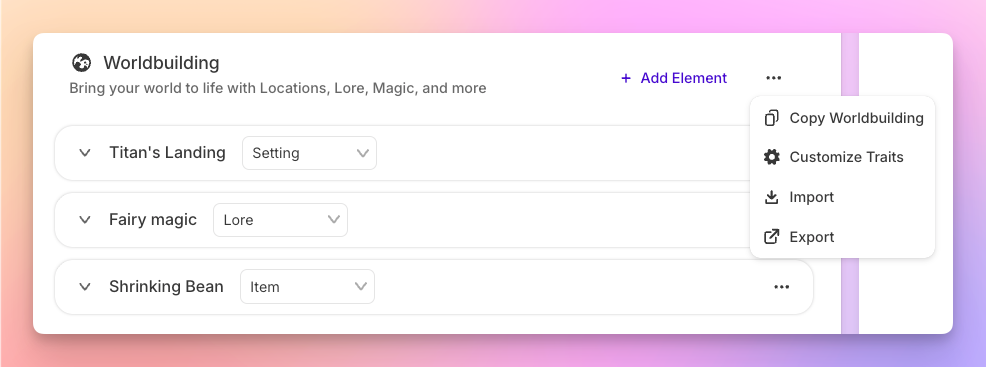
Sudowrite implements this through Worldbuilding cards in the Story Bible. Each card stores a magical element's source, cost, limitation, and interactions. The Write feature reads these cards alongside your manuscript, and the Excellent prose mode (Claude 3.7 Sonnet) handles the dense fantasy prose that magic-heavy scenes demand.
Why Writing Magic Systems with AI Matters
Your Brain Can't Grep a Manuscript
You're juggling a hard magic system with twelve rules, three exceptions, and a prophecy loophole from the prologue. Forty thousand words in, can you remember whether healing magic requires physical contact or line of sight? Can you confirm you already answered that on page 89?
Nobody can. Sudowrite's Worldbuilding cards turn your magic rules into persistent reference data the AI checks every time it generates prose. Your system stays consistent even when your memory doesn't.
The Revision Math Tells the Story
According to the Written Word Media 2025 Indie Author Survey, 87% of indie authors would never use AI for exact book text, but many rely on it for revision and editing support. For fantasy writers, the bulk of revision goes to catching worldbuilding contradictions and continuity breaks. Meanwhile, writers using AI report a 57% average productivity boost (Gotham Ghostwriters 2025).
"Sudowrite understands story. It doesn't just autocomplete — it thinks about narrative. But I'm still the one making every decision about what stays and what goes."
. Francisco, Author
Sanderson Gave You Laws. You Need a Cop.
Brandon Sanderson's First Law: your ability to solve conflict with magic is proportional to how well the reader understands it. Second Law: limitations are more interesting than powers. Third Law: expand what you have before adding something new.
Brilliant rules. Impossible to enforce manually at novel scale. Sudowrite's Chat can check your manuscript against your Worldbuilding cards and flag scenes where magic solves problems the reader hasn't been prepared for. The laws are yours. The enforcement is AI's job.
How Writing Magic Systems with AI Works in Sudowrite
Three stages: define your rules, write with enforcement, audit for contradictions.
Define Rules in Worldbuilding Cards
Create a card for each magical element. Here's a template:
| Card Field | Example Entry |
|---|---|
| Magic Name | Bloodfire |
| Source | Caster's blood (1 oz per fireball) |
| Limitation | Cannot cast in rain. Requires open wound |
| Cost | Physical weakness proportional to blood spent |
| Interaction | Nullified by iron. Amplified near volcanic rock |
| Known Exception | Royal bloodline substitutes tears (established Ch. 3) |
The Story Bible holds up to 2,000 entries. Even epic fantasy systems fit.
Write with Automatic Enforcement
Use the Excellent prose mode (Claude 3.7 Sonnet) for magic-heavy scenes. Write pulls your Worldbuilding cards into context alongside your manuscript and linked chapters. When a character casts Bloodfire, the AI knows it costs blood. No prompt engineering required.
Audit with Chat
Open Sudowrite's Chat sidebar and ask it to check chapters against your magic cards. Chat sees your entire Story Bible and full document text. Ask: "Does any scene in chapters 10-12 violate my Bloodfire limitations?" Thirty seconds. Targeted answers.
Getting Started with Sudowrite
Brain Dump Your Magic System
Open a new Sudowrite project and use the Story Bible's Braindump section. Pour everything about your magic system into it. Sources, costs, who can use it, what happens when it fails. Don't organize yet. Include edge cases and exceptions. Those are the rules you'll forget first.
Build Your Worldbuilding Cards
handle to the Worldbuilding section. Create one card per magical element using the template above. Be specific about costs. "Fire magic is tiring" gives the AI nothing. "Each fireball costs 1 oz of caster's blood and causes proportional weakness" gives it a contract to enforce.
Pro tip: Set your Genre to something specific like "epic fantasy with hard magic system" for better calibration.
Write a Magic-Heavy Scene
Select Excellent prose mode. Use Write in Guided mode with direction like "Kael uses Bloodfire against the iron-armored guards, and it fails." Watch how the AI incorporates your limitations. If it gets something wrong, refine your Worldbuilding card. The problem is almost always a vague rule.
Run a Consistency Check
Open Chat and ask: "Review chapters 1-5 and list scenes where magic is used without the cost I defined in Worldbuilding cards." Here are the kinds of contradictions AI catches:
| Contradiction Type | Example | How AI Catches It |
|---|---|---|
| Forgotten cost | Fireball with no blood price | Worldbuilding card specifies cost; Chat flags omission |
| Exceeded limitation | Casting in rain (rules say impossible) | Card states rain nullifies; Write avoids generating it |
| Inconsistent scaling | Novice casts master-level spell | Character card + Worldbuilding card cross-reference |
| Retroactive change | New rule contradicts Ch. 3 | Chat checks full document against Story Bible |
Run this every five chapters. Small contradictions compound fast.
"The first draft was mine , the bones, the voice, the weird parts. Sudowrite helped me see options I wouldn't have considered. It's like brainstorming with someone who never gets tired."
. Eric, Fiction Author
Best Practices
Start with Limitations, Not Powers
Sanderson's Second Law isn't just craft advice. It's AI advice. Cards that emphasize what magic can't do produce better conflicts. "Teleportation exists" gives the AI nothing to push against. "Teleportation requires line of sight and leaves the caster blind for 30 seconds" creates scenes that write themselves.
Version Your Rules as You Draft
Magic systems evolve mid-draft. When you change a rule, update the Worldbuilding card and note which chapter the change takes effect. Chapter Continuity links up to 25 documents, so the AI tracks where old rules end and new ones begin.
Use Chat Before Your Beta Readers
Don't wait for human feedback. After every major magical scene, ask Chat: "Did I establish that iron blocks Bloodfire before the armory fight in chapter 9?" Thirty seconds of checking beats thirty hours of revision.
Common Mistakes
Vague Worldbuilding Cards
"Magic is powered by emotion" tells the AI nothing actionable. Which emotions? How much power? What's the cost? Vague inputs produce vague enforcement. Treat each card like a contract with specific terms.
Skipping the Story Bible Entirely
Jumping to drafting without filling your Story Bible is like coding without specs. Write reads your Worldbuilding cards, Genre, Style, and Synopsis. Skip them, and the AI writes fantasy blind.
Too Many Systems at Once
Sanderson's Third Law again: expand before you add. Writers who dump six magic systems into cards before finishing act one get contradictions between systems. Start with one. Get it airtight. Then layer.
FAQ
Can AI actually understand complex magic systems?
AI doesn't "understand" magic the way a reader does. It references structured rules you define. Sudowrite's Worldbuilding cards store your system as data the AI checks during writing. More specific cards mean more consistent enforcement.
What's the best AI model for fantasy writing?
Sudowrite's Excellent prose mode, powered by Claude 3.7 Sonnet, handles dense fantasy prose well. The proprietary Muse 1.5 model is also strong for creative fantasy. Switch between models per scene based on whether you need atmospheric richness or precise rule-following.
How do I apply Sanderson's Laws with AI tools?
Encode each law as a constraint in your Worldbuilding cards. For the First Law, make sure every magic rule your protagonist uses to solve problems has a corresponding card. Sudowrite's Chat audits your manuscript against these constraints on demand.
Does this work for soft magic systems?
Soft magic systems benefit too, though differently. Instead of hard rules, your Worldbuilding cards store tone and atmosphere boundaries. "Magic should feel mysterious and never be fully explained" shapes how the AI writes magical scenes.
How many Worldbuilding cards should a magic system have?
Most functional magic systems need 5-15 cards. One per element, plus cards for interactions, exceptions, and cultural context. Sudowrite's Story Bible holds up to 2,000 entries, enough for the most elaborate epic fantasy series.
Can I track magic systems across multiple books?
Sudowrite's Series Folder shares Story Bible information across books. Worldbuilding cards persist and evolve, so rules from book one carry forward automatically. Chapter Continuity links up to 25 documents within each book for context awareness.
Magic systems are one layer of fantasy worldbuilding. Writers building across multiple books will find lore and continuity management covered in How to Write a Fantasy Series with AI: Managing Lore Across Multiple Books. If you blend magic with romance, AI for Romantasy Writers: Writing Fantasy Romance with Sudowrite shows how to balance hard world-rules with emotional arcs. For stories with parallel timelines where events in one thread affect another, Writing Multiple Timelines with AI explains how Chapter Continuity tracks the splits.
Key Takeaways
Magic system contradictions kill fantasy novels slowly. The fix isn't better notes. It's rules the AI enforces while you write.
- Worldbuilding cards in Sudowrite's Story Bible turn magic rules into persistent, AI-readable constraints
- Write and Chat cross-reference your rules across your manuscript and linked chapters
- Sanderson's Laws become enforceable contracts, not principles you hope to remember
- Excellent mode (Claude 3.7 Sonnet) handles dense fantasy prose where magic consistency matters most
Your magic system deserves better than a spreadsheet you stop updating in chapter eight. Build the rules. Let the AI enforce them. Write the story.