

Table of Contents
You're three chapters into the best scene you've written all month. Your protagonist is finally vulnerable, the tension is right, and then your AI writing tool hits the brakes. Content blocked. Session over. No explanation, no workaround, just a wall where your story used to be.
According to the Authors Guild Survey, 67% of professional novelists now use AI writing tools. But most of those tools weren't built for fiction — and the ones that were built for fiction often won't let you write all of it. The uncensored AI writer you actually need isn't just one that removes filters. It's one that produces prose worth reading after the filters are gone.
Sudowrite, built by fiction writers and trained on storytelling, handles mature content without restrictions while delivering prose that reads like a human author wrote it. In this guide, you'll learn which major AI tools block what content, why "unfiltered" alone doesn't mean "good," and how to pick a tool based on prose quality. Not just freedom.
In This Guide
- What Is an Uncensored AI Writer?
- The Real Problem: Unfiltered Doesn't Mean Good
- AI Writing Tools Ranked by Prose Quality and Freedom
- Getting Started with Sudowrite
- Common Mistakes
- FAQ
- Key Takeaways
TL.DR: Most AI writers either block fiction content or produce mechanical prose when filters are removed. Sudowrite's fiction-trained Muse model writes mature content without restrictions while maintaining the narrative quality, character voice, and sensory detail that 92% of its users say helps them complete manuscripts faster (Sudowrite User Survey).
What Is an Uncensored AI Writer?
An uncensored AI writer is a writing tool that generates fiction across all themes and content levels. Including violence, horror, and adult intimacy. Without blocking, flagging, or sanitizing the author's creative intent. For fiction novelists, this means writing dark fantasy battles, psychological thrillers, or romance scenes at any heat level without triggering content restrictions that halt generation mid-scene.
The concept sounds simple, but the execution splits into two camps. Camp one: general-purpose AI models with safety filters removed or loosened. These let you write anything, but the prose often reads like it was assembled from spare parts, functional vocabulary, zero emotional architecture. Camp two: fiction-specific AI tools that understand storytelling conventions and treat mature content as a legitimate part of the narrative spectrum.
Sudowrite falls squarely in camp two. Its proprietary Muse model was trained on fiction, producing prose that carries character voice and sensory texture even in the scenes other tools refuse to touch. Features like Write Guided let you steer scene direction and intensity, while the Story Bible keeps character details consistent whether you're writing a tender conversation or an explicit encounter.
The Real Problem: Unfiltered Doesn't Mean Good
Which Major Tools Block What, and Why It Matters
You've probably hit this wall yourself. You're writing a paranormal romance, a gritty war novel, or literary fiction with frank sexuality, and suddenly your AI assistant turns into a hall monitor. ChatGPT restricts explicit content across the board. Claude. Despite being praised by The New York Times for its prose quality, blocks mature fiction outright. Google's Gemini flags violence and intimacy alike.
The Fiction Writers Survey found that 89% of writers using specialized fiction AI tools report better prose quality compared to general-purpose AI. The gap isn't about vocabulary. It's about whether the model understands what a scene is trying to accomplish emotionally.
The Prose Quality Gap Nobody Talks About
"I published 270,000 words last year and I'm on track to surpass that this year, all thanks to Sudowrite's efficiency. I wouldn't be where I am without it." , Gianmarco, Romance and Sci-Fi Author
Grok lets you write explicit content. NovelAI removes filters entirely. But read what they produce. The prose tends toward mechanical repetition. Correct words in a technically valid order, stripped of the rhythm and subtext that makes fiction feel alive. A love scene isn't a list of physical actions. It's vulnerability, power dynamics, sensory memory, emotional risk. An AI that doesn't understand fiction conventions can't write any of that, no matter how "uncensored" it claims to be.
Sudowrite's Muse model was trained on storytelling. The Describe feature generates five-sense details, sight, sound, touch, taste, smell, plus metaphor, that give intimate scenes the atmospheric texture readers expect from published fiction.
Why Fiction Training Changes Everything
Picture two painters. One has every color available but no training in composition. The other studied under masters and knows how light, shadow, and emotion work together. Unfiltered access to the full palette means nothing without the craft to use it.
According to the Publishing Perspectives Study, fiction writers using AI complete first drafts 40% faster on average. But speed only matters if the output holds up. Sudowrite's Write feature reads up to 20,000 words of preceding context plus Story Bible data. Characters, worldbuilding, plot details, so it continues your story with the right voice, the right tone, and the right emotional register. You don't prompt-engineer your way to good prose. The model already understands how fiction works.
"I've been able to go from taking six months to a couple of years to write a novel… to about one or two months." , Joe Vasicek, Fiction Author (Author of Genesis Earth)
AI Writing Tools Ranked by Prose Quality and Freedom
Here's what actually matters: not just whether a tool lets you write freely, but whether the output is worth keeping. This ranking prioritizes prose quality alongside content freedom.
| Tool | Content Freedom | Prose Quality (Fiction) | Fiction-Specific Features | Novel-Length Support | Best For |
|---|---|---|---|---|---|
| Sudowrite | Full (including mature) | High. Fiction-trained Muse model | Story Bible, Write Guided, Describe, Rewrite, Chapter Continuity | Yes (20K word context, 25 linked chapters) | Serious fiction writers across all genres |
| NovelAI | Full (no restrictions) | Medium. Capable but often repetitive | Basic story memory | Limited | Short fiction, hobbyist writers |
| Claude (direct) | Restricted (blocks mature content) | High. Praised for literary quality | None (general-purpose chat) | No persistent memory | Non-mature fiction drafting |
| Grok | Full (minimal filters) | Low-Medium. Mechanical, lacks nuance | None | No | Casual, non-fiction |
| ChatGPT | Restricted (blocks explicit content) | Medium. Formulaic for fiction | None (general-purpose) | Limited context window | Non-fiction, brainstorming |
| KoboldAI | Full (open-source, no filters) | Variable, depends on model loaded | Community-built tools | Depends on setup | Technical users comfortable with configuration |
The pattern is clear. The tools with the most freedom tend to have the weakest fiction prose. The tools with the best prose tend to block your content. Sudowrite is the exception, fiction-trained quality without content restrictions.
"One of the best features of Sudowrite is how it gives you alternatives for phrasing, which helps avoid the repetition that often creeps into long-form writing." , Francisco, Fiction Writer and Dungeon Master
Sudowrite also discussed this exact tension on their podcast: freedom without fiction training produces junk. The Muse model exists because the founders. Both science fiction writers, needed a tool that respected the craft.
Getting Started with Sudowrite: Step-by-Step
Step 1: Start Your Free Trial and Set Up Your Story Bible
What you'll accomplish: A workspace that already knows your story's characters, world, and tone.
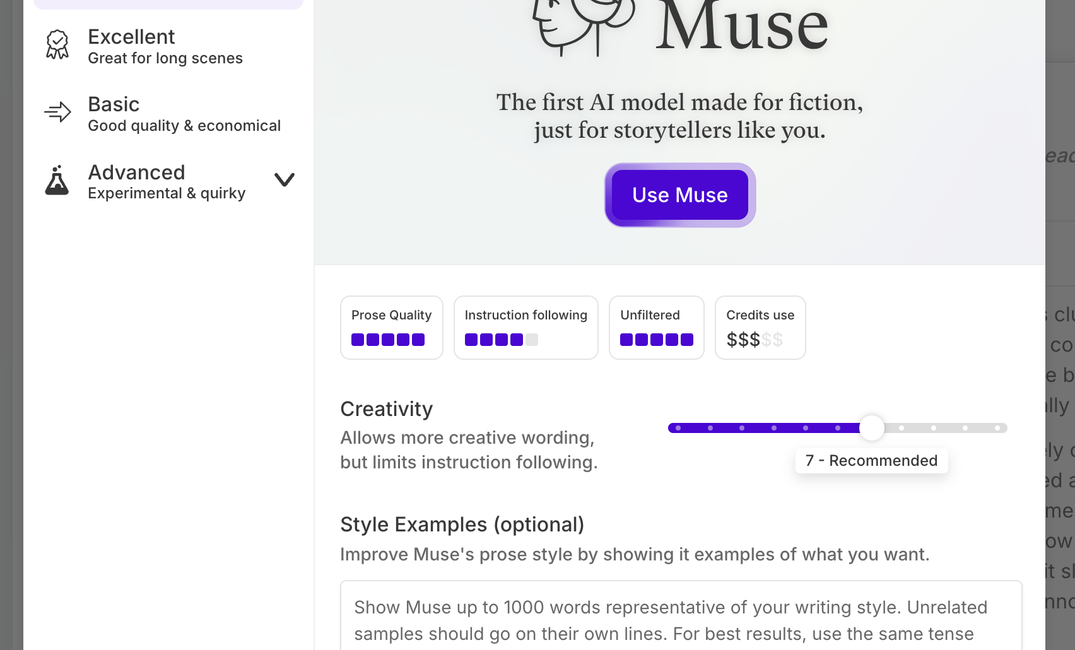
Sudowrite's Muse model is trained for fiction and doesn't filter adult scenes.
Sign up at Sudowrite. No credit card required. Create a new project and open the Story Bible. Start with a Braindump: dump everything you know about your story. Then let the guided workflow walk you through Synopsis, Genre, Characters, and Worldbuilding. Set your Style preferences here too, so the AI matches your voice from the first word.
Pro tip: The more specific your Genre description (e.g., "dark paranormal romance with slow-burn tension" rather than just "romance"), the better Muse calibrates its output.
Step 2: Write Your First Scene Using Guided Mode
What you'll accomplish: A full scene drafted with your story's context intact.
Paste or write your opening paragraphs, then click Write and choose Guided mode. You'll get three continuation suggestions informed by your Story Bible data. Pick one, modify it, or type your own direction. For mature scenes, Write Guided lets you specify exactly what should happen next, intensity, pacing, emotional focus.
"I use Sudowrite for auto-writing when I get stuck. It helps generate ideas that I can build on and shape into my own." , Kayla, Romance Author
Step 3: Refine with Describe and Rewrite
What you'll accomplish: Polished prose with sensory depth and emotional texture.
Highlight a flat passage and hit Describe to generate five-sense details and metaphors. Use Rewrite in Show Not Tell mode for scenes that summarize when they should immerse. The More Intense mode tightens pacing for climactic sequences. According to the Alliance of Independent Authors Report, AI-assisted editing reduces revision time by 35%.
"Sudowrite makes it so much easier to write a chapter or short story, it's intuitive and helps me get the ideas out, fast." , Liese Sherwood-Fabre, Author (Over 9,000 Books Sold)
Step 4: Scale to a Full Manuscript with Chapter Continuity
What you'll accomplish: A consistent novel-length draft without voice drift or plot holes.
Link your chapters so Write reads up to 25 previous documents as context. Series Folder shares Story Bible information across multiple books. Your characters don't reset between sessions. Your world rules don't contradict. Data from Sudowrite shows users save an average of 15 hours per week on revision with these continuity features.
"Sudowrite has sped up how I write…we've published nine physical books, with thirty-two more waiting to go through editing." , Erwin T. Hurst Sr Founder of Family-Run Publishing Company
Common Mistakes When Choosing an Uncensored AI Writer
Picking Freedom Over Prose Quality
The temptation is obvious, find the tool with zero restrictions and call it done. But if the output reads like a robot summarizing a romance novel from Wikipedia, you'll spend more time rewriting than you saved. The Writer's Digest Survey found 73% of fiction writers say AI helps overcome writer's block, but only when the AI's prose is worth building on.
Need a premise to start from? The free adult writing prompt generator will hand you one to react to.
Ignoring Context and Memory
A tool that generates one scene at a time with no memory of your characters, plot, or worldbuilding will contradict itself by chapter three. General-purpose chatbots reset every session. Your protagonist's eye color, your magic system's rules, your villain's motivation, gone. Look for persistent Story Bible and chapter-linking features.
Confusing "Uncensored" with "Unstructured"
Removing content restrictions doesn't give you a fiction writing tool. It gives you a text generator without guardrails. You still need features designed for novel-length storytelling: POV consistency, tense management, outline-to-draft workflows. Without them, you're prompt-engineering your way through a manuscript one disconnected paragraph at a time.
FAQ
What does "uncensored AI writer" actually mean for fiction?
An uncensored AI writer generates fiction content across all themes. Including violence, dark subject matter, and explicit intimacy. Without triggering content blocks. For novelists, the practical test is whether you can write a complete scene in any genre without the tool refusing or sanitizing your work mid-generation.
Can Claude or ChatGPT write mature fiction?
No. Both Claude and ChatGPT block explicit content by default, and workarounds are unreliable. The New York Times has praised Claude's prose quality as among the best in AI, but that quality comes with strict content restrictions. Sudowrite offers access to multiple models including Claude for non-mature scenes, while its Muse model handles mature content natively.
How is Sudowrite different from NovelAI or KoboldAI?
Sudowrite combines content freedom with a fiction-trained model, Story Bible, and novel-length context, features the others lack or implement minimally. NovelAI removes filters but tends toward repetitive prose. KoboldAI requires technical setup and varies wildly in output quality. Sudowrite's Muse was purpose-built for fiction with 20,000-word context awareness.
Does Sudowrite work for full novels, not just short scenes?
Yes. Chapter Continuity links up to 25 documents, giving the AI up to 20,000 words of your story across your entire manuscript. Series Folder extends this across multiple books. 86% of users say Story Bible features helped them overcome plot problems (Sudowrite User Feedback).
Will my writing style be preserved or will the AI override it?
Sudowrite's Style settings in Story Bible let you define your voice, and Muse adjusts to match. You can paste style examples, set tone preferences, and use the Creativity Slider to control how predictable or experimental the output gets. The Rewrite feature includes Rephrase mode specifically designed to preserve meaning while varying language.
"I'm impressed with how Sudowrite builds on user feedback. It's one of the few AI tools that truly listens to writers, constantly improving the writing experience." , Piero, Non-Fiction Writer
Is it worth paying for a specialized tool when free options exist?
Free uncensored tools typically trade prose quality for price. According to the Fiction Writers Survey, 89% of writers using specialized fiction AI tools report better results than general AI. Sudowrite offers a free trial with no credit card. If you're publishing fiction. Especially across genres that include mature content. The difference in output quality pays for itself in revision hours saved.
"My first year using Sudowrite, I hit 1.2 million words. It helped me stay focused and productive." , Eric, Novel/Fiction Writer
Key Takeaways
The right uncensored AI writer isn't the one with the fewest filters. It's the one that writes fiction worth reading after those filters are gone.
- Prose quality separates real fiction tools from text generators. Unfiltered access means nothing if the output is mechanical.
- Sudowrite's Muse model is fiction-trainedproducing prose with narrative pacing, character voice, and sensory texture across all content levels.
- Context and memory matter as much as freedom. Story Bible, Chapter Continuity, and 20,000-word context windows keep your novel consistent.
- 92% of Sudowrite users report completing manuscripts faster because the tool understands storytelling, not just vocabulary.
Your fiction deserves an AI partner that respects both your creative freedom and your craft. Stop fighting content restrictions. Start writing the story you actually want to tell.
Related Reading
More from the Sudowrite adult fiction library:
- AI Sex Story Generator: Honest Reviews and Alternatives, our complete guide to writing intimate scenes with AI
- AI for Adult Writing: The Uncensored Guide, the full framework for choosing tools, building prompts, and editing AI output for adult fiction
- Sudowrite vs. DreamGen for NSFW Fiction, direct comparison for writers choosing between the two leading NSFW platforms
- Dark Romance AI Writer: Writing Without Content Blocks, for dark romance, morally grey dynamics, and content-sensitive scenes
- How to Make AI Erotica Read Like Real Fiction, the prose quality problem in AI-generated adult content, and how to fix it