

Table of Contents
Can Claude write NSFW fiction? You opened Claude, typed out a steamy scene between your two leads, hit enter, and got a polite refusal. Maybe a warning. Maybe your third warning this week. If you write romance, erotica, or dark fiction, you've probably already discovered that most AI writing assistants treat your genre like contraband.
Here's what's actually happening behind those refusals, which tools will work with you instead of against you, and what you genuinely risk by pushing the boundaries.
What "NSFW Content Policy" Means for Fiction Writers
When AI companies talk about NSFW policies, they're referring to the rules governing sexually explicit, graphically violent, or otherwise "mature" content. For fiction writers, these policies determine whether an AI tool will help you write a love scene, a fight scene, or a psychological thriller without flinching.
The problem: most large language models were built for general audiences. Their content restrictions don't distinguish between a user requesting harmful content and a novelist crafting chapter twelve of a paranormal romance. Your carefully constructed tension scene and a bad-faith prompt look identical to an automated filter.
Why AI Content Policies Matter for Your Writing Career
Your Account Is on the Line
This isn't hypothetical. Writers have reported account suspensions and permanent bans from platforms like Claude and ChatGPT after repeatedly triggering content restrictions. Anthropic's usage policy explicitly prohibits sexually explicit content generation through Claude, and repeated violations can result in account termination. Taking your conversation history, custom instructions, and subscription payment with it.
content restrictions don't Understand Context
AI content restrictions operate on pattern matching, not literary analysis. They can't tell the difference between gratuitous content and a key scene that serves your narrative. A Syracuse University study confirmed that Claude maintains "absolute prohibition" and "categorical refusal" of sexually explicit content regardless of creative context.
The Market Is Enormous, and Underserved
Romance accounts for nearly one in five adult fiction books sold in the U.S. Annually, and the genre saw a 52.4% sales surge in 2023. Yet according to the Technology Policy Institute34% of AI users cite content restrictions as their reason for switching tools. Romance and erotica writers represent one of the largest fiction demographics, and the one most poorly served by mainstream AI.
How AI Content Policies Actually Work
Stage 1: Training-Level Restrictions
Models like Claude are trained with reinforcement learning from human feedback (RLHF) that penalizes explicit outputs. These restrictions are baked into the model's weights. No prompt engineering or "jailbreak" will reliably bypass them, because the refusal behavior is fundamental, not surface-level.
Stage 2: Platform-Level Filters
On top of model-level restrictions, platforms add automated content moderation layers. These scan both your inputs and the model's outputs for policy violations. ChatGPT, Gemini, and Claude all use these secondary filters. Triggering them can flag your account even if the model itself didn't refuse.
Stage 3: Enforcement and Consequences
Violations are typically handled in escalating steps: soft refusal, warning, temporary restriction, permanent ban. The timeline varies by platform. Claude tends toward immediate refusal. ChatGPT may produce a watered-down response before flagging repeated attempts. The key risk: you often don't know how many strikes you have left.
The Policy Comparison: 7 AI Tools, Ranked by Restriction Level
Here's what each major AI tool actually allows for fiction writers as of early 2026:
| Tool | NSFW Fiction Policy | content restriction Level | Account Risk | Best For |
|---|---|---|---|---|
| Claude (Anthropic) | Prohibited. Categorically refuses explicit content. | Strict | High. Account ban for repeated attempts | General writing, non-explicit fiction |
| ChatGPT (OpenAI) | Evolving. Erotica allowed for verified adults as of late 2025, with age-gating. | Moderate-to-Permissive (with opt-in) | Medium. Terms still restrict some content | Writers willing to verify and use opt-in mode |
| Gemini (Google) | Prohibited. Follows Google's conservative safety guidelines. | Strict | High — account flags for policy violations | Research, plotting, non-explicit tasks |
| Grok (xAI) | Permissive. "Unfiltered mode" loosens restrictions for adult themes. | Low-to-Moderate | Low-Medium. Fewer reported bans, but policies evolving | Experimental adult fiction, fewer guardrails |
| NovelAI | Fully uncensored. No content restrictions. 18+ age gate only. | None | None. Platform designed for it | Erotica, dark fiction, unfiltered creative writing |
| DreamGen | Fully uncensored. "No rules, no restrictions." | None | None. Platform designed for it | Role-play, fanfiction, mature storytelling |
| Sudowrite | Unfiltered via Muse model. Purpose-built for fiction writers. | None (Muse) / Moderate (GPT/Claude models) | None with Muse | Full-length novels, romance, adult fiction with professional writing tools |
Getting Started: Choosing the Right Tool for Your Content
Step 1: Assess your content needs honestly. If your manuscript includes explicit scenes. Even a few. You need a tool that won't fight you on them. Trying to "trick" a restricted model wastes time and risks your account.
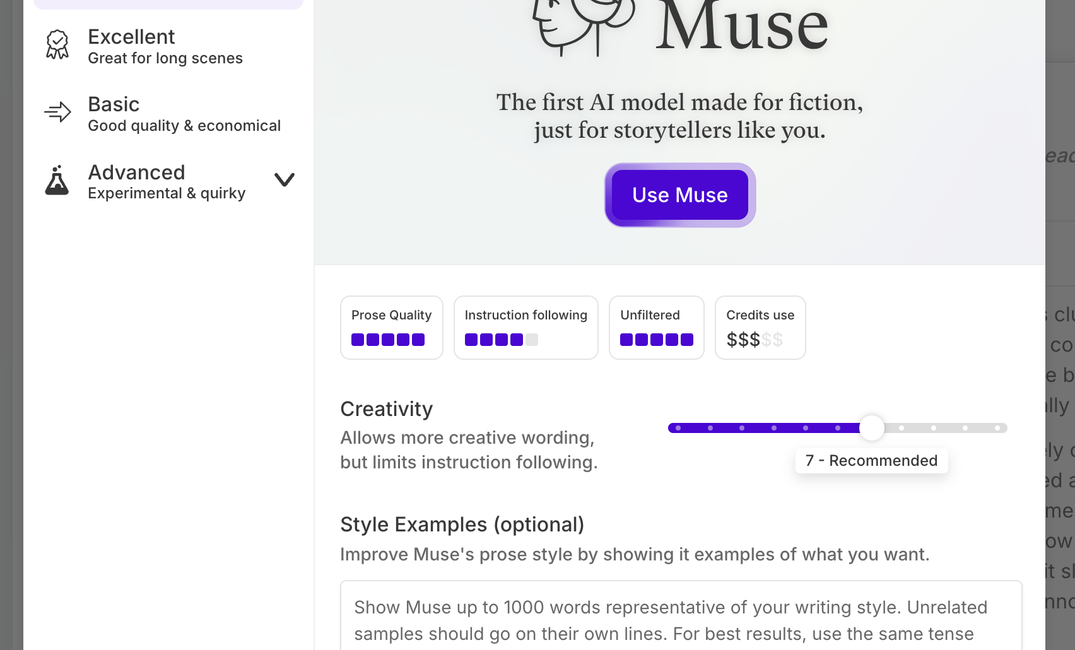
Sudowrite's Muse model is trained for fiction and doesn't filter adult scenes.
Step 2: Check the terms of service. Read them. Every platform listed above has a publicly available usage policy. Claude's is unambiguous. ChatGPT's has shifted. Know what you're agreeing to before you build a workflow around it.
Step 3: Test before committing. Most tools offer free tiers or trials. Write your most explicit planned scene as a test. If the tool refuses or sanitizes it, you have your answer.
Step 4: Separate your workflows. Many professional fiction writers use multiple AI tools, a restricted model like Claude for plotting, world-building, and dialogue coaching, and an unfiltered tool for drafting scenes that require creative freedom. This keeps you within terms of service everywhere.
Step 5: Choose a purpose-built fiction tool. General-purpose chatbots were designed for customer service, coding, and essay writing. Tools like Sudowrite were designed specifically for novelists. The Muse model produces vivid, original prose without content restrictions, while features like Story Bible, Beat Sheet, and scene-level generation keep your long-form project coherent.
Best Practices for AI-Assisted Fiction Writing
Need a premise to start from? The free adult writing prompt generator will hand you one to react to.
- Never rely on a single AI tool. Use restricted models for structure and unrestricted models for prose. This protects your accounts and improves output quality.
- Keep local backups of everything. If an account gets suspended, your conversation history may disappear. Export regularly.
- Don't attempt jailbreaks on restricted platforms. The NYT reported on romance writer Coral Hart, who built an entire publishing operation around AI, but even sophisticated users hit walls. Prompt injections flag your account faster than straightforward requests.
- Respect platform-specific guardrails. Every tool, even permissive ones, prohibits content involving minors and non-consensual depictions of real people. These are hard limits across the industry.
Common Mistakes Writers Make with AI content restrictions
- Assuming all AI tools work the same way. They don't. If you've asked "can Claude write NSFW content?" and then assumed NovelAI works the same way, you're comparing two entirely different systems. Researching each tool's specific policy takes ten minutes and saves hours of frustration.
- Trying to "trick" Claude into writing explicit content. Jailbreak prompts are unreliable, often produce lower-quality output, and actively risk your account. A Change.org petition against Claude's filters reflects widespread frustration, but the solution is choosing the right tool, not fighting the wrong one.
- Ignoring the ChatGPT policy shift. OpenAI's October 2025 announcement that it would allow erotica for age-verified adults represents a significant industry change. If you dismissed ChatGPT years ago, it may be worth revisiting.
- Overlooking purpose-built fiction tools. Writers often default to whatever chatbot they already use. Dedicated fiction writing platforms offer better prose quality, longer context windows, and story-aware features that general chatbots lack.
Can Claude Write NSFW Fiction? No. Here Are Your Alternatives
If Claude's strict content policy doesn't serve your writing needs, your strongest alternatives are:
- Sudowrite (Muse model): Purpose-built for fiction with no content restrictions, professional-grade writing tools (Story Bible, Beat Sheet, scene generation), and prose quality tuned specifically for novels. Muse 1.5 delivers 40% longer scene generation. Ideal if you want an all-in-one fiction writing environment.
- NovelAI: Fully uncensored with strong privacy (XSalsa20 encryption). Best for writers who want maximum freedom and don't need structured novel-writing features.
- DreamGen: Uncensored with a focus on role-play and short-form fiction. Strong for character-driven scenes and fanfiction.
- ChatGPT (with opt-in): Now allows erotica for verified adults. A viable option if you're already in the OpenAI ecosystem, though output quality for fiction tends toward the clinical.
Frequently Asked Questions
Can Claude write NSFW content at all?
No. Claude categorically refuses sexually explicit content under Anthropic's usage policy. This applies to all versions of Claude, including Claude available through third-party apps. There is no setting, prompt, or workaround that reliably bypasses this restriction.
Will I get banned from Claude for trying to write explicit fiction?
Possibly. Repeated attempts to generate prohibited content can result in warnings and eventual account suspension. Anthropic's enforcement escalates with repeated violations, though the exact threshold isn't publicly documented.
Did ChatGPT change its NSFW policy?
Yes. In October 2025, OpenAI CEO Sam Altman announced that ChatGPT would allow erotica generation for age-verified adult users. The feature rolled out with opt-in age-gating and still prohibits content involving minors, non-consent, and real individuals.
Is it safe to use NovelAI or DreamGen for explicit fiction?
Yes. Both platforms are specifically designed for uncensored creative writing. NovelAI encrypts all stories with XSalsa20 encryption, and both platforms require users to be 18+. Neither imposes content restrictions on fiction.
What's the difference between Sudowrite's Muse model and using Claude through Sudowrite?
Sudowrite offers multiple AI models. When using Claude or GPT-based models within Sudowrite, those models' content restrictions still apply. Sudowrite's proprietary Muse model has no content restrictions and was trained specifically on fiction, producing better prose for novels.
Can I use Claude for parts of my novel and another tool for explicit scenes?
Absolutely, and many professional authors do exactly this. Use Claude for plotting, character development, and dialogue. Switch to an unfiltered tool like Sudowrite's Muse for scenes that require creative freedom. This hybrid approach keeps you within every platform's terms of service.
What does Google Gemini's NSFW policy look like?
Gemini follows Google's conservative content safety guidelines and does not support explicit fiction writing. It's useful for research, plotting, and non-explicit tasks but will refuse mature content similar to Claude.
Are there any risks to using "jailbreak" prompts?
Yes. Jailbreak prompts are unreliable. They work inconsistently and often produce degraded output. More importantly, they flag your account for policy violations. Platforms increasingly detect and penalize circumvention attempts. The smarter approach is to use a tool that's built for your content needs.
Key Takeaways
- Claude does not write NSFW content and will ban accounts for repeated attempts to circumvent its filters.
- ChatGPT now allows erotica for age-verified adults after its October 2025 policy change.
- Gemini and Claude share similar strict policiesand neither supports explicit fiction.
- Grok offers a more permissive middle ground but faces regulatory scrutiny and evolving policies.
- NovelAI and DreamGen are fully uncensored platforms designed for adult creative writing.
- Sudowrite's Muse model is purpose-built for fiction writers who need unfiltered creative freedom paired with professional novel-writing tools like Story Bible, Beat Sheet, and long-form scene generation.
- The safest strategy is using the right tool for each taskrestricted models for structure, unfiltered models for prose, rather than fighting content restrictions.
Related Reading
More from the Sudowrite adult fiction library:
- AI Sex Story Generator: Honest Reviews and Alternatives, our complete guide to writing intimate scenes with AI
- AI for Adult Writing: The Uncensored Guide, the full framework for choosing tools, building prompts, and editing AI output for adult fiction
- Sudowrite vs. DreamGen for NSFW Fiction, direct comparison for writers choosing between the two leading NSFW platforms
- Dark Romance AI Writer: Writing Without Content Blocks, for dark romance, morally grey dynamics, and content-sensitive scenes
- How to Make AI Erotica Read Like Real Fiction, the prose quality problem in AI-generated adult content, and how to fix it