

Table of Contents
By the Sudowrite Team | Published April 2026
You've read AI-generated erotica. You can spot it in about three paragraphs. Something goes dead behind the prose, technically correct but emotionally vacant, like a love scene directed by an accountant. The problem isn't the concept of AI erotica quality. According to the Gotham Ghostwriters 2025 Survey60% of fiction authors using AI say it improves their writing quality. The problem is that most writers are using the wrong AI for the job. Sudowrite's fiction-trained Muse model was built to kill these robotic patterns at the source. What follows is a diagnostic guide: six specific tells that expose AI erotica as machine-generated, and the exact fix for each one.
In This Guide
- What AI erotica quality actually means
- The 6 tells of robot prose (with before-and-after fixes)
- Getting started with Sudowrite
- Common mistakes
- FAQ
- Key takeaways
TL.DR: Most AI erotica fails because generic models recycle the same euphemisms, flatten emotions, and ignore every sense except sight. Sudowrite's Muse model, Describe feature, and Rewrite modes (Show Not Tell, More Inner Conflict) fix each of these six tells. According to the Gotham Ghostwriters 2025 Survey60% of fiction authors using AI say it improves their writing quality, and the before-and-after examples below show why.
What AI Erotica Quality Actually Means
AI erotica quality measures how closely AI-generated intimate fiction matches the emotional depth, sensory richness, and character consistency of human-authored romance and erotica, specifically avoiding the mechanical prose patterns that signal machine-generated text to experienced readers. The bar isn't "passes a grammar check." The bar is: would a romance reader keep turning pages, or would they throw their Kindle at the wall?
Generic AI tools treat erotica like any other text task. Sudowrite's Muse was trained on fiction storytelling. It understands the pacing, the voice shifts, the emotional architecture that separates a scene your reader feels from a scene they skim.
The 6 Tells of Robot Prose and How to Fix Each One
Your readers are pattern-recognition machines. They don't need a linguistics degree to diagnose robot prose. They feel it. Here are the six patterns that give AI erotica away every single time, and how to kill each one.
Tell #1: Euphemism Spam
Before: "His throbbing member pressed against her silken folds as waves of desire crashed through them both."
After: "His hand found the curve of her hip, and she caught the faint tremor in his fingers, the same hands that never shook. Not once. Not ever."
Generic AI has roughly twelve euphemisms for body parts and cycles through them like a broken jukebox. Your reader clocks it by page three. The fix isn't going clinical. It's replacing vague stand-ins with specific, physical detail. Sudowrite's Describe feature generates alternatives across all five senses. Instead of another "silken" anything, you get texture, temperature, and the small physical truths that make a scene feel inhabited.
Tell #2: Emotional Flatness
Before: "She felt a surge of passion as he kissed her. She wanted him desperately. He wanted her too."
After: "She kissed him back and hated how easy it was, how quickly her body forgot every reason she'd spent six months building a wall between them."
AI defaults to labeling emotions. "She felt passion." Great. That tells your reader nothing they couldn't guess from context. Sudowrite's Rewrite in Show Not Tell mode transforms those flat labels into actions, thoughts, and contradictions. Desire mixed with guilt. Want tangled with resentment. That's what makes a scene connect with readers.
Tell #3: Sensory Monoculture
Before: "She looked at his muscular chest. She saw the hunger in his dark eyes. His handsome face moved closer to hers."
After: "The scratch of his jaw against her neck. The low sound that started in his chest before he said her name. Rain still on his lower lip."
Robot prose is almost entirely visual. Real intimacy involves touch, taste, sound, smell, the stuff that makes a reader's pulse actually change. Sudowrite's Describe generates options tagged to each of the five senses plus metaphor. Highlight a flat passage, select "Touch" or "Sound," and the visual monoculture breaks open.
Tell #4: Repetitive Rhythm
Before: "He pulled her close. She wrapped her arms around him. He kissed her deeply. She moaned softly. He held her tighter."
After: "He pulled her close, not gently, there was nothing gentle left between them by then, and when she exhaled, the sound was so quiet he almost missed it."
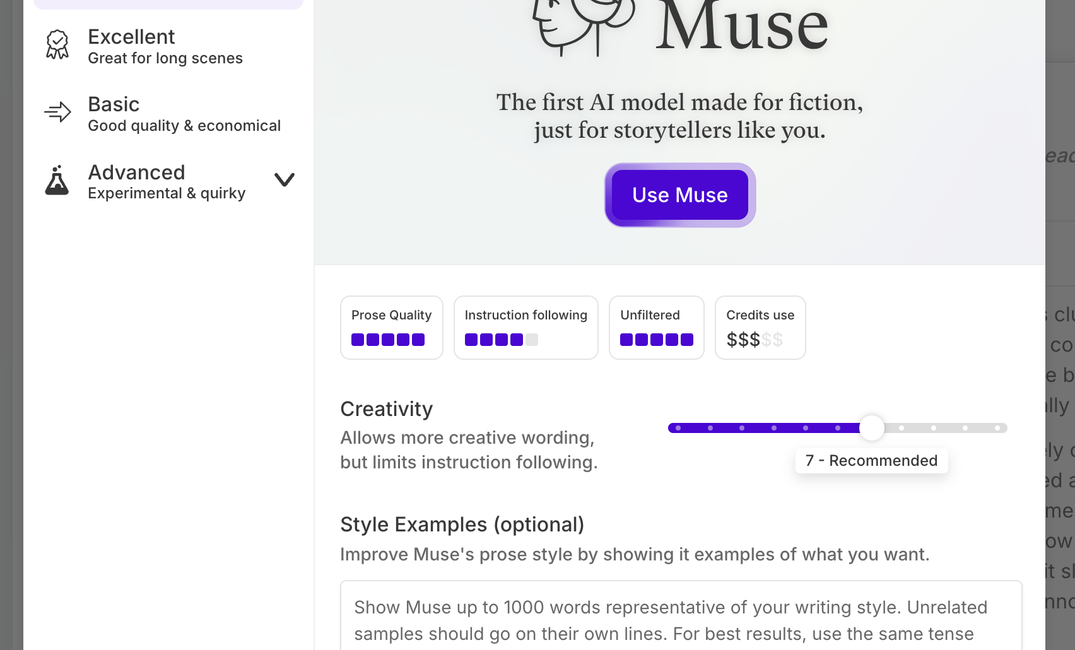
Subject-verb-object. Subject-verb-object. That metronomic cadence is generic AI's biggest fingerprint. Muse was trained on published fiction, so it varies sentence length the way real novelists do: short fragments after long setups, interruptions, clauses that tumble forward. The Creativity Slider pushed above the midpoint introduces more rhythmic variation without losing coherence.
Tell #5: Character Drift
Your confident CEO who seduced three people in chapter two shouldn't be whispering "I've never done this before" in chapter eight. Unless you've earned that shift.
Before: "'I've never done this before,' whispered the confident CEO who had seduced three people in chapter two."
After: "'I've never wanted it to matter before,' she said, and the admission cost her something the boardroom never had."
Generic AI forgets who your characters are mid-scene. The shy librarian starts talking like a pirate captain. Sudowrite's Story Bible stores character cards with personality, dialogue style, and backstory, and the Write feature reads that data alongside up to 20,000 words of prior context. Your characters stay themselves, even when they're falling apart.
Tell #6: Climax-Skipping
Before: "They made love passionately. Afterward, they lay together feeling satisfied and happy."
After: "The world narrowed to breathing and the way her fingers tightened in the sheets, then loosened, slowly, like releasing something she hadn't known she was holding."
AI rushes through the moments that matter most. Trained. Trained to move on. Sudowrite's Expand takes a compressed beat and opens it up with texture and breath, no padding, just presence. Write Guided lets you steer exactly where the scene lingers and how it unfolds, so the emotional peak gets the page time it deserves.
Getting Started with Sudowrite
Step 1: Build Your Character Cards First
Open your Story Bible and create cards for every character in the scene. Include personality, dialogue style, and relationship dynamics. Muse reads this data during generation, which is how you prevent character drift before it starts.
Step 2: Draft with Muse in Guided Mode
Set the Creativity Slider to 60-70% and use Write Guided. Type a brief direction ("the tension breaks" or "she decides to stay") and Muse generates options that match your characters and tone. Pick one, then edit it into your voice.
Step 3: Run the Diagnostic Pass
Go through your draft hunting each tell. Highlight flat passages and use Describe (touch, taste, sound) to break sensory monoculture. Use Rewrite >. Show Not Tell for emotional flatness. Use Rewrite >. Rephrase for rhythmic monotony. One pass per problem.
Pro tip: Tone Shift set to "Sensual" works for initial drafts. Switch to "Conflicted" or "Romantic" during revision to layer emotional complexity.
Common Mistakes Writers Make
Cranking Creativity to Maximum
More doesn't mean better. At max settings, Muse gets unpredictable in ways that derail scenes rather than enrich them. Start at 60-70% and nudge upward. You want surprise, not chaos.
Skipping the Story Bible
Writing intimate scenes without character cards is the number one cause of character drift. According to Sudowrite user data, 86% of writers say the Story Bible system helped them overcome consistency problems. Two minutes of setup saves an hour of revision.
Applying One Fix to Every Problem
Describe won't fix emotional flatness. Rewrite won't fix sensory monoculture. Match the tool to the specific tell you've diagnosed. That's the whole point of thinking diagnostically.
FAQ
Why does AI erotica always sound the same?
Generic AI models aren't trained on fiction craft. They default to euphemism clusters, labeled emotions, and visual-only description because their training skews toward internet text, not published novels. Sudowrite's Muse is trained specifically on fiction storytelling.
Can Sudowrite actually write explicit content?
Muse won't refuse you mid-scene or fade to black unexpectedly. Unlike models that block adult scenes entirely or bail on you at the worst possible moment, Sudowrite treats romance and erotica as the legitimate fiction genres they are.
What's the difference between Describe and Rewrite?
Describe generates new sensory details from scratch. Rewrite transforms existing text. Use Describe to add a missing sense. Use Rewrite to fix flatness or rhythm in passages you've already drafted.
How does the Creativity Slider change intimate scenes?
Higher settings produce more unexpected language choices and rhythmic variation. Lower settings stay safe and predictable. For erotica, 60-80% typically hits the sweet spot between surprise and coherence.
Does the Story Bible actually prevent character drift during scenes?
Sudowrite reads your character cards during every generation. Personality traits, dialogue style, and backstory stay active in context, so your characters don't suddenly become someone else at the worst possible moment.
How is this different from just prompting ChatGPT better?
Prompt engineering can't replicate fiction-specific training. Sudowrite's Muse, Describe (five senses), Rewrite (Show Not Tell), and Write Guided are purpose-built tools that don't exist in chat interfaces. According to Circana BookScan 2025 via Publishing Perspectives, romance remains one of the top-performing fiction categories, and writers using AI report a 57% average productivity boost (Gotham Ghostwriters 2025) when they're using tools built for fiction.
Key Takeaways
Robot prose isn't a mystery. Six identifiable patterns cause it, and each one has a specific fix.
- Euphemism spam and sensory monoculture break when you use Describe across all five senses
- Emotional flatness transforms under Rewrite's Show Not Tell mode
- Character drift stops when your Story Bible cards are doing their job
- Muse's fiction training produces natural rhythm that general-purpose AI can't match
Your readers can feel the difference between a scene written with emotional intelligence and one generated by a model predicting the next token. Give them the real thing.
Related Reading
More from the Sudowrite adult fiction library:
- AI Sex Story Generator: Honest Reviews and Alternatives, our complete guide to writing intimate scenes with AI
- Writing Erotica with AI: How to Get Actually Good Output
- The 'AI Wrote This' Tell: How to Write Smut That Doesn't Sound Like a Bot