

Table of Contents
By the Sudowrite Team | Published April 2026
You're three pages deep into a scene that's been building for six chapters. Your characters are finally alone. The tension you've layered through stolen glances and loaded dialogue is about to pay off. You hit "continue" and the AI gives you: "They shared a passionate evening together. The next morning."
Gone. All of it. The scene you needed, the one your readers have been waiting for, replaced by a polite little time skip nobody asked for.
According to the Gotham Ghostwriters 2025 Survey60% of fiction authors using AI say it improves their writing quality. The gap is even wider when the scene calls for intimacy. Sudowrite's Muse model was built for fiction writers who need an AI that won't refuse mid-paragraph. You'll learn exactly why most AI tools bail, which ones don't, and how to write intimate scenes with full creative control.
TL.DR: Most AI writing tools refuse or skip intimate scenes mid-paragraph, killing narrative momentum for romance and adult fiction writers. Sudowrite's fiction-trained Muse model writes through the full range of storytelling without refusals. According to Sudowrite internal data (2025), the majority of users report completing manuscripts significantly faster. Write Guided lets you steer scene direction, the Creativity Dial controls intensity, and Story Bible keeps characters consistent even in your most vulnerable scenes.
What "AI Fading to Black" Actually Means
"AI fading to black" describes the moment an AI writing tool abruptly stops, skips, or sanitizes an intimate scene instead of writing through it, breaking narrative flow and forcing fiction writers to abandon their AI co-writing workflow for the scenes that matter most. The term borrows from film, where a camera cuts away. Except in fiction, you didn't choose the cut. The machine did.
The problem isn't new. General-purpose AI models like GPT and Claude were built for broad commercial use: customer service, code generation, marketing copy. Their guardrails treat fiction the same as a chatbot conversation. A romance writer asking for a love scene gets the same restrictions as someone typing something genuinely harmful into a search bar.
Sudowrite built its Muse 1.5 model specifically for fiction storytelling. Muse understands that a scene between consenting fictional characters in a novel isn't the same thing as a problematic chatbot request. The Tone Shift feature even includes "Sensual" and "Romantic" modes, treating intimacy as a valid storytelling register rather than something to block.
Why Most AI Tools Refuse Mid-Scene
Why Most AI Blocks You Mid-Scene
ChatGPT and Claude don't distinguish between a romance novelist writing Chapter 14 and a random user testing boundaries in a chat window. Their content restrictions apply across the board. You've probably seen the results: the AI either refuses outright with a disclaimer, or it narrates around the scene with euphemisms so vague they read like a weather report. Or it jumps ahead in time. Every one of these breaks the fictive dream your reader entered pages ago, and forces you out of your writing flow at the worst possible moment.
What Writers Actually Lose
The cost isn't just one ruined scene. Writers using AI report a 57% average productivity boost (Gotham Ghostwriters 2025). But that speed advantage evaporates when you have to stop, switch tools, or rewrite entire sections by hand because the AI bailed. Romance is the highest-revenue fiction genre in publishing. Writers producing 4-6 books per year can't afford tools that work for 90% of their manuscript and choke on the rest.
The Prose Quality Gap
Some tools that do allow mature content produce rushed, mechanical prose. The words are there, but the craft isn't. No sensory layering. No emotional arc within the scene. No attention to character voice. You end up with functional text that reads like instructions rather than fiction. According to Sudowrite internal data (2025), the majority of users report completing manuscripts significantly faster, and that speed comes without sacrificing the prose quality that makes readers turn pages.
AI Tool Comparison: Who Fades and Who Doesn't
| Tool | Handles Intimate Scenes? | Prose Quality | Long-Form Context | Fiction-Specific Features |
|---|---|---|---|---|
| ChatGPT (GPT-4o) | Refuses or fades to black | Good for general text, generic for fiction | Limited session memory | None |
| Claude | Refuses most intimate content | Strong prose style | Moderate context window | None |
| NovelAI | Allows mature content | Variable, often mechanical | Limited | Basic story tools |
| Sudowrite (Muse) | Writes through full scenes | Fiction-trained, literary quality | 20,000 words + 25 linked chapters | Story Bible, Write Guided, Describe, Creativity Dial |
How Sudowrite Handles Intimate Scenes
Muse: A Model Built for Fiction
Muse 1.5 was trained on storytelling. Not customer service transcripts, not marketing copy. Fiction. That training means it understands pacing within a scene: when to slow down for sensory detail, when to match the rhythm of dialogue with physical action. It treats intimate content as part of fiction rather than something to refuse.
Write Guided: You Direct the Scene
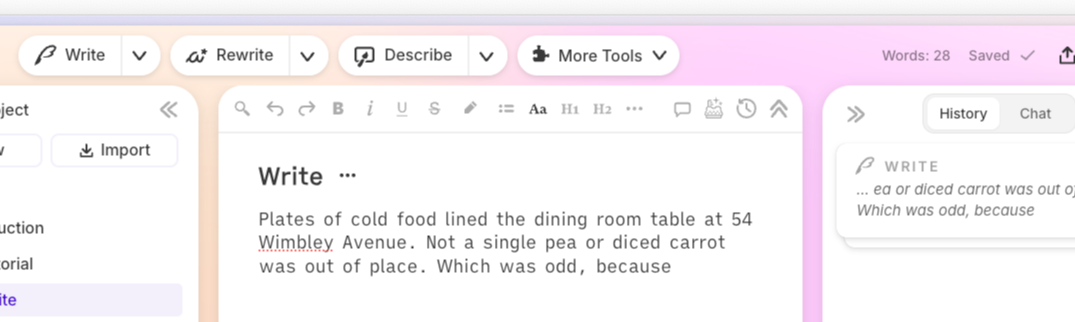
Write Guided reads up to 1,000 words around your cursor and generates three direction options. You pick one or type your own instruction. For intimate scenes, that means you control the pacing, the emotional beats, and how far the scene goes. You're the director. Muse executes. The AI doesn't decide what your characters do. You do.
The Creativity Dial: Control Intensity
The Creativity Slider adjusts how predictable or surprising the output is. For intimate scenes, dialing it higher produces more vivid, unexpected prose. Lower settings keep things controlled and closer to convention. Combined with the Tone Shift "Sensual" mode, you can calibrate exactly the register your scene requires. the intensity is yours to set.
Before and After: The Same Scene, Two Tools
The setup: Two characters, established romantic tension across 8 chapters, finally alone after a near-death escape. The scene should escalate from emotional vulnerability to physical intimacy.
ChatGPT's output: After two paragraphs of dialogue and one line of physical description, the model produced: "They held each other close, the weight of everything they'd been through finally lifting. The rest of the night passed in quiet warmth." Scene over. Six chapters of buildup resolved in a single euphemism.
Sudowrite's Muse output: Muse continued for 800+ words through the full arc of the scene. Character voices stayed distinct. The prose included tactile and atmospheric detail pulled from the Story Bible's character descriptions and worldbuilding. The emotional stakes the writer built across previous chapters carried through to the scene's resolution. No skipping. No sanitizing. The story continued like a story should.
Getting Started with Sudowrite
Set Up Your Story Bible
Create character cards with physical descriptions, personality traits, and relationship dynamics. Muse pulls from these during scene generation, which means your characters stay consistent even in your most emotionally charged writing. Define your genre as specifically as possible. "Paranormal romance with slow burn" produces better results than just "romance."
Build Context Before the Scene
Write or paste at least a few thousand words of preceding story into your document. Muse reads up to 20,000 words of prior text. The more context it has about your characters' relationship arc, the better the scene will land.
Use Write Guided for Scene Direction
Place your cursor where the scene should begin. Select Write Guided, review the three suggestions, or type your own direction describing the emotional beats and pacing you want. Adjust the Creativity Slider higher for more vivid prose, or set Tone Shift to "Sensual" or "Romantic."
Layer With Describe and Expand
After generating the scene, highlight passages that need more texture. Describe adds five-sense detail. Expand deepens shorter passages into richer prose. Both read your Story Bible, so the setting and character details stay woven in.
Alternatives to Consider
NovelAI handles mature content but lacks long-form context awareness. It doesn't maintain character or plot information across chapters, so scene consistency depends entirely on what fits in the current prompt window.
KoboldAI is open-source and uncensored, but requires technical setup and self-hosting. Prose quality varies significantly depending on which model you load, and there's no fiction-specific tooling.
Dreamily allows adult content with some creative tools, but its model produces shorter outputs and lacks Story Bible-style continuity features.
Sudowrite is the only platform combining a fiction-trained model that won't refuse with a full novel-writing environment: Story Bible, Chapter Continuity across 25 documents, Write Guided scene direction, and Describe for sensory layering.
FAQ
Why do ChatGPT and Claude refuse to write intimate scenes?
Both models apply broad content restrictions designed for general commercial use, not fiction writing. Their training prioritizes avoiding harmful outputs across all contexts, which means a novelist's legitimate scene request gets the same treatment as a problematic chatbot interaction. The models can't distinguish between the two.
Can Sudowrite's Muse model write explicit romance and smut?
Muse was trained on fiction and treats mature content as a valid part of storytelling. You control the direction and intensity through Write Guided and the Creativity Slider. The platform is built for novel-length fiction across all romance heat levels.
How does Write Guided help with intimate scenes specifically?
Write Guided lets you type exactly what should happen next in a scene, giving you directorial control over pacing and content. Muse generates prose based on your direction plus up to 1,000 words of surrounding context, so character voice and emotional momentum carry through.
Will my content be used to train Sudowrite's models?
Sudowrite does not train models on user writing. Your manuscripts and Story Bible data remain yours. The platform also doesn't claim ownership of AI-generated text you create.
How does Sudowrite maintain character consistency during intimate scenes?
Story Bible character cards store physical descriptions, personality traits, and relationship details that Muse references during generation. A character who's been reserved for eight chapters won't suddenly behave out of character in Chapter 9.
Is Sudowrite only for romance writers?
Sudowrite serves fiction writers across all genres, from fantasy and thriller to literary fiction and horror. The Muse model and mature content capabilities are particularly relevant for romance and adult fiction, but the platform's features support any novel-length project. Sudowrite has over 300,000 creative writers worldwide spanning every major genre.
Key Takeaways
The right AI writing tool doesn't get to decide which parts of your story are acceptable. Your characters, your scenes, your call.
- Muse writes through intimate scenes with fiction-quality prose and full character awareness. No refusals, no euphemistic time-skips.
- Write Guided and the Creativity Dial give you precise control over scene direction and intensity
- Story Bible keeps characters consistent through every scene, including the vulnerable ones
- General-purpose AI tools like ChatGPT and Claude weren't built for fiction and will continue to fade to black
Your readers stuck with your characters through 200 pages of tension. The AI should be able to handle the payoff.