

Table of Contents
There's a specific kind of stuck that only happens in the middle of a book. You have 40,000 words. You know roughly how it ends. And you haven't opened the file in eleven days. The questions below are the ones writers ask each other about that stall.
TL;DR: Mid-draft stalls are almost always a story problem wearing a discipline costume: something upstream is unresolved, so the next scene won't come. The fix is to find the unresolved thing (usually a character who wants nothing, or a middle with no turn), decide it, and then lower the cost of the next 500 words. Sudowrite is built for that last part: Write reads back up to 20,000 words of your draft and picks up where you left off, and Chat can read the chapter you have open and tell you where it went slack.
I'm about 40,000 words into my novel and I'm completely stuck. How do I get moving again?
Getting unstuck starts with finding the problem, not pushing harder at the next scene. Forty thousand words in, the stall is rarely about willpower. Something in the story has gone unresolved, and your instinct is refusing to build on it.
Writers who get past it tend to work through the same five steps, in order.
- Reread the last three chapters as a reader, not an editor. Don't fix anything. Note where you got bored. That's usually within a chapter of where the stall started.
- Check what your protagonist wants right now, on this page, rather than in the book overall. If the answer is "to get to the next plot point," they've stopped driving and you're pushing. Give them a want that's specific and slightly wrong.
- Ask whether the ending you planned still fits the character you've written. Forty thousand words changes people. If the planned ending no longer fits, your subconscious knows, and it's on strike.
- Write the scene you're avoiding. There's almost always one. It's usually the confrontation you keep delaying. Write it badly, today.
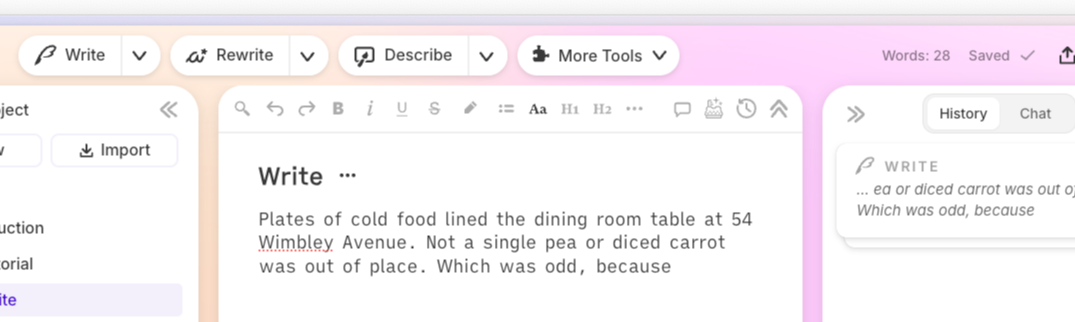
- Lower the cost of the next 500 words. Once you know where you're going, the barrier is the blank space after your last sentence. In Sudowrite, Write reads back over what came before, plus your Story Bible, and continues from your cursor in your voice. You'll cut half of it. That's fine. The point is that you're moving again, and cutting is easier than starting.
If you want a second opinion on steps one through three, Chat can see your Story Bible and the full document you have open. Ask it "where does the tension drop in the last three chapters" and argue with the answer.
I started a draft of my book and it sucks. What do I do?
Keep going, because you can't fix a draft that doesn't exist yet, and because "sucks" at the first-draft stage is normal to the point of being the rule.
Two things are worth separating. A draft can be bad in the prose (flat sentences, clumsy dialogue) or bad in the story (nothing happens, no one wants anything). Prose problems are a revision job and should be ignored until you type "the end." Story problems are worth stopping for, briefly.
A quick diagnostic: summarize each chapter you have in one sentence. If several of those sentences are "they talk about what happened" or "she travels to the next place," you have a story problem, and the fix is to give each of those chapters a decision that can't be taken back. If every sentence has a decision in it and the draft still feels bad, that's prose, and it can wait.
Sudowrite helps with both, in different tools. For story, the Story Bible's Outline lets you see the chapter-by-chapter shape and rewrite a chapter summary before you rewrite the chapter. For prose, Rewrite works on up to 6,000 selected words at a time, with modes for Show Not Tell, More Inner Conflict, More Intense, and a Customize box for anything else. Leave it until the draft exists, because right now the job is getting more words down.
Why can't I ever finish a first draft? I keep starting novels and abandoning them.
Because starting is more fun than continuing, and because the point at which you abandon a draft is probably the same point every time. Find that point and you've found the problem.
Writers who keep abandoning drafts tend to fall into one of three patterns:
- The 15,000-word wall. The premise runs out. You had an opening and a world but no engine. Fix: before you start the next one, write down what the protagonist wants, what stands in the way, and what it costs them to fail. If you can't, you have a setting, not a story yet.
- The shiny new idea. A better book shows up around chapter eight of every draft. Fix: write the new idea down in one page and put it in a folder. It'll still be there. Most of them are less good a month later.
- The perfectionist loop. You keep going back to fix chapter one. Fix: don't allow yourself to reread before the draft is done. If you need to remember what you established, that's what a story bible is for. Sudowrite's Story Bible holds your characters, world, and outline, and Chat can answer "what did I say about Mara's sister" without you opening chapter two.
Whichever pattern is yours, the practical rule is the same: the draft you finish will be worse than the one you imagined. Finish it anyway and fix it in revision.
How do you push through the boring middle part of a book without giving up?
Make the middle less boring. A middle that bores you to write will bore people to read, so pushing through is the wrong instinct. Put a turn in it instead.
The middle of a novel needs at least one event that changes what the story is about. That can be a reveal that reframes the goal, a choice that can't be undone, or a loss that raises the price. If your outline says "chapters 12 through 20: they journey toward the citadel," there's no turn, and the boredom you feel is accurate.
Practical moves:
- Find the exact midpoint of your planned word count and put something irreversible there.
- Take the thing the protagonist is most afraid of and make it happen earlier than planned.
- Let a secondary character make a decision that wrecks the protagonist's plan.
- If you outline in Sudowrite, use Canvas to lay the chapters out visually and look for the stretch with no turns. It's usually obvious once you can see it. Canvas ships with four outline templates (Hero's Journey, Hollywood Beats, Story Circle, Romance Outline), all of which put a specific demand on the midpoint.
Then draft the turn first, out of order, before the connecting chapters. Once the turn exists, the chapters leading to it have somewhere to go.
What do people actually use to help them get a novel drafted faster?
Most writers who draft fast use some combination of the following. None of them is magic and most of them are cheap.
- Timed sprints. Twenty or twenty-five minutes with the internet off. The oldest trick and still the best one for volume.
- An outline you actually follow. Even pantsers benefit from knowing the next three scenes. The outline can be a sentence per chapter.
- Dictation. Speaking is faster than typing for most people, and it bypasses the inner editor. Sudowrite's mobile app includes Smart Dictation, which turns what you say into formatted prose with punctuation and dialogue formatting, and recognizes your characters' names.
- A story bible so you never stop to look things up. Stopping to check an eye color costs more time than the check itself, because it breaks the flow. Sudowrite's Story Bible keeps characters, worldbuilding, and outline in one place the AI can also see.
- An AI co-writer for the blank space after your last sentence. Sudowrite's Write reads up to 20,000 words of your preceding draft and continues in your voice, and Draft turns a chapter's Scenes into a full first-pass chapter using Muse, the model Sudowrite built for fiction. Writers use this to get a rough version down that they then revise, which is a very different thing from having a machine write the book.
- Scrivener or a similar organizer, if you like to see the whole manuscript as movable pieces. Sudowrite can import a Scrivener backup if you decide to move a project over.
The common thread is that fast drafters remove reasons to stop.
FAQ
Is being stuck at 40,000 words normal?
Yes. The 35,000 to 50,000 word range is where the opening's energy runs out and the ending is still too far away to pull you forward. Almost every novelist hits it. The ones who finish are the ones who diagnose it as a story problem rather than a character flaw.
Should I skip ahead and write the ending?
If you know it, yes. Writing the ending gives the middle a target. You can write the connecting chapters afterward, and they'll be easier because you know exactly what they need to set up.
Can Sudowrite write the middle of my book for me?
It can draft chapters from your Scenes, but the middle problem is a decision problem, and the decisions are yours. Sudowrite is most useful once you've decided what the turn is and need to get it onto the page. Chat can help you find the decision. Write and Draft help you execute it.
How long should I stay stuck before I change the plan?
If you haven't written a scene in two weeks, look at the plan before you look at your discipline. Change something upstream.