

Table of Contents
Every AI-assisted draft seems to arrive with the same accent, and writers are asking the same two questions: why, and how do I stop it happening to my book.
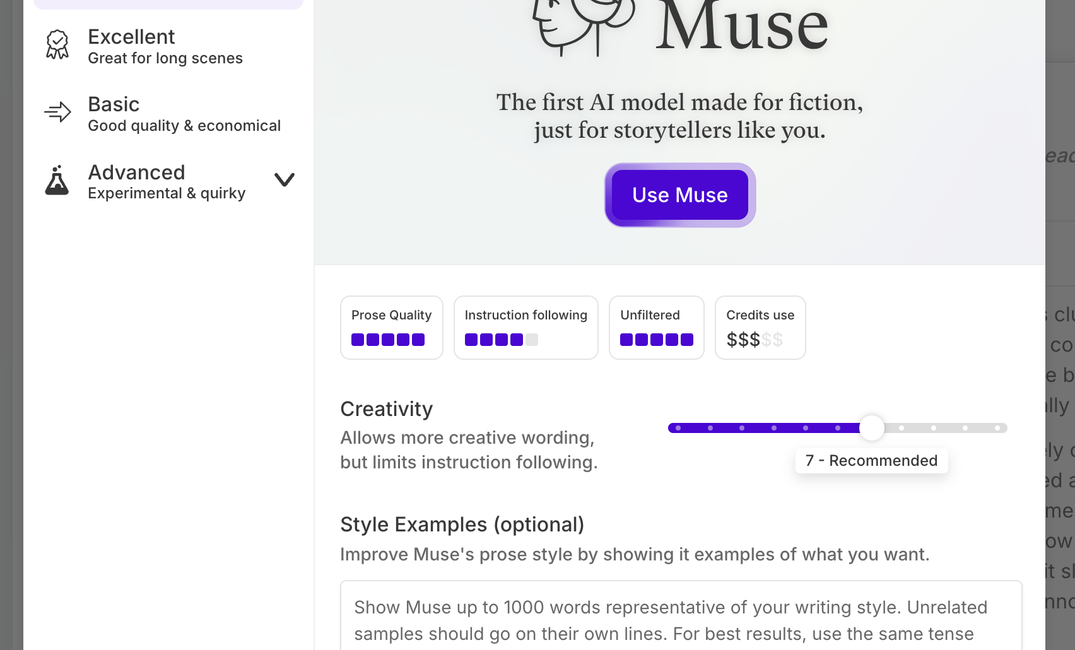
TL;DR: AI writing sounds the same because general-purpose models are trained to produce the most statistically likely next word across every kind of text, which pulls every sentence toward the average. You fix it in two places: in the tool, by using a model trained only on fiction and giving it your own prose as the reference, and in the edit, by learning the dozen tells and cutting them. Sudowrite's Muse is trained only for fiction and has AI clichés measured and removed during training, and Style Examples let you hand it up to 1,000 words of your own writing to match.
Why does AI writing all sound the same?
Because a general model is optimized to be right about everything, and the safest way to be right about everything is to be average. When a model predicts the next word, it leans toward the choice that fits the widest range of contexts. Across a paragraph, that produces prose that's grammatical, smooth, and interchangeable with every other paragraph produced the same way.
Three things make it worse for fiction specifically:
- The training mix. A general model has read far more marketing copy, forum posts, and explainer articles than novels. Its default register is explanation, so it tends to tell you what a scene means rather than let you feel it.
- The safety of the middle. Extreme choices, the odd word, the sentence that runs on for a reason, the paragraph with no resolution, are exactly what a model trained to minimize error avoids. Voice lives in those choices.
- Reinforcement toward pleasing. Models are tuned to produce responses people rate highly in the moment. That rewards tidy endings, balanced sentences, and a reassuring tone, none of which is what a thriller needs at the end of chapter nine.
None of this means AI can't write in a voice. It means the default is no voice, and you have to change the default.
The tells: how AI prose gives itself away
Once you can name them, you'll see them everywhere, including in your own drafts. The most common in fiction:
- The punchline paragraph. Every paragraph lands on a short, dramatic sentence. And then silence.
- Held breath. Characters let out breaths they didn't know they were holding, feel a chill run down their spine, and have hearts that hammer or pound at least once a chapter.
- Stacked adjectives. "The ancient, weathered, moss-covered door." Pick one.
- The rule of three, always. Three nouns, three clauses, three examples, in every list, forever.
- Not X, but Y. "It wasn't fear she felt, but something colder." Once is a device. Twenty times is a tic.
- Explaining the emotion. "She felt a surge of anger at his betrayal." The prose tells you the feeling and its cause in one line, so there's nothing left to notice.
- Meaning-announcers. "A testament to." "A reminder that." "Underscoring." These are essay words, and they sound like a narrator standing outside the story.
- Em dashes everywhere. Used as a universal joint between clauses that should have been two sentences.
- Somehow, and other hedges. "Somehow, she knew." "Almost as if." The model isn't sure, so it hedges, and it sounds like it.
- Symmetry. Sentences of the same length, one after another, with the same rhythm, where human prose would be lumpier.
How do I tell if my own writing sounds like AI?
Read a page aloud and listen for the rhythm. AI prose has an even, mid-length cadence, one sentence after another of roughly the same weight. If your page sounds like a metronome, that's the first sign. Then run the checklist:
- Count the paragraphs that end on a short dramatic line. More than one in five is a pattern.
- Search the document for "breath," "spine," "hammered," "testament," "somehow," and "not just." Note how many are yours by choice.
- Highlight every list of three. Ask whether the third item is earning its place or filling a slot.
- Look for emotions named outright: felt, realized, knew. Each one is a place where the reader was told rather than shown.
- Check whether any paragraph is allowed to end unresolved, or whether every one ties a bow.
This works whether or not you used AI. Plenty of human writers have absorbed the cadence from reading too much of it. The fix is the same either way: put the odd choices back in. In Sudowrite, generated text stays purple until you edit it, so you can see at a glance how much of a page is still untouched suggestion, which is where these tells accumulate.
Everything I write with ChatGPT comes out sounding generic. How do I get AI to write more like me?
Change three things: the model, the reference, and the unit of work.
The model
ChatGPT is a general assistant, and generic is its default for the reasons above. A model trained only on fiction starts from a different place. Sudowrite's Muse is the first AI made for fiction, and during training AI clichés are specifically measured and systematically removed from its output. It's also the most unfiltered model on Sudowrite, so it will follow a dark or intense scene where a general model would soften it into something safer. Muse isn't the only model Sudowrite trains in house. Ballad is the second. If you prefer a particular lab's model for a particular pass, Sudowrite also gives you Claude and others, but Muse is the default for a reason.
The reference
A model can only sound like you if it has seen you. In Sudowrite, Style Examples take up to 1,000 words of your own prose and use them as the voice reference for Muse. Match My Style does the same job from a sample in the Style field of your Story Bible. This is the single biggest lever. A chatbot with no sample of your writing is guessing at a voice. A tool with a thousand words of it is matching one.
The unit of work
Asking a chatbot for "the next chapter" produces a chapter in its voice. Asking a tool to continue from your cursor, after it has read back over your manuscript, produces a continuation shaped by everything you already wrote. Sudowrite's Write does the second thing. Guided mode lets you say what should happen next in a sentence and keeps the voice yours. If you want to steer tone deliberately, Tone Shift offers eight registers, from Ominous to Sensual.
Then edit, cutting the tells and putting the odd word back. The point of the tool is a faster path to a page that sounds like you, and the last ten percent of that is always your hand.
A worked example
Generic version, the kind a general model produces on request:
The rain hammered against the window as Elena stared into the darkness, her heart pounding. Somehow, she knew he wasn't coming back. It wasn't sadness she felt, but something deeper, a hollow ache that seemed to echo the storm outside. She let out a breath she didn't know she'd been holding.
Every tell in one paragraph. Now the same beat, written from a voice reference and then edited:
Rain on the glass. Elena counted the cars that slowed at the corner and didn't turn in. At nine she stopped counting and put his plate in the fridge, still covered, in case.
Nobody's heart pounds and nobody explains what Elena feels. The reader works it out from the covered plate, and working it out is what makes the reader feel it.
FAQ
Will an AI ever be able to write in my voice without a sample?
No, and you should be suspicious of any tool that claims otherwise. Voice is a set of specific choices, and a model has to see them before it can make them, which is why you give it your own prose to work from.
Does using AI make my writing sound generic no matter what?
Not if you change the model, give it your writing as a reference, and edit the output. It does if you use a general chatbot with no sample and accept the first draft.
What's the fastest way to de-AI a draft I already have?
Search for the tell words listed above, cut every held breath and testament, split the em-dashed sentences, and make every third paragraph end without a punchline. In Sudowrite, Rewrite's Customize box takes an instruction like "shorter sentences, no metaphors, don't explain the emotion" on up to 6,000 selected words.
Is Muse really different from ChatGPT for fiction?
It's trained only for fiction, with AI clichés measured and removed during training, and it doesn't filter or soften scenes. That's a different starting point from a general assistant. Whether the result sounds like you still depends on giving it your own writing as a reference.