

Table of Contents
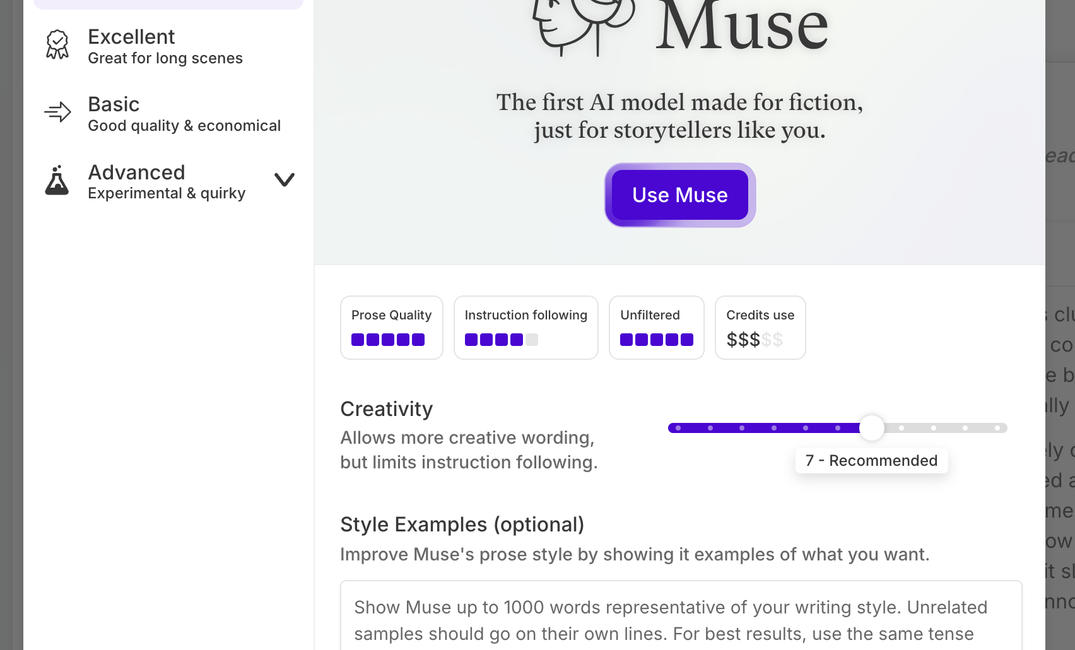
The best AI for novel writing in 2026 is Sudowrite for most novelists: it's the only tool with its own fiction-trained model, Muse, and a Story Bible the model reads while it drafts, from $10 a month billed annually. NovelAI is the flat-fee alternative, Novelcrafter the bring-your-own-key one, and general assistants like ChatGPT and Claude handle pieces of the job and refuse adult scenes. This guide compares seven tools on the five things a novel needs. We make Sudowrite, so we've named the places where another tool is the better pick. Prices are as of October 2026 and link to each company's own page.
TL;DR: Sudowrite wins on memory, prose in your voice, structure help and no refusals, and runs on monthly credits. NovelAI wins on unlimited generation for $10 to $25 a month and has no planning tools. Novelcrafter wins on control if you already pay for an API. Squibler drafts a whole manuscript fast. ChatGPT and Claude are for occasional help, and ProWritingAid is the editor at the end.
What a Novel Needs From an AI
Five things, in the order they bite.
- Memory across 80,000 words. A chatbot forgets your protagonist's eye colour by chapter three. A novel tool has to hold characters, world and plot and use them on every generation.
- Prose in your voice. General models write competent, forgettable sentences. You need a model that was trained on fiction and can be shown your style.
- Help with structure, because the middle of a book is where most drafts die.
- No refusals. Romance, horror and thrillers contain sex and violence. A tool that stops mid-scene is a tool you'll stop using.
- A price you can keep paying for the year a book takes.
Every tool below is judged on those five.
The Seven Tools Compared
| Tool | Price | Memory of your book | Fiction-trained model | Structure tools | Refuses adult scenes? |
|---|---|---|---|---|---|
| Sudowrite | $10, $22 or $44 a month billed annually | Story Bible, read on every generation. Series Folder. 25 linked chapters | Yes, Muse | Canvas, Outline, Scenes, First Draft | No |
| Novelcrafter | $4 to $20 a month, plus your own API costs | Codex | No, you connect a model | Strong | Depends on the model |
| NovelAI | $10, $15 or $25 a month, unlimited text | Lorebook | Yes, its own models | None | No |
| Squibler | Free tier, then $15.83 a month billed annually | Partial | No | Book and screenplay templates | Limited |
| ChatGPT | Plus $20 a month | Only the current conversation | No | None for fiction | Yes |
| Claude | Pro $20 a month, $17 annually | Only the current conversation | No | None for fiction | Yes |
| ProWritingAid | Editing subscription | Not a drafting tool | No | None | Not applicable |
1. Sudowrite
Sudowrite is a fiction writing workspace with its own fiction-trained model, Muse, and a Story Bible the model reads while it drafts. You build the Story Bible from a braindump: Synopsis, Genre, Style, Characters, Worldbuilding, Outline. Then Write continues from your cursor and keeps the whole story in mind, Describe and Expand add texture, Rewrite revises with preset modes, and Feedback returns five things to improve. Canvas gives you a whiteboard with Hero's Journey, Hollywood Beats, Story Circle and Romance Outline templates. The Series Folder carries one Story Bible across every book in a series.
Where it falls short: it runs on monthly credits, and new users spend them faster than they expect. Max rolls unused credits over for 12 months. The other plans don't. If you want no meter at all, read the NovelAI entry.
Price: Hobby & Student $10, Professional $22, Max $44 a month billed annually. Monthly billing costs more. Every plan includes every feature. Free trial, no credit card.
Who it's for: novelists who want the model to know the book, and anyone who'd rather press Describe than write a prompt. Hugh Howey's line on it is "It's scary good."
2. Novelcrafter
Novelcrafter is a planning-first workspace that connects to a model you pay for separately. Scribe at $4 a month has no AI. Hobbyist ($8), Artisan ($14) and Specialist ($20) add AI through your own API key, so your OpenAI or Anthropic bill is on top. The Codex stores characters and lore, scene beats and series tools are built in, and the 21-day trial needs no card.
Where it falls short: no model of its own, so the prose is whatever your key buys, and the setup is an afternoon of configuration. Where it wins: control over everything, and a low fixed cost if you already pay for an API.
Who it's for: plotters, series writers who think in spreadsheets, and anyone who wants to pick the model per task. Full comparison: Sudowrite vs Novelcrafter.
3. NovelAI
NovelAI is an unlimited text engine with its own models, for a flat fee. Tablet $10, Scroll $15, Opus $25 a month, no annual discount. The Lorebook holds a world of any size through keyword-triggered entries. There are no outlining or revision tools.
Where it falls short: it plans nothing and the settings panel takes real study. Where it wins: no refusals, no meter, and distinctive prose once tuned.
Who it's for: pantsers, worldbuilders, and heavy generators who want one price. Full comparison: Sudowrite vs NovelAI.
4. Squibler
Squibler drafts a whole book or screenplay from a premise. Free tier with 1,000 credits a month, Plus at $15.83 a month billed annually with 10,000 credits, Pro at $49.17 billed annually with unlimited credits.
Where it falls short: the draft is Squibler's voice until you rewrite it, and the model underneath is general. Where it wins: fastest route from idea to a complete manuscript, and screenplay formatting included. Full comparison: Sudowrite vs Squibler.
5. ChatGPT
ChatGPT is a general assistant that writes fiction on request, for $20 a month on Plus. Good for research, for arguing with about a plot hole, and for a paragraph when you're stuck.
Where it falls short for a novel: it remembers only the current conversation, so continuity is your job. It refuses explicit scenes. There's no manuscript, no outline, no series. We've written up writing a book with ChatGPT and exactly where it breaks.
6. Claude
Claude is the general assistant novelists tend to prefer for feedback, at $20 a month on Pro or $17 billed annually. It reads long documents well and gives line-level notes that are worth having.
Where it falls short: the same two things as ChatGPT. It refuses adult scenes and it forgets your book between sessions. Many writers pair it with a drafting tool, which is why Claude models are also available inside Sudowrite's experimental panel. See Sudowrite vs Claude and can Claude write NSFW.
7. ProWritingAid
ProWritingAid is an editing tool, not a drafting one. It checks grammar, style, pacing and repeated words across a manuscript and has added AI rewriting. It won't write your chapter and doesn't hold your story. It belongs at the end of the process, after the draft exists, and it pairs with any of the tools above.
Which One Should You Use?
- You want the AI to know your book and help you finish it: Sudowrite.
- You already pay for an API and want full control: Novelcrafter.
- You want unlimited words for a flat fee and no structure: NovelAI.
- You want a complete draft generated fast: Squibler.
- You need occasional help and no commitment: Claude or ChatGPT.
- You have a draft and need an editor: ProWritingAid.
If you write romance, dark fantasy or anything with a sex scene, cross off the two general assistants first. They'll stop at the door. Our guides to the best spicy AI writers and writing dark romance with AI go further.
Frequently Asked Questions
What is the best AI for writing a novel?
Sudowrite, if you want a fiction-trained model that reads your Story Bible while it drafts and helps you plan and revise. NovelAI, if you want unlimited generation for a flat fee. Novelcrafter, if you'd rather bring your own API key. General assistants like ChatGPT and Claude work for pieces of the job and refuse adult scenes.
Can AI write a whole novel?
Squibler will generate one from a premise, and Sudowrite's First Draft and Draft tools will produce chapters from an outline. In both cases the result reads like a first draft that needs you. The tools that work best treat the AI as a collaborator who drafts and the writer as the one who decides.
Which AI writing tool is best for beginners?
Sudowrite, because the tools are buttons with modes rather than prompts, and the Story Bible walks you through the setup a novel needs. Plans start at $10 a month billed annually and the trial needs no card. Our beginner's tutorial goes from blank page to first chapter.
Which AI is best for fantasy and worldbuilding?
NovelAI's Lorebook for the largest, most configurable worlds. Sudowrite's Story Bible if you want the worldbuilding read by the model automatically and carried across a series. Our worldbuilding comparison covers both.
Do any of these tools train on my writing?
Sudowrite doesn't train on your writing and claims no rights to it. Check each other provider's terms, especially for the general assistants, where the default settings vary by plan.