

Table of Contents
You know the rule, one point of view per scene, and you've known it for years. And your beta readers keep sending back chapters with "whose head are we in?" scribbled in the margin. This post is about why that keeps happening to writers who know better, and how to stop it without switching your whole book to first person.
TL;DR: Head-hopping is switching the viewpoint character mid-scene without a break, so the reader loses track of whose thoughts they're inside. It persists because the rule is easy to state and hard to feel while drafting. The fix is a three-pass revision (find the anchor, hunt the leaks, rebuild the breaks) and a setting that stops it recurring: decide POV per scene or per chapter before you draft. Sudowrite lets you set point of view and tense globally or per chapter in the Story Bible, and Write, Draft, and Expand all follow that setting.
I keep head-hopping between characters and my beta readers keep flagging it.
They're flagging it because it's disorienting in a way that's hard to name from the inside.
Head-hopping is a continuity error in viewpoint, and it isn't the same as writing multiple POV. A book can have six viewpoint characters and never head-hop, as long as each scene (or each clearly marked section) stays inside one of them. Head-hopping is when the camera slides from one character's interior to another's within the same scene, with no break, so the reader is inside Mara's thoughts in one sentence and inside Tom's in the next. The reader doesn't consciously register the switch. They register a faint seasickness and a sense that they aren't sure whom to root for.
The reason it keeps happening to writers who know the rule is that drafting is where you discover what everyone in the room is feeling. Your subconscious wants to tell you what Tom thinks of Mara's lie, so it does, right there in Mara's scene. That's useful information sitting in the wrong scene.
So the fix has two parts: catch the slips in revision, and set things up so fewer of them happen in the first place.
The three-pass fix
Do this scene by scene, not chapter by chapter, because the scene is the unit the rule applies to.
Pass one: name the anchor. At the top of each scene, write the viewpoint character's name in the margin (or in the scene's notes). Ask one question: whose scene is this, meaning who has the most at stake and changes the most by the end? That's your anchor. If two characters have an equal claim, the scene may want to be two scenes with a break between them.
Pass two: hunt the leaks. Read the scene looking only for sentences that report something the anchor couldn't know. The usual leaks:
- Another character's thoughts or feelings stated directly ("Tom wondered if she was lying").
- Sensory detail the anchor couldn't perceive (what's happening behind them, what someone's face looks like when the anchor is looking away).
- Judgments in another character's voice ("It was the stupidest thing she'd ever heard," in a scene anchored on the person who said it).
- Knowledge the anchor doesn't have yet ("She didn't know it, but the letter had already been sent").
Each leak gets one of three treatments. Cut it. Convert it to something the anchor can observe ("Tom's jaw moved like he was chewing on the question"). Or move it to a scene where that character is the anchor.
Pass three: rebuild the breaks. Where you decide a scene needs two viewpoints, put a break in and make it visible: a line space, a section marker, a chapter break. The rule isn't "never switch." It's "never switch without telling the reader."
Stop it coming back: decide POV before you draft
Revision catches slips. A setting prevents them.
If you outline, put the viewpoint character in every scene summary. "Ch 12, scene 2: Mara POV. She finds the letter." When you sit down to draft that scene, the decision is already made and your subconscious has less room to wander.
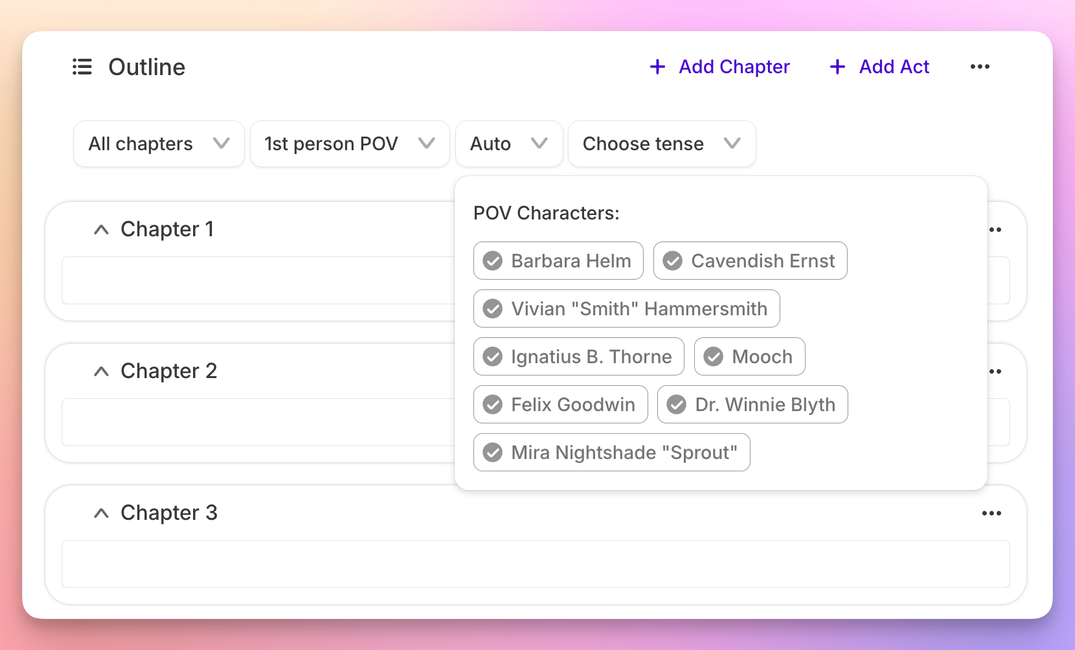
In Sudowrite this is a built-in setting rather than a note to yourself. Point of view and tense live in the Outline section of the Story Bible, and you can set them once for the whole novel or customize them chapter by chapter, which is what you want for an alternating-POV book. Once set, the Draft tool, the Write button in both Auto and Guided mode, and Expand all generate in that POV. New projects default to third person limited, past tense, and if you generate a Synopsis, Sudowrite will pick a POV and tense that fit the genre, which you can override at any time.
Two more things help. If you're assigning specific characters as viewpoint characters, you can name them in the POV setting, and when more than one is assigned, Sudowrite uses the scene's context to decide which one is speaking. And the Scenes tool in Story Bible makes the scene the unit you draft from, so each generated chapter is built scene by scene, with the POV decision attached to each one.
When head-hopping isn't the problem
Two things get flagged as head-hopping that aren't.
The first is omniscient narration. A true omniscient narrator can report anyone's thoughts because the narrator is a distinct voice standing above the story, and the reader is told so from the first page. The trouble is that most modern readers expect close third, so an omniscient book has to establish its narrator early and keep the voice consistent. If your beta readers are flagging POV slips in a book you meant to be omniscient, the narrator isn't established strongly enough, which is a different fix.
The second is a deliberate switch at a break. If you switch viewpoint at a section break, that's a structural choice, not a slip. Readers accept it as long as the break is visible and the new section makes its viewpoint clear in the first sentence or two.
A quick before and after
Before:
Mara set the letter down. She wasn't going to cry in front of him. Tom watched her hands shake and wondered how long she'd known. He felt a stab of guilt. "You should have told me," she said.
Whose scene is that? Both, which means neither.
After, anchored on Mara:
Mara set the letter down. She wasn't going to cry in front of him. Across the table, Tom's eyes went to her hands and stayed there. He didn't say anything for a while. "You should have told me," she said.
Tom's guilt is still in the scene. It's now in his silence and where he looks, which Mara can see, rather than in his head, which she can't.
FAQ
Is head-hopping always wrong?
It's always disorienting when it's unmarked. Some classic novels do it, usually in an omniscient register that the book establishes from the start. In a close third-person book, treat it as a slip.
How many POV characters is too many?
There's no number. The test is whether each viewpoint character carries scenes that only they can carry. If a character's viewpoint exists only to deliver information, cut it and find another way to deliver the information.
Can Sudowrite fix head-hopping in a chapter I already wrote?
It can help. Select the passage (up to 6,000 words) and use Rewrite's Customize box with an instruction like "rewrite this in Mara's point of view only, third person limited." Then do pass two yourself, because the leaks you want to keep as observable behavior are a judgment call.
Should I switch to first person to avoid it?
Only if the book wants first person. First person makes head-hopping structurally harder, but it's a large change to make for a problem that a three-pass revision solves.