
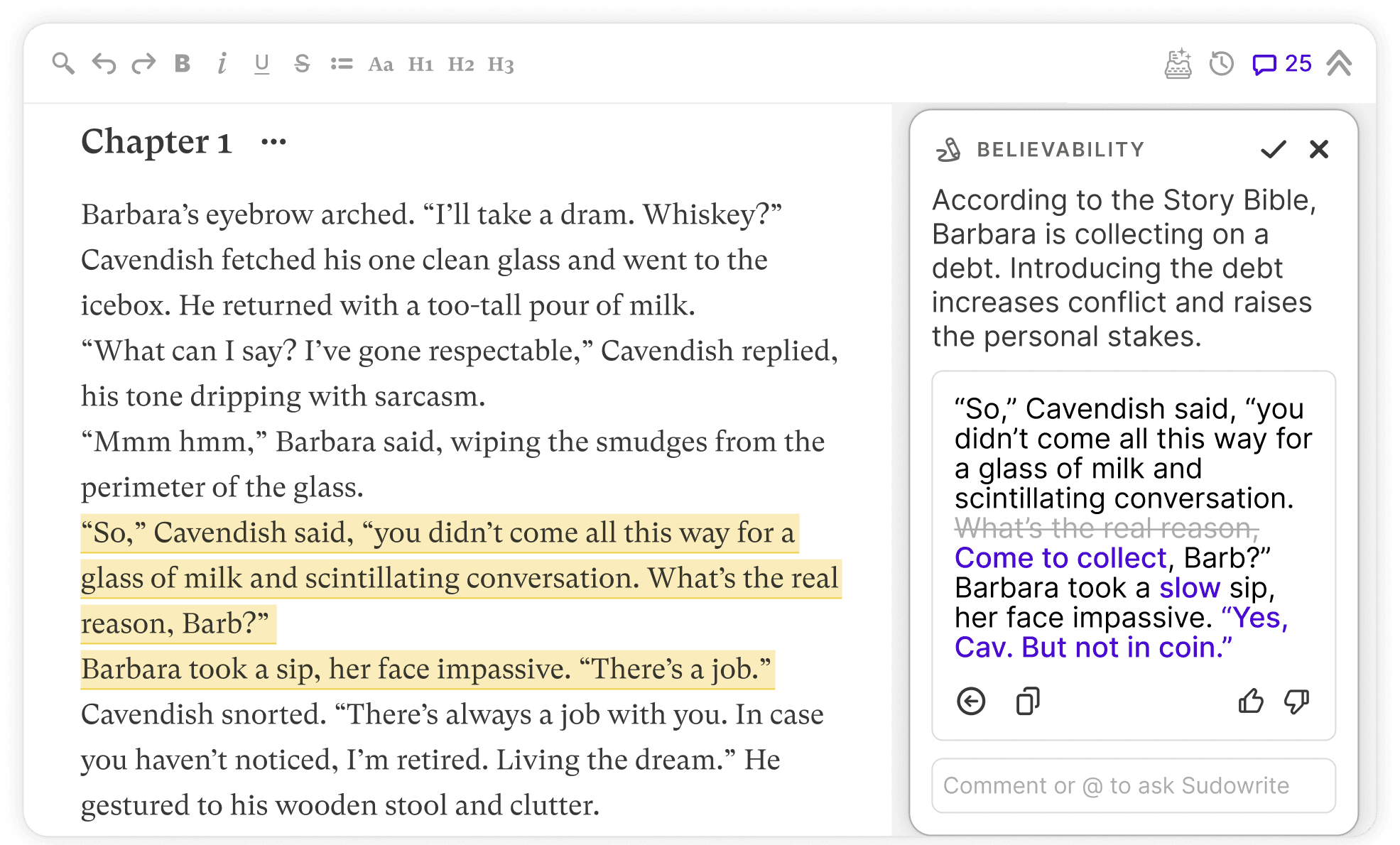


Your book is 90% done, but that last 10% matters most. Sudowrite Feedback reads your document and tells you what’s wrong with it.
It leaves comments in the margin, just like a real editor—but even better because it sees your Story Bible.
Sudowrite helps you complete a first draft faster than ever. But where do you go after that? For most authors, the answer is nowhere fast.
Beta readers can be slow. Editors are expensive. Your critique group meets every third Thursday and Brenda always wants to talk about her own book. So your mostly-done draft sits in a drawer, while you wonder how to turn it into a bestseller.
Feedback shows you ways to improve your work. Use it on a chapter, a scene, or the whole book, and Sudowrite reads through your work leaving the exact sort of feedback you’re looking for—from developmental edits to line or copy edits to entirely custom feedback types. Your next steps, made crystal clear.

ChatGPT and Claude don’t know your characters. They don’t know your outline. They don’t know that the scar is on the left side of his face and why that matters in chapter twelve. Feedback does, because it has access to the same Story Bible you do.
When Feedback tells you a scene is dragging, it’s not basing that on “typical” best practices. Feedback knows what your character would actually do there. When it surfaces unnatural dialogue, it’s because Feedback knows what that character would say in that circumstance. And when Feedback suggests a cut, it knows that there’s no payoff disrupted three chapters later.
Feedback is the ultimate know-it-all.

Feedback doesn’t just point at problems. It tells you what to try.
Every comment comes with a clear next step—a suggested rewrite, a question to consider, a craft note to think through. Some of them you’ll take. Some of them you won’t. But you won’t be left staring at “this scene needs work” with no idea what that means.

Select from over a dozen specific Feedback types, ranging from Developmental edits to Line or Copy edits.
Can’t find what you need? Create your own.
For everything else, there’s Custom Feedback types.
Want to flag every scene where your protagonist’s grief surfaces? Every place where your antagonist is too sympathetic? Every instance of a specific phrasing?
Create a custom Feedback type and Sudowrite will hunt for whatever across your draft.
Developmental edits
The big-picture stuff.
Pacing, structure, character arcs, plot holes. The notes a developmental editor would leave on a draft.
Line edits
Sentence-level work.
Awkward phrasing, redundant words, dialogue that doesn’t land. Places your beta reader may stumble.
Dialogue edits
Conversation-level tuning.
Speaker attribution, dialogue tags, lines that sound stilted or off-character. Opportunities to make it sound natural.
Copy edits
That final polish.
Grammar slips, passive voice, punctuation. The stuff you might overlook, but a copyeditor wouldn’t.

The objective perspective that beta readers offer is invaluable to your process. But working with beta readers—finding them, waiting for their feedback, and keeping your fingers crossed its substantive—leaves something to be desired.
Feedback’s Beta Read includes three distinct AI readers. Maya tracks where the emotions land. Anton eyes structure, pacing, and motivation. And Joan finds places where plausibility breaks and your readers would put the book down. Get their detailed notes one at a time, or all at once, at any point in your process. (Thank goodness for well-read robots.)

Most editing tools surface problems and make them yours to fix. Feedback follows through.
Reply @Sudowrite to any comment—from Feedback or your beta readers—and Sudowrite’s Chat picks up the thread. Ask why. Push back on a note. Ask for a rewrite. Let Sudowrite make the change for you, or talk it through until you know what you want to do. Feedback is just the beginning of your editing conversation.
Novelists, Feedback was built just for you.
Feedback is the first editing tool built just for authors (by authors!) writing long-form narrative fiction.
That means the notes and suggestions you get actually take your character development and continuity into consideration.