

Table of Contents
Every romance writer has had the moment: you reread the scene you wrote last night and want to close the laptop and walk into the sea. It's a specific kind of embarrassment, and it stops more romance novels than any plot problem does. This post is about where it comes from and how to write through it.
TL;DR: The cringe comes from writing feelings at the wrong distance: either so far away that the scene is generic, or so close that it's unfiltered diary. The fix is craft, and it's learnable: anchor every emotional beat in a concrete, specific detail, let characters want things they can't say, and treat sex scenes as scenes with a turn rather than as choreography. If you draft with AI, use one that will follow the scene where you take it. Sudowrite's Muse was built for fiction and is unfiltered, so it keeps writing the scene instead of cutting away halfway through.
How can I write romance without feeling like the biggest idiot?
By accepting that the embarrassment is a sign you're doing it right, and then getting more specific.
The cringe has one main cause. Romance runs on emotions most of us have been trained since childhood not to say out loud, and writing them down feels like saying them out loud. The instinct is to protect yourself, and there are two ways writers do that, both of which make the writing worse.
The first is distance. You write the feeling in general terms ("she felt a connection she couldn't explain") so that no one, including you, has to look at it directly. The result reads as generic, which is its own kind of embarrassing.
The second is overexposure. You write the feeling exactly as you would feel it, in full, with nothing between you and the page. That reads as a diary, and diaries are embarrassing to read because they weren't written for a reader.
The way out is specificity. Not "she felt a connection" and not "her whole body ached with wanting him." Instead: what does she notice about him that she's never noticed about anyone else? Which small thing does she do differently now that he's in the room? The more precise the detail, the less it feels like confession and the more it feels like observation, and observation is a craft skill rather than an exposure.
Three habits that make the embarrassment manageable:
- Write the scene once badly, on purpose, then rewrite it. The first pass is for finding out what happens. Nobody sees it.
- Give each character a thing they want and can't say. The gap between what they want and what they say is where romance lives, and it's also where the writer gets to be indirect, which is a relief.
- Read your scene as your protagonist's best friend would. Not as a critic. As someone who wants it to work out.
How do romance writers write sex scenes without them coming out cringey?
By writing them as scenes rather than as choreography. The cringe in a sex scene almost never comes from the sex. It comes from the writing forgetting that these are two specific people who want specific things and are afraid of specific outcomes.
What experienced romance writers do:
- Decide what changes. A sex scene that ends with the characters in the same emotional place they started is a scene you can cut. Something has to be admitted, risked, or revealed, and it doesn't have to be spoken.
- Stay in one character's perception. Not a camera hovering over the bed. One person's attention, which is selective and strange and specific. What they notice is the scene.
- Cut the thesaurus. The words that make readers laugh are the ones the writer reached for to avoid the plain ones. Use the plain ones or use nothing and let the reader fill it in.
- Match the heat to the book. A spicy contemporary and a dark romance have different registers, and importing one into the other is where a lot of cringe comes from. Decide your heat level before you write the scene, not during.
- Keep the characters in character. The sharp-tongued heroine stays sharp-tongued. The scene should sound like her, even at its most vulnerable, or especially then.
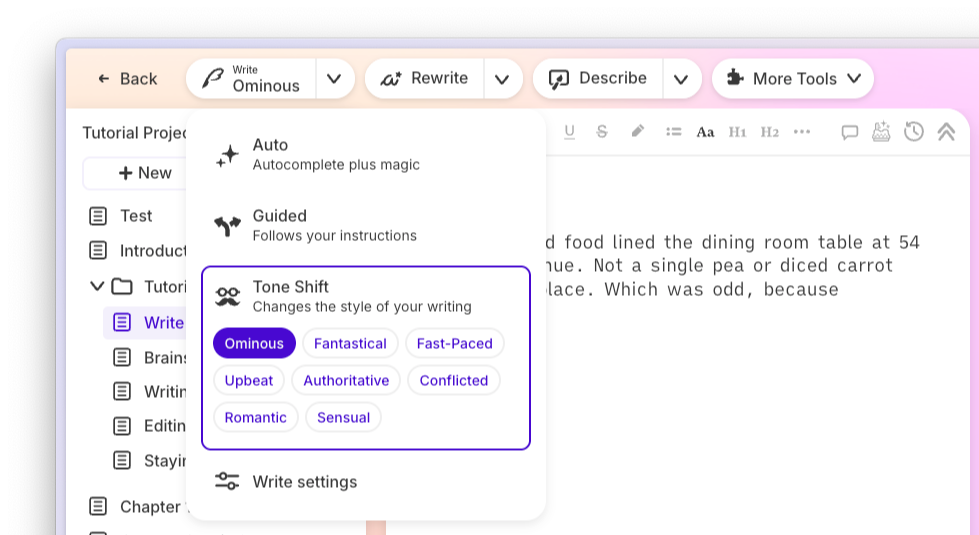
If you use AI to draft intimate scenes, the practical problem is that most general models will refuse, sanitize, or cut away partway through, which leaves you with a scene that has all the setup and none of the turn. Sudowrite's Muse is unfiltered and built for fiction, so it follows the scene at the heat level you set rather than steering it somewhere safer. You can set heat level as a Key Detail so Write respects it, use Write's Guided mode to say what happens next in a sentence, and use the Sensual and Romantic options in Tone Shift to steer register. Describe adds sensory detail across all five senses plus metaphor when a scene reads as too clinical, and Rewrite's More Inner Conflict mode is the fix for a scene where the bodies are present and the people aren't.
How do you write sexual tension and slow burn that actually works?
By delaying the thing the reader wants while making it more wanted every chapter. Slow burn fails in one of two directions: the tension isn't believable (the characters could kiss any time and simply don't, for no reason the reader believes), or the tension is believable but static (the same longing look in chapter four and chapter fourteen).
What makes it work:
- An obstacle that holds. Not a misunderstanding that one conversation would clear up. Something structural: a rule, a debt, a history, a loyalty to someone else. The reader has to believe that acting on the feeling would cost something.
- Escalation. Each encounter should move a step closer. Proximity, then a touch that could be accidental, then one that couldn't, then a near miss. If you can swap two tension scenes without loss, they aren't escalating.
- Awareness that grows. Early on, the character notices the other person. Later, they notice themselves noticing. Later still, they notice the other person noticing them. Each stage is a new kind of tension and gives you new material.
- Small permissions. Slow burn is a series of tiny yeses on the way to the big one. Letting someone carry your bag. Using a first name. Falling asleep in the same room. Each is a scene.
- A near miss that hurts. Around the middle, they almost. And then they don't, for a reason that costs both of them. This is the scene that makes the eventual payoff land.
For tracking this across a novel, an outline helps more than most writers expect, because slow burn is a structure problem as much as a prose problem. Sudowrite's Canvas includes a Romance Outline template built around the turns a romance needs, and the Story Bible's Outline lets you note the tension stage of each chapter so you can see whether it's climbing. If you write series romance, the Series Folder shares your Characters and Worldbuilding across books, which matters when the couple from book one shows up married in book three.
The embarrassment doesn't go away, and that's fine
Writers who have published twenty romances still reread a new scene and wince. The difference is that they've learned to read the wince as a note on the scene rather than on themselves. Usually it means the scene is one revision from working: a detail is missing, a character has gone generic, or the heat is out of step with the book. Fix that one thing and reread it.
FAQ
Why does my romance writing sound so cheesy?
Almost always because the emotion is stated rather than shown through a specific, concrete detail. "Her heart raced" is a claim. "She realized she had been holding the same page of the menu for a full minute" is evidence. Replace claims with evidence.
How explicit should a sex scene be?
As explicit as your subgenre and your book promise. Readers of closed-door romance and readers of explicit romance both feel cheated when the book changes its mind mid-scene. Decide before you write, and if you draft with AI, use one that will honor the decision. Muse is unfiltered, so it writes at the heat level you set.
Can AI help with slow burn?
It helps most with structure and revision. Use an outline template to make sure the tension escalates, ask Chat (which can see your Story Bible and the chapter you have open) where the tension goes flat, and use Rewrite's More Inner Conflict on scenes where the longing has stalled.
Is it normal to be embarrassed writing romance?
It's close to universal. The writers who finish are the ones who write through it and fix the scene afterward, rather than the ones who wait to stop feeling it.