

Table of Contents
You asked ChatGPT to continue your thriller's interrogation scene, and it gave you something that reads like a LinkedIn post with a body count. Stiff dialogue. Zero tension. Your detective suddenly talks like a corporate trainer explaining quarterly goals.
You're not alone. According to the AI and the Writing Profession survey by Gotham Ghostwriters (2025), 60% of fiction authors who use AI say it improves the quality of their writing, and 87% say it boosts their productivity. The gap between what ChatGPT produces and what fiction actually demands has pushed thousands of novelists toward tools built for storytelling. Sudowrite, with its fiction-trained Muse model and Story Bible system, has become where most of them land.
This isn't a sales pitch. It's a pattern report. You'll learn the three specific gaps that drive fiction writers away from ChatGPT, how Sudowrite closes each one, and what real authors say about making the switch.
In This Guide
- What's Actually Driving the Switch
- The Three Gaps That Push Writers Away from ChatGPT
- How Sudowrite Closes Each Gap
- What Real Writers Say After Switching
- Getting Started with Sudowrite
- Already started your draft?
- FAQ
- Key Takeaways
TL;DR: ChatGPT has no story memory, refuses genre-appropriate content, and produces generic prose that kills character voice. Sudowrite's fiction-trained Muse model, Story Bible, and 20,000 words of story memory solve all three. According to Sudowrite internal data (2025), the majority of users report completing manuscripts significantly faster.
What's Actually Driving the Switch
Switching from ChatGPT to Sudowrite is the migration pattern happening when fiction writers realize general-purpose AI chatbots can't handle novel-length storytelling and move to a platform built specifically for fiction, with persistent story memory, genre-aware prose generation, and craft-specific editing tools.
The shift isn't random. ChatGPT launched as a general assistant, and writers were among the first power users. But novel writing exposed hard limits that no amount of prompt engineering fixes. A chatbot designed to answer questions and write emails doesn't understand pacing, subtext, or why your anti-hero needs to sound different from your narrator.
Sudowrite was built by fiction writers. Co-founders Amit Gupta and James Yu ran a writing group called Sudowriters before building the software. The Muse model is trained specifically on storytelling conventions. The Story Bible stores characters, worldbuilding, and plot structure so the AI reads your universe before generating a single word. The Write feature pulls reads up to 20,000 words of your story before continuing plus up to 25 linked chapters. Over 300,000 creative writers worldwide have made Sudowrite their primary writing environment. The New York Times profiled romance authors using Sudowrite in its February 2026 piece "The New Fabio Is Claude," and The Verge called it one of the most capable AI fiction tools available.
The Three Gaps That Push Writers Away from ChatGPT
Zero Story Memory
You've spent three hours feeding ChatGPT your protagonist's backstory: her speech patterns, the scar above her left eye she touches when she lies, the way she never uses contractions. You close the tab. Open a new chat for chapter twelve. Gone. Every detail. You're copy-pasting character sheets into prompts like it's 2019 and you're emailing yourself reminders.
According to the AI and the Writing Profession survey by Gotham Ghostwriters (2025), 60% of fiction authors who use AI say it improves the quality of their writing, and 87% say it boosts their productivity. But the ones sticking with ChatGPT are rebuilding context from scratch every single session. Sudowrite's Story Bible eliminates this entirely. It stores up to 2,000 characters with personality traits, dialogue style, and physical descriptions, and the Write feature reads all of it automatically.
Content Refusals That Kill Entire Genres
According to the According to the AI and the Writing Profession survey by Gotham Ghostwriters (2025), 60% of fiction authors who use AI say it improves the quality of their writing, and 87% say it boosts their productivity. But that stat means nothing if the AI won't write your scene. Romance authors hit walls constantly with ChatGPT. A tension-filled moment between characters gets flagged. A villain's threatening dialogue gets sanitized. Horror writers can't write horror. Thriller writers get their violence neutered into something resembling a safety pamphlet.
Sudowrite's Muse model allows mature, genre-appropriate content. It doesn't refuse you mid-scene and doesn't fade to black when the story demands intensity. Write Guided lets you steer scene direction and intensity. The New York Times profiled author Ms. Rompoti using Sudowrite to help write ten novels, the kind of sustained, genre-respectful output that ChatGPT's content policies make nearly impossible for romance and adult fiction writers.
Prose That Sounds Like a Chatbot Wrote It
Here's a quick test. Paste a ChatGPT-written scene next to something from your favorite author. You'll spot the difference in two sentences. ChatGPT prose is clean but flat. Every character sounds the same. Descriptions default to visual-only, and metaphors arrive pre-packaged and stale.
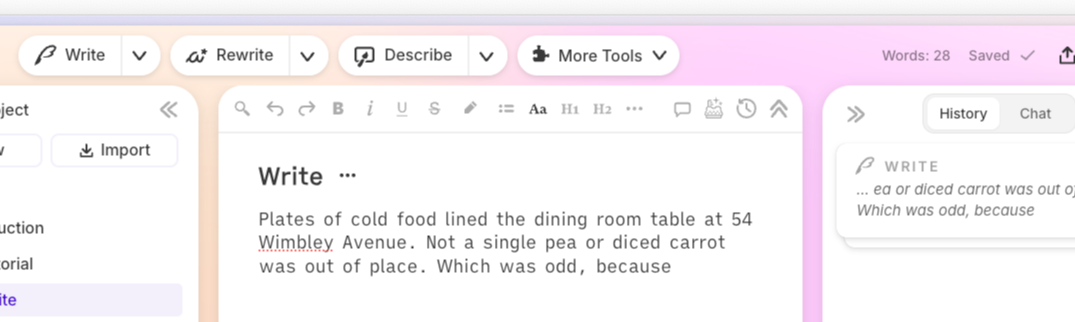
Sudowrite's Muse 1.5 is built for storytelling, not internet text. The Describe feature generates descriptions across all five senses plus metaphors. Highlight any passage and choose from different versions like Show Not Tell, More Inner Conflict, and More Intense. These are craft-specific tools that ChatGPT simply doesn't have because it wasn't designed for this work.
How Sudowrite Closes Each Gap
The pattern is straightforward: every major reason writers leave ChatGPT maps directly to a Sudowrite feature built specifically to solve it.
Feature-by-Feature Comparison
| Fiction Writing Need | ChatGPT | Sudowrite |
|---|---|---|
| Story memory | None. Resets every session | Story Bible with characters, worldbuilding, plot. Persists across sessions |
| Context for prose | ~8,000 tokens per message | 20,000 words + 25 linked chapters via Chapter Continuity |
| Genre-appropriate content | Frequent refusals for romance, horror, thriller | Muse allows mature content; Write Guided controls intensity |
| Prose quality | Generic, uniform voice | Fiction-specific Muse model; Describe for 5-sense detail; 7 craft-specific revision options |
| Series continuity | Must re-explain everything per book | Series Folder shares Story Bible across multiple books |
| Prompt engineering required | Extensive. Results vary wildly | Zero. Click Write, choose a revision style, or use Describe |
| AI model options | GPT only | 20+ models including GPT, Claude, Gemini, DeepSeek, Grok, Mistral |
| Story structure guidance | Generic advice | Canvas with Hero's Journey, Hollywood Beats, Romance Outline templates |
| Revision tools | "Make it better" prompts | Show Not Tell, More Descriptive, More Inner Conflict, Shorter, Rephrase, More Intense, Customize |
That last column isn't marketing copy. Those are actual button labels in the interface. You highlight text, pick an option, and the revision happens. No prompt engineering. No "act as a professional editor" prefix. Just click.
What Real Writers Say After Switching
The writers who made the switch tell the story better than any number could.
"I was skeptical, but Sudowrite doesn't claim any rights to my work. That was non-negotiable for me." — Gianmarco, Novelist
Getting Started with Sudowrite
Step 1: Start Your Free Trial and Build Your Story Bible
What you'll accomplish: Your story's DNA loaded into the AI before you write a single word.
Sign up at Sudowrite (no credit card required). Create a new project and open the Story Bible. Start with Braindump: dump everything you know about your story. The platform walks you through Synopsis, Genre, Characters, and Worldbuilding from there.
If you're migrating an existing manuscript from ChatGPT, paste your character sheets and world notes directly into the relevant Story Bible sections. Every feature reads this data automatically.
Pro tip: Be specific in Genre. "Enemies-to-lovers fantasy romance" produces dramatically better results than just "fantasy."
Step 2: Import Your Manuscript and Link Chapters
What you'll accomplish: Full context continuity across your entire novel.
Create documents for each chapter and link them in order. The Write feature reads up to 20,000 words across 25 linked documents. Set your POV (first person, third limited, etc.) and tense at the project level so every generation stays consistent.
Pro tip: Leave your last sentence unfinished when you hit Write. The AI continues more naturally from an incomplete thought.
Step 3: Choose Your Prose Mode and Write
Select Muse 1.5 for the fiction-specific model, Excellent (Claude 3.7 Sonnet) for literary polish, or experiment with 20+ other models. Use the Creativity Slider to control risk. Generate multiple cards (up to 6 variations) and pick the one closest to your voice.
For revision, highlight any passage and choose a version style. Show Not Tell, More Inner Conflict, or More Intense are where most writers switching from ChatGPT notice the biggest difference.
Ready to switch? Start your free Sudowrite trial , no credit card required. Or read the full ChatGPT vs. Sudowrite comparison first to see the differences on paper before you switch.
I've already got 60,000 words written in Google Docs. Is there anything that can work with a draft I've already started?
Yes. The distinction worth understanding is between a tool that sits beside your draft and one that reads it in. Pasting scenes into a chat window is the first kind, which is why every session starts with you re-explaining who your protagonist is and what happened last chapter.
Sudowrite has three ways in, and choosing the right one matters more than anything else you do on day one.
- Import Novel brings the whole manuscript in and builds your Story Bible from it, pulling out characters, worldbuilding elements and an outline on its own. It's optimized for documents up to 120,000 words, focuses on your five to seven main characters, and accepts .txt, .doc, .docx, .rtf and .odt. Coming from Google Docs, that's File → Download → Microsoft Word (.docx).
- Import Scrivener takes a Scrivener project as-is. Back the project up to a .zip, choose Import Scrivener, and your folders and documents come across the way you had them.
- Document Import drops a single file into a project you've already set up. No size limit, and it leaves your Story Bible untouched.
Worth knowing before you run it: Import Novel always creates a new project rather than writing into an existing one, so it can't collide with a Story Bible you've already built. Characters you never named may come back with placeholder names, and a very long outline can end up saved as separate documents.
For a 60,000-word draft, budget about ten minutes for the import and half an hour afterwards reading what it pulled out and correcting what it got wrong. Keep the Google Doc as an archive for a few weeks until you trust the new setup.
FAQ
Can I import my existing ChatGPT-written drafts into Sudowrite?
Yes. Paste or import any text directly into the editor. Build a Story Bible around your existing manuscript, link your chapters, and the AI picks up your story's context immediately. No reformatting required.
Does Sudowrite work for genres ChatGPT restricts, like romance and horror?
Sudowrite's Muse model supports mature, genre-appropriate content without the refusals ChatGPT imposes. Romance writers can write intimate scenes. Horror writers can write actual horror. Write Guided gives you control over scene direction and intensity.
How is Sudowrite's prose quality different from ChatGPT's?
Muse 1.5 is built for fiction storytelling, not general internet text. The difference shows in dialogue that sounds character-specific, descriptions that engage all five senses, and pacing that matches genre conventions. Sudowrite also offers 20+ AI models so you can match the model to your writing style.
Is Sudowrite worth it for writers who already prompt-engineer ChatGPT well?
Even skilled prompt engineers report faster output with Sudowrite because the interface removes the engineering entirely. According to the AI and the Writing Profession survey by Gotham Ghostwriters (2025), 60% of fiction authors who use AI say it improves the quality of their writing, and 87% say it boosts their productivity.
Does Sudowrite remember my story between sessions?
The Story Bible persists permanently across every session and every feature. Characters, worldbuilding, plot structure, and style preferences stay loaded. Chapter Continuity links up to 25 documents. Series Folder shares Story Bible data across multiple books.
What does Sudowrite cost compared to ChatGPT Plus?
Sudowrite starts at $10/month for the Hobby plan (225K credits) and goes up to the Professional plan at $22/month with one million credits. All tiers include all features, differentiated only by credits. A free trial lets you test everything before committing, no credit card required.
Before you commit, the full ChatGPT vs. Sudowrite comparison has a direct feature breakdown across prose quality, story memory, and content policies with real examples from fiction writers. And once you're in, Sudowrite Prose Modes Explained shows you exactly which model to pick for your genre on day one.
Key Takeaways
The switch from ChatGPT to Sudowrite isn't about one tool being "better" in the abstract. It's about fiction writing demanding things a general chatbot was never designed to provide.
- ChatGPT's three fatal gaps for fiction (no story memory, content refusals, and generic prose) map directly to features Sudowrite was built to solve
- Story Bible and Chapter Continuity give the AI persistent memory across your entire manuscript and series
- Muse 1.5 produces fiction-quality prose because it was built for storytelling, not internet text
- According to Sudowrite internal data (2025), the majority of users report completing manuscripts significantly faster, and the testimonials from working authors back that up
The writers who've already made the switch aren't going back. If you're still copy-pasting character sheets into ChatGPT prompts every morning, there's a better way.