

Table of Contents
The fastest way to ruin a slow burn is a scene that runs a beat too hot. Your couple hates each other in chapter 7, shares a charged glance in chapter 8, and somehow your beta readers say chapter 14 reads like they skipped straight to the bedroom. That tonal gap is not a prose problem. It is a tracking problem, and AI tools built for fiction can finally solve it.
Slow burn is the hardest pacing puzzle in romance. Sarah J. Maas spends three books getting Feyre and Rhysand to a real kiss. Ali Hazelwood gets there in about fifteen chapters with white-knuckle restraint. Both work because the authors tracked every micro-shift between the leads.
Most drafting tools cannot see across chapters. Sudowrite can. Here is how to use Chapter Continuity, Muse, and Tone Shift to pace a thirty-chapter slow burn without ever lurching from cold to combustion.
Why slow burn is a pacing problem, not a chemistry problem
Writers tend to talk about chemistry as if it's mystical. It's not. Chemistry on the page is the result of specific, measurable beats placed in deliberate sequence.
The "burn" is the rate of change between those beats. Too steep a slope and you lose tension. Too shallow and readers bounce.
The reason this matters is that a slow burn has to feel inevitable in retrospect and impossible in the moment. Chapter 12 should feel like a brick wall between your leads. Chapter 13 should feel like a hairline crack. Chapter 14 should feel like that crack widening just enough that the reader notices but the characters don't. If you write those three chapters out of order, or weeks apart, or after rereading the wrong reference scene, the slope breaks.
This is where most drafting falls apart. You finish chapter 11 on a Tuesday and start chapter 13 the following Sunday. Your hate-tinged banter from chapter 7 is no longer in active memory.
Neither is the rule you set in chapter 4 that your hero never touches anyone without permission, or the detail in chapter 9 where your heroine clocks his hands but pretends she didn't. Continuity decays. The burn drifts off-temperature.
Build a tension arc before you write a single scene
Before drafting, open Story Bible and lock the pacing math down. Slow burn lives in the Outline and Synopsis fields. Your Characters cards should already list each lead's voice, baseline temperature toward the other (hostility, indifference, wary curiosity), and the one thing that has to change before they can act on it.
Inside the Outline, give every chapter a tension score between 1 and 10. Think of it as the reader's pulse rate. A 1 is "they're in separate cities and haven't thought about each other in a week." A 10 is "consummation or confession." The arc between those two values is the burn.
For a thirty-chapter romance, a healthy slope looks something like this. Chapters 1 through 6 climb from 1 to 3. Chapters 7 through 14 climb from 3 to 5. Chapter 15 (your midpoint) spikes to 6.5 and drops back to 5.
Chapters 16 through 22 climb from 5 to 7.5. Chapter 23 is your false low. Chapters 24 through 28 climb from 6 back to 9. Chapter 29 hits 10. Chapter 30 is the aftermath.
Write those numbers into your Synopsis. You are not committing to them. You are giving your future self a thermostat.
Use Muse for the actual scene prose
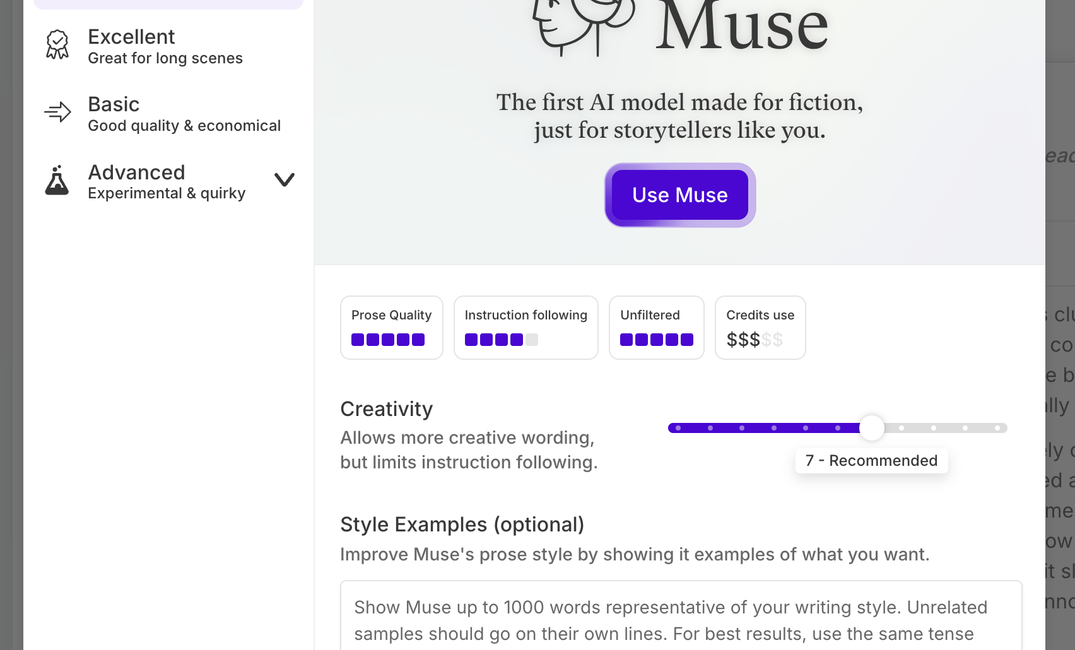
Once your beat map is set, pick the right model for the prose itself. Per Sudowrite's prose-modes matrix, Muse is the default for romance because it does not flinch and it writes like a novelist. That matters in slow burn for two reasons.
First, the early chapters need restraint Muse can hold. Your leads should not be staring at each other's mouths in chapter 3. Muse will let you write tension that lives in elbow brushes, half-finished sentences, and one character pointedly not looking at the other. Lesser models will rush. They want to give you the kiss because that's what training data rewards.
Second, the late chapters need heat that does not flinch. Whether your slow burn ends in a fade-to-black or an explicit scene, Muse will write what the story actually requires without softening it into something safer. If you have spent twenty-eight chapters earning a moment, the model should not undercut it on chapter twenty-nine.
Set Creativity Dial around 4 to 6 for most slow-burn scenes. Higher than that and Muse starts inventing complications you didn't plan for. Lower and the prose can read too obedient. Use Guided Write when you need the scene to land a specific beat. Use Auto when you want Muse to riff on what's already on the page.
Chapter Continuity is the actual game-changer
Here is the feature most slow-burn writers underuse. Chapter Continuity reads across every chapter you have written and flags contradictions. In a contemporary thriller, that means catching the gun your detective left in a drawer in chapter 4 and pulled from a holster in chapter 11. In a slow burn, it means catching the moment your heroine "had never let anyone see her cry" in chapter 6 and then sobs in front of your hero in chapter 9 with no acknowledgment that the rule just broke.
Slow burn is full of these invisible rules. Each lead has a wall. Each wall has cracks. Each crack matters more than the last.
If your hero held the heroine's gaze for two seconds in chapter 5 and it was a big deal, then a four-second held gaze in chapter 12 should be a bigger deal, not equivalent, and definitely not smaller. Chapter Continuity will tell you when your characters are emotionally regressing without your noticing.
Run Continuity after every five chapters at minimum. After chapter 10, 15, 20, 25, and 30, run it as a hard checkpoint. Look specifically for:
- Touch escalation regressions. If they touched in chapter 8 and it was charged, they should not be casually high-fiving in chapter 14 without a reason.
- Eye contact baselines. What was a held look in chapter 6 cannot become unremarkable in chapter 18.
- Confession drift. If she told him in chapter 11 that she was raised by her grandmother, he cannot ask about her parents in chapter 22 like it is new information.
- Power dynamic shifts. Slow burn often involves a power gap (boss/employee, captor/captive, rival/rival). Continuity will flag if you forget to honor that gap mid-arc.
Tone Shift handles your turning points
The seven or eight scenes in a thirty-chapter slow burn that genuinely change the temperature need to feel different on the page than the connective tissue between them. Tone Shift (Romantic) is built for this. Use it sparingly. The whole book should not read "romantic." The book should read like a slow accumulation of weight, with specific moments that downshift into romantic register and then climb back out.
The turning-point scenes in a thirty-chapter arc usually land at chapters 7, 11, 15, 19, 23, 27, and 29. Not all of them are kisses or confessions. Some are quieter.
A shared silence after one lead almost dies. A character realizing they remember the other's coffee order. A moment of physical care that is not erotic but is suddenly impossible to misread as platonic.
On those scenes, draft the structural beats first, then run Tone Shift to layer Romantic onto the prose. Do not start in Romantic mode. You want the romance to surface inside an otherwise grounded chapter, not flood it. If your chapter is supposed to be a tense interrogation that ends with one lead realizing they care, write the interrogation cold, then shift only the last 400 to 600 words.
A 30-chapter slow-burn beat sheet
Here is a beat sheet for an enemies-to-lovers slow burn between a war-weary captain named Aren and a captured field medic named Lira. Adapt the slope to your subgenre. The numbers are tension scores, not chapter lengths.
- Chapter 1 (1). Lira's village is raided. Aren is the officer in charge. Cold capture. No eye contact.
- Chapter 2 (1). Lira refuses to treat Aren's wounded. He doesn't push. First flicker of something other than hatred.
- Chapter 3 (2). Forced proximity in a medical tent. Lira treats a child. Aren watches. He sees her hands shake.
- Chapter 4 (2). Aren establishes a rule: no one touches her without permission. Lira clocks it but does not soften.
- Chapter 5 (2). First held look. Two seconds. They both look away.
- Chapter 6 (3). Lira nearly escapes. Aren catches her without harming her. The restraint is the moment.
- Chapter 7 (3.5). Turning point. Aren tells her something true about why he fights. She hates that she believes him.
- Chapter 8 (3). She regresses, sharper than ever. He absorbs it.
- Chapter 9 (4). Battle. Lira chooses to treat his men. Choice, not coercion.
- Chapter 10 (4). Continuity checkpoint. He thanks her. She doesn't reply.
- Chapter 11 (5). Turning point. She tells him about her brother. He doesn't interrupt.
- Chapter 12 (4.5). She tries to hate him again and finds she can't. He notices.
- Chapter 13 (5). Their first real conversation about the war. They disagree completely.
- Chapter 14 (5). Almost-touch. He moves to brush hair from her face and stops himself.
- Chapter 15 (6.5). Midpoint. He's injured. She has to treat him. First sustained physical contact. Pulls back hard.
- Chapter 16 (5). The morning after. Both pretend nothing happened. Both fail.
- Chapter 17 (5.5). Lira is offered a release. She hesitates. He sees her hesitate.
- Chapter 18 (6). Quiet scene. He brings her a book. Tone Shift (Romantic) on the last 300 words.
- Chapter 19 (6.5). Turning point. Confession of want without acting on it. She walks out.
- Chapter 20 (6). She avoids him for a chapter. He lets her.
- Chapter 21 (7). Forced cooperation under threat. They work in sync.
- Chapter 22 (7.5). First touch they don't pull back from. Hand on a forearm. Held.
- Chapter 23 (5). False low. He has to do something terrible. She sees him do it.
- Chapter 24 (6). She refuses to speak to him. He doesn't defend himself.
- Chapter 25 (7). She returns. They speak honestly for the first time about what they are.
- Chapter 26 (8). First kiss. Brief. Interrupted. Devastating.
- Chapter 27 (8.5). Turning point. He offers her freedom. She chooses to stay.
- Chapter 28 (9). The night before the final battle. Slow, deliberate scene. Muse handles this one. Creativity Dial 5.
- Chapter 29 (10). Consummation, structurally and emotionally. The slow burn pays off.
- Chapter 30 (7). Aftermath. Quiet. Future-facing. New equilibrium.
Notice the slope is not monotonic. There are dips. Chapter 8, 12, 16, 20, 23, and 24 all pull back. Slow burn without regression reads like a metronome. The regressions are where the tension actually compounds.
How to actually run this in Sudowrite
Drafting workflow looks like this. Open Story Bible. Lock your Characters cards for both leads, including their baseline temperature and what specifically has to change.
Write your thirty-row Outline with tension scores. Pick Muse as your prose mode. Set Creativity Dial to 5 by default and adjust per scene.
For each chapter, write your beats in the Outline first, draft in Muse using Guided Write, and run Chapter Continuity every five chapters. On turning-point chapters (7, 11, 15, 19, 23, 27, 29), apply Tone Shift (Romantic) to the final third of the scene only. Use Rewrite (More Inner Conflict) on any scene that feels too easy. Use Describe to expand sensory beats during the dips, because dips are where readers should feel time slowing down.
When you hit chapter 15 and chapter 23, stop. Reread the last five chapters cold. Ask whether the slope feels earned. If it doesn't, Continuity will usually tell you which scene rushed. Cut it, regrade the tension scores, redraft.
The version of slow burn that ruins readers
The slow burns readers remember (Maas, Hazelwood, Christina Lauren, Casey McQuiston) all share one trait. The authors made specific decisions, kept them consistent, and let the tension compound. None of that requires AI. All of it requires tracking the kind of detail human memory loses by chapter 18.
That is the actual job AI does in fiction. It does not write your slow burn for you. It holds the thread so you can.
Muse keeps the prose honest. Chapter Continuity keeps the rules consistent. Tone Shift earns the turning points. The thirty chapters are still yours.
If you want to see how Muse handles a slow-burn scene before you commit, the free trial lets you draft a few chapters with the full Story Bible and Continuity tools. Map the tension, write the first turning point, and watch what happens to chapter 7.