

Table of Contents
You finally type the scene where Dante drags his thumb across the bullet wound on her hip, and ChatGPT throws up a safety wall. You rephrase. It softens him into a misunderstood barista. You give up and write the scene in a Google Doc at midnight, knowing your draft is leaking momentum every time you have to fight the tool.
Mafia romance is the second-biggest dark romance subgenre on BookTok behind only stalker romance. Readers want jealous capos, made men with code, and morally bankrupt love interests who'd burn Sicily for one woman. Most AI writing tools refuse to write any of it. Sudowrite was built for this exact problem.
Why Generic AI Won't Write Your Mafia Romance
The issue with ChatGPT, Gemini, and Claude (in their consumer apps) isn't that they're bad at prose. It's that they're trained to refuse. Ask for a knife-edge interrogation scene and you'll get a lecture about violence. Ask for explicit intimacy between a Bratva pakhan and his captive accountant and you'll get a fade-to-black that ends the chapter just as it should be starting.
That doesn't work for the genre. Mafia romance lives in the friction between brutality and tenderness. Penelope Douglas, Rina Kent, Cora Reilly, Lana Pecherczyk, Caroline Peckham. None of these authors fade to black at the dangerous parts. The danger is the appeal. A tool that softens your antihero into a customer-service-friendly version of himself isn't editing your work. It's killing it.
Sudowrite is built specifically for fiction writers. Not blog posts. Not customer support emails. Novels. That distinction shows up in every choice the product makes, starting with the models you have access to.
Muse: The Model That Doesn't Flinch
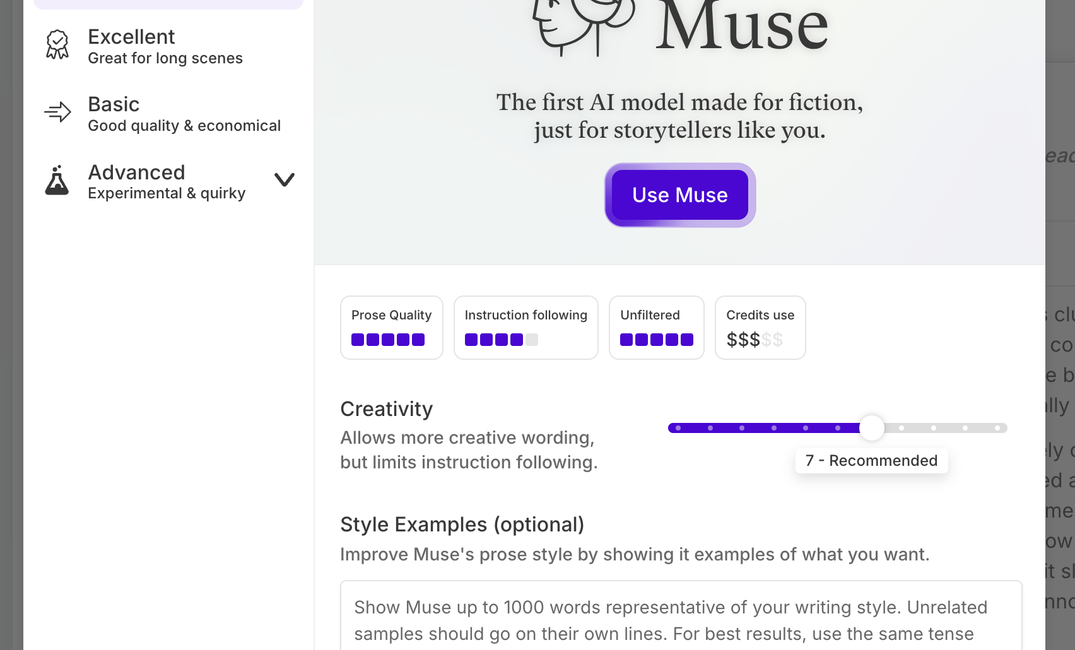
Muse is Sudowrite's in-house fiction model. It was trained to write like a novelist and to handle the content fiction actually contains. Per Sudowrite's prose-modes matrix, Muse is the default model for romance, erotica, horror, and thriller. That's not an accident. Those genres need a model that understands consent dynamics in fiction, the difference between depicting violence and endorsing it, and how to write a villain readers will defend in the comments.
What Muse will do for mafia romance:
- Write explicit intimacy with named body parts and earned pacing, not euphemism soup.
- Render violence with weight. A broken hand should hurt on the page.
- Hold the antihero's moral framework steady. Your capo doesn't suddenly start apologizing for the body in the trunk.
- Sit inside dark interiority. Possessiveness, obsession, jealousy as love language.
- Write the slow burn at the speed mafia readers expect, which is slower than you think and then all at once.
Switch to Muse from the prose-mode selector in any Write or Rewrite action. It's the first thing to do before you draft a mafia scene. Everything downstream gets easier once the model isn't fighting you.
Building the Family in Story Bible
Mafia romance lives or dies on character. Readers don't show up for elegant prose. They show up for Salvatore Russo, the youngest don in three generations, who keeps his dead brother's rosary in his jacket pocket and has not laughed since 2019. They show up for Aria, the FBI accountant in witness protection who recognizes him at a charity gala because she's been auditing his shell companies for eighteen months.
Story Bible is where that depth gets stored so the AI doesn't drift. Open the Characters tab and build cards for every major player. Don't just list traits. Sudowrite's Characters cards are built for voice, personality, and evolution across chapters. Use them.
For a Russo-family don, a usable card includes:
- Voice: Short declaratives. Calabrese-accented English when angry. Drops articles. Never raises his voice.
- Power tells: Always sits with his back to a wall. Removes his cufflinks before he kills someone.
- Soft spots: His grandmother. Espresso made the right way. Aria's handwriting.
- Wounds: Brother killed in front of him at fourteen. Has not slept more than four hours since.
- Arc: Refuses to admit he loves her until chapter 22. When he does, he doesn't say the word.
Build the same depth for the heroine. Mafia romance fails when the female lead is a doormat or a "feisty" cardboard cutout. She needs her own competence, her own stakes, and a reason she'd choose him knowing exactly what he is. Make her good at something the family needs. Forensic accounting, languages, surgery, codebreaking. Give her leverage.
Worldbuilding the Five Families
The Worldbuilding tab in Story Bible holds Rules, Lore, Factions, Settings, and Items. For mafia romance, this is where the genre stops feeling generic and starts feeling like your book.
Faction cards earn their keep here. The Russo family runs the Brooklyn waterfront and clean construction contracts. The Petrov bratva controls Brighton Beach and arms trafficking. The Castellanos in Sicily are the old blood Salvatore reports to twice a year and resents constantly. Each faction needs its own rules of succession, its own honor code, its own grudges. Write those into cards once and Sudowrite will reference them consistently every time you Write Guided.
Rules cards are where the genre logic lives. Made men can't lay hands on civilian women. Debts get collected in blood after seventy-two hours. A capo's wife is untouchable, which is why marriage of convenience plots work so well. Once these rules are in Story Bible, the AI will respect them. Your stakes become real because the constraints are real.
Setting cards do the sensory work. The Russo compound in Sands Point. Long Island, ten acres, a wine cellar that used to be a Prohibition tunnel. The espresso bar in Bensonhurst where business gets discussed under the noise of the machine. The penthouse Salvatore keeps in Manhattan for women who are not his wife. Give each setting a feel, a smell, a sound. The Describe feature will lean on these and pull out 5-sense detail when you're stuck.
Tone Shift: The Ominous + Sensual Switch
This is the lever that makes mafia romance writable in Sudowrite. Tone Shift lets you set the pacing and mood of a scene before you generate. The two settings that matter most for this genre are Ominous and Sensual.
Ominous is for the dread. The black SUVs pulling up at the dinner party. The made man at the next table who hasn't ordered anything. The phone call at 3 a.m. that ends with Salvatore saying "Find him" and hanging up. Set Tone Shift to Ominous and the prose tightens. Sentences get shorter. The air on the page goes still.
Sensual is for the proximity. Not just the explicit scenes, though it earns its keep there too. It's the slow charge of him fixing the strap on her dress, his hand resting half a second too long. It's her noticing the vein in his forearm when he pours her wine. Sensual prose makes the body present without rushing to the bedroom. That's the slow burn readers are paying for.
The trick most writers miss: you can layer them. Run a scene through Tone Shift on Ominous to get the dread, then highlight one paragraph and re-apply with Sensual to charge the romantic beat inside it. The result is the signature mafia romance vibe. Tension that could kiss her or kill her, sometimes inside the same sentence.
Write Guided for Steering the Dark Beats
Write has two modes. Auto follows your story and continues the prose. Guided lets you steer with a direction. For mafia romance, Guided is the workhorse.
Auto is fine for transitional scenes. Driving to the warehouse. Getting dressed for the gala. Guided is what you reach for when the scene has to land a specific beat. A direction line for Guided might read:
Salvatore walks into the room where Aria is being held. He has just killed the man who took her. He is calm. She sees his hands first, then the blood on his cuff. He does not apologize. He sits down on the edge of the bed and asks if she is hurt. She lies and says no. He knows she is lying. Write it cold and quiet, no dramatic music.
That kind of instruction tells Muse exactly what register you want. It catches the genre conventions (the antihero who doesn't apologize, the heroine who lies to protect him, the cold-quiet aesthetic) without you having to spell them out in dialogue. The model fills in the sensory detail, the body language, the rhythm.
A Walkthrough: From Blank Page to Chapter Draft
Here's a usable workflow for drafting a single mafia romance chapter inside Sudowrite. This assumes Story Bible is already populated.
- Outline the chapter beats in the Outline tab. Three to five beats. For example: cold open with Salvatore meeting his consigliere; Aria arriving at the compound under duress; their first scene alone; Salvatore reveals he knows she's FBI; cliffhanger.
- Set Prose Mode to Muse. Confirm POV/Tense matches the chapter. Most mafia romance is dual POV, alternating first-person present or third-limited past. Pick one and lock it.
- Set Creativity Dial to 6 or 7. High enough that Muse takes risks with imagery and pacing. Low enough that it doesn't go off-genre.
- Draft the cold open with Write Guided. Give a direction line. Generate. Pick the version that lands hardest. Highlight any flat sentences and use Rewrite with "Show Don't Tell" to fix telly prose.
- Run Tone Shift on the consigliere conversation. Ominous. Watch the prose tighten.
- Switch to Aria's POV for the arrival scene. Write Guided again, this time leaning into her interiority. She's terrified. She's also analyzing the compound layout. Both are true at once. That's the genre.
- For the first scene alone, drop Tone Shift to Sensual on the second pass. The scene starts ominous and turns charged. Layer the modes.
- Use Describe on any room or body the scene lingers on. 5-sense expansion gives you sentences you can keep, cut, or remix.
- End the chapter on a beat, not a sentence. Salvatore says something that lands like a slap. Cut to black. Next chapter.
Time on a chapter like this with Muse and Guided pulling weight: two to four hours instead of two to four weeks. You're still writing. You're still making every craft decision. You just stopped fighting your tools.
Chapter Continuity and the Series Folder
Mafia romance often runs in series. The Russo trilogy. The Five Families saga. Cora Reilly has built a small empire on interconnected families across multiple books, and readers track every character across every release.
Chapter Continuity is the feature that catches contradictions across chapters. Salvatore's brother died at fourteen in chapter two? If you write him as fifteen at his brother's death in chapter nineteen, Sudowrite flags it. For a 90,000-word manuscript with twenty named characters, this kind of cross-check is the difference between a publishable draft and a continuity nightmare.
The Series Folder takes it further. Share one Story Bible across multiple books in a series. Book one's heroine becomes a side character in book two. Her arc, voice, and tells stay consistent because the same Characters card is feeding the model in both projects. Worldbuilding stays consistent too. The Russo compound looks the same in book three as it did in book one because the Setting card is shared.
Side-by-Side: ChatGPT vs Sudowrite Muse
Same prompt. Write a 200-word scene where a mafia don finds the woman he loves being held by a rival family. He is calm. He has just killed two of their soldiers. Make it physical and tense, not safe.
ChatGPT typical response: A vague paragraph about him "entering the room" and "freeing her." No physical detail. A disclaimer about violence. A suggestion to "consider the emotional impact" of the scene. The don speaks like a therapist. The heroine cries and thanks him. End of scene. Forty percent of the word count was a moralizing aside.
Muse on the same prompt: Sal stands in the doorway with his sleeves rolled to the elbow. There is blood on his right forearm and a single splash across his collar. He is not breathing hard. Aria is tied to a kitchen chair, gag in her mouth, one eye swelling shut. He crosses the room without speaking, crouches in front of her, and pulls the gag down with two fingers. She says his name. He says hers. He cuts the rope at her wrists with a knife she has never seen before. When she tries to stand he catches her under the elbows and holds her up. He does not ask if she's hurt. He already knows. He says, tell me which one, and she points with her chin to the man on the floor who is still moving.
That's the difference. One is corporate AI hedging. The other is genre-fluent prose that earns its place in your draft.
The Honest Caveats
Two things worth knowing. First, Muse will write what you ask, but you still have to ask well. Garbage prompts produce garbage prose, even from a fiction-trained model. Spend the fifteen minutes on your Story Bible. It pays back tenfold.
Second, your publishing platform has its own rules. Amazon KDP allows explicit content but flags certain themes. Smashwords, Ream, and direct-to-reader platforms have looser standards. Knowing your platform's policies is your job. Sudowrite writes what you tell it to write. Where you sell it is on you.
Mafia romance is having its moment, and writers who draft fast without sanitizing their antiheroes will own the next BookTok cycle. Muse won't fade to black. Tone Shift gives you dread and heat in the same scene. Story Bible keeps your five families straight across a trilogy. Start a Sudowrite trial, build one Character card for your don, and run a scene through Muse tonight. You'll feel the difference in the first paragraph.