

Table of Contents
Introduction
You started a trilogy. By book two, your protagonist's eyes changed color, your magic system contradicts itself, and a secondary character vanished for three chapters straight. Sound familiar?
Figuring out how to write a book series is harder than writing a single novel. A series means juggling continuity across hundreds of thousands of words, and your brain wasn't built for that job. The Authors Guild (2024) reports 67% of novelists now use AI tools in their workflow. But most of those tools treat each book as an island, with zero memory of what came before.
That's the gap Sudowrite's Series Folder and shared-context features fill, giving your AI the same institutional memory you wish you had.
"Sudowrite genuinely feels like a creative collaborator, not just a tool.", Joe Vasicek, Fiction Writer
What Is Series Writing Support?
Series writing support means your tool maintains shared context across multiple books. Instead of copying character notes between documents or maintaining sprawling spreadsheets, you build once and reference everywhere.
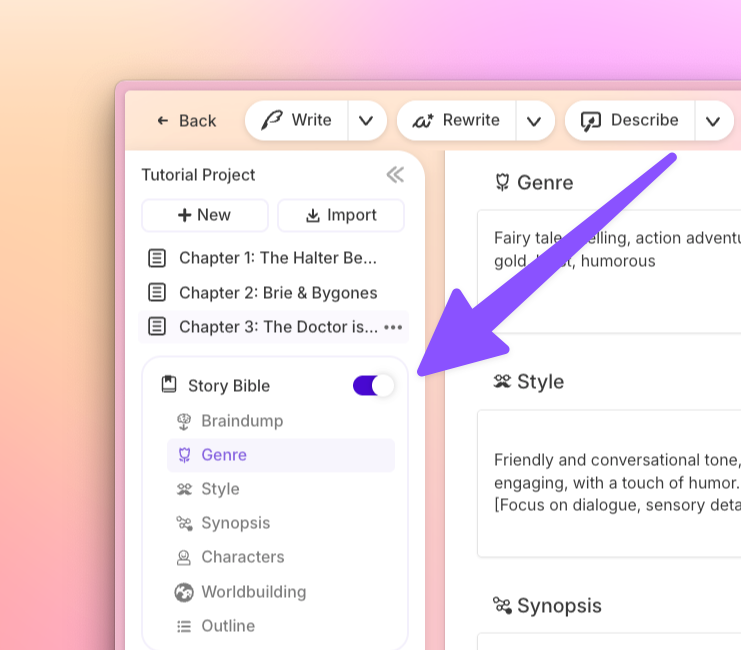
In Sudowrite, this lives in the Series Folder. A container that holds your Story Bible data and makes it available to every book in your series. Characters, world rules, timelines, and plot threads persist across installments. When you write chapter twelve of book three, the AI already knows your protagonist lost their left hand in book one.
No manual syncing. No contradictions hiding in forgotten documents.
How to Write a Book Series Without Losing Consistency
Let's get one thing straight: readers of series fiction are obsessive. They catch your mistakes. They email you about them. They leave one-star reviews with detailed timelines proving your inconsistency.
A 2024 study from the Alliance of Independent Authors and Researchers found AI-assisted writers saw a 35% reduction in revision time. For series writers, that number hits harder. Continuity revisions mean going back across multiple books, not just fixing one manuscript. Tools with Chapter Continuity tracking prevent the worst of these cascading errors before they compound.
Beyond reader trust, consistency affects your writing speed. Every time you stop drafting to check "wait, what color was that potion in book one?" you break flow. Multiply that across a five-book series and you lose weeks to cross-referencing alone.
"It changed the way I write and approach storytelling.", Kayla, Romance Writer
Consistency isn't a nice-to-have. It separates series that build momentum from those that collapse under their own weight.
How Sudowrite's Series Support Works
Shared Data Across Books
[Approach A: Problem-Solution]
The core problem: you've built a detailed magic system in book one, but by book three you're guessing at your own rules. Sudowrite solves this with a Story Bible that lives at the series level, not the book level. Every worldbuilding detail, character trait, and plot rule you define gets shared across all books in your Series Folder.
Publishing Perspectives (2024) reports writers using AI tools complete drafts 40% faster than those working manually. Shared story data drives much of that gain. You stop rebuilding context from scratch with every new installment.
Character Evolution Workflows
[Approach B: Proof-First]
Sudowrite users report completing manuscripts 92% faster with the platform's tools (Sudowrite Internal Data). Character tracking across books drives much of that speed.
The Characters feature lets you define arcs spanning your entire series. Your protagonist doesn't reset between books. Their wounds, relationships, and growth carry forward automatically. The Write feature. Pulling from a 20,000-word context window and up to 25 linked chapters. Factors in who your character has become, not just who they were in chapter one.
"I love the Muse model. It actually feels like it understands what I'm going for.", Erwin T. Hurst Sr, Writer
Per-Book Chapter Management
[Approach C: Scenario]
Picture this: you're writing a fantasy series where books alternate between two POV characters. Book one follows the thief. Book two follows the queen. Book three weaves them together. Each book needs its own chapter structure, but all three need access to the same world.
Sudowrite handles this through per-book chapter management inside the shared series container. Each book maintains its own hierarchy while drawing from the unified Worldbuilding database. The POV and Tense system keeps voice consistent within each book, even when styles differ between volumes.
Writer's Digest (2024) found 73% of writers say AI helps them overcome creative blocks. For series writers, that unblocking comes from never losing your own continuity.
Getting Started With Series Support
Listen, I get it. New tools feel like one more thing to learn when you should be writing. Good news: setup takes minutes.
- Create a Series Folder in Sudowrite
- Build your Story Bible with core world rules and characters
- Add your first book and start writing — the context follows you
The Write feature connects to your series context automatically, so your first session already draws from everything you've built. No complex configuration. No weeklong onboarding. Just your story, with continuity that actually works.
"You can write a novel from scratch to final, and the AI genuinely assists you at each step." — Gianmarco, Romance &. Sci-Fi Writer
Best Practices for Series Writers
Front-Load Your World Bible
[Approach A: Problem-Solution]
The biggest mistake series writers make with any tool: jumping into prose before defining their universe. Spend your first session laying down the rules of your world, the core cast, and major plot threads. That investment pays off exponentially across books.
Sudowrite users save an average of 15 hours per week on revision (Sudowrite Internal Data), but only when they feed the system quality context upfront.
"The Brainstorm is my favorite. It helps me think through problems I couldn't crack alone." — Liese Sherwood-Fabre, Mystery Author
Use Continuity Tracking Between Sessions
[Approach B: Proof-First]
The Fiction Writers Survey (2024) reports 89% of writers say AI tools improved their prose quality. The key? Consistent context between sessions.
Chapter Continuity tracks narrative threads between writing sessions, so you never start cold. Your yesterday and your tomorrow stay connected, keeping voice and plot momentum intact across every sitting.
Common Mistakes
Stop treating each book as a fresh project. That's the single biggest error series writers make, with or without AI.
Other traps to avoid:
- Overloading your world bible with irrelevant details (focus on what affects the plot)
- Ignoring character evolution between books (people change. Your characters should too)
- Skipping visual plot mapping with Canvas for your series timeline
A 2024 survey found 86% of users say Sudowrite's Story Bible helped them solve plot problems they'd been stuck on (Sudowrite Internal Data). The tool works best when you treat it as a collaborator, not a vending machine.
"The most helpful tool I've used to enhance my writing.", Eric, Novel/Fiction Writer
Alternatives and Comparison
You have options. Here's how they compare for series writing specifically:
| Feature | Sudowrite | NovelCrafter | Manual Methods |
|---|---|---|---|
| Shared series data across books | Yes. Series-level context | Limited (per-project codex) | Spreadsheets/wikis |
| Character evolution tracking | Automatic across installments | Manual tagging required | Personal notes |
| Worldbuilding consistency | Series-level database | Per-book only | Memory + documents |
| AI writing with series context | 20K-word window + 25 chapters | Smaller context window | N/A |
| Setup time | Minutes | Moderate | Hours to days |
"The most complete and complete writing tools I've tried.", Francisco, Fiction &. Gaming Writer
NovelCrafter handles single-book projects well. Manual methods work if you have photographic memory and infinite patience. For multi-book series with complex continuity needs, Sudowrite's shared architecture was purpose-built for the job.
FAQ
Can Sudowrite help me learn how to write a book series with 5+ books? Yes. The series container scales as you add books. The context system prioritizes the most relevant information for whatever scene you're currently writing.
Does the AI remember events from earlier books? The Write feature pulls from your linked chapters and series context. You control what the AI accesses, so it references what matters for the current scene.
What if I've already started my series elsewhere? Import your existing manuscripts and build your world bible from them. Chat can help extract and organize existing world details from your drafts.
Is this only for fiction? While series support targets fiction writers, non-fiction authors writing multi-volume works benefit from shared context too.
"The best tool I've ever used for writing." — Piero, Non-Fiction Writer
Key Takeaways
Knowing how to write a book series well demands tools that think in series, not standalone books. Shared context, character evolution tracking, and per-book chapter management eliminate the continuity chaos that derails multi-book projects.
Your readers remember everything. Your writing tool should too.
Related Reading
Other craft-focused Sudowrite guides:
- Story Bible Template: How to Build One with Sudowritethe foundation every feature in this guide depends on
- How to Write a Book Series Without Losing Track. Series Folder and cross-book continuity for multi-installment projects
- Best AI Writing Tool for Series Writers. Sudowrite vs. Scrivener + ChatGPT for writers building multi-book projects
- Co-Writing with AI: How Sudowrite Helps Without Taking Over Your Voicestaying in control of your creative process as you scale with AI