

Table of Contents
You've got a novel idea. Maybe a dozen. What you don't have is a plan for turning those ideas into 80,000 coherent words.
Welcome to outlining—the part of writing most people skip and then regret around chapter seven. There's no shortage of outlining methods. The problem isn't finding one; it's finding one that doesn't make you want to abandon your manuscript before you've started.
Here, we'll discuss five proven approaches to outline a novel, then shows you a sixth: letting AI handle the structural heavy lifting with Sudowrite.
A novel outline is a structured plan that maps your story's key plot points, character arcs, and chapter progression before you write the full manuscript. It can range from a sparse scene list to a beat-by-beat breakdown. The format matters less than the function: giving you a roadmap so you're not writing into the void.
Think of it as scaffolding. It holds the structure up while you build. You can remove it later.
TL;DR: Five classic outlining methods each have tradeoffs. Sudowrite's Outline feature uses your Story Bible—characters, world, synopsis—to generate a chapter-by-chapter plan in minutes, not weeks.
Contents:
- 5 Proven Methods to Outline a Novel
- Why Outlining Your Novel Matters
- How Sudowrite's Outline Feature Works
- Getting Started: Outline a Novel in Sudowrite Step by Step
- Best Practices for AI-Assisted Outlining
- Common Outlining Mistakes
- FAQ
5 Proven Methods to Outline a Novel
Save the Cat
Blake Snyder's beat sheet breaks your story into 15 beats. Originally designed for screenwriting, fiction writers swear by it for pacing. Best for plot-driven stories where timing matters.
Three-Act Structure
Setup, confrontation, resolution. Simple enough to sketch on a napkin. It works because it mirrors how humans process narrative—but it won't help you figure out what happens between the turning points.
Snowflake Method
Randy Ingermanson's approach starts with a one-sentence summary and expands outward—one paragraph, then a page, then character sheets, then scenes. Methodical and thorough. It's also time-consuming.
Hero's Journey
Joseph Campbell's monomyth gives you 12 stages from the Ordinary World to the Return. Fantasy and adventure writers love it. Literary fiction writers tend to run screaming.
Scene-Sequel
Dwight Swain's method structures every scene as action (scene) followed by reaction (sequel). Granular and effective for maintaining tension, but requires planning at the scene level before you've written a word.
| Method | Best For | Structure Level | Learning Curve |
|---|---|---|---|
| Save the Cat | Plot-driven, genre fiction | High (15 beats) | Moderate |
| Three-Act Structure | Any genre, beginners | Low (3 parts) | Low |
| Snowflake Method | Detail-oriented planners | Very High | High |
| Hero's Journey | Fantasy, adventure, epic | High (12 stages) | Moderate |
| Scene-Sequel | Tension-driven stories | Very High (per scene) | High |
Why Outlining Your Novel Matters
It Saves Revision Time
First drafts written without outlines tend to require structural rewrites—not just line edits. An outline catches plot holes before you've written 50,000 words around them.
It Fights the Sagging Middle
Most abandoned novels die between chapters 8 and 15. An outline gives you something to write toward when motivation fades and the middle stretches like taffy.
It Makes Chapter Writing Easier
As author Liese Sherwood-Fabre found using Sudowrite, having a solid structural plan means each chapter practically writes itself. You stop staring at blank pages because you already know what happens next.
How Sudowrite's Outline Feature Works
Sudowrite doesn't spit out a generic plot template. It reads your Story Bible—your synopsis, characters, and worldbuilding—and generates a chapter-by-chapter outline that fits your story.
Stage 1: Feed the Story Bible
Add your synopsis, characters, and world details using Braindump (paste existing notes) or build them directly inside Sudowrite. The more context you provide, the sharper the outline.
Stage 2: Generate the Outline
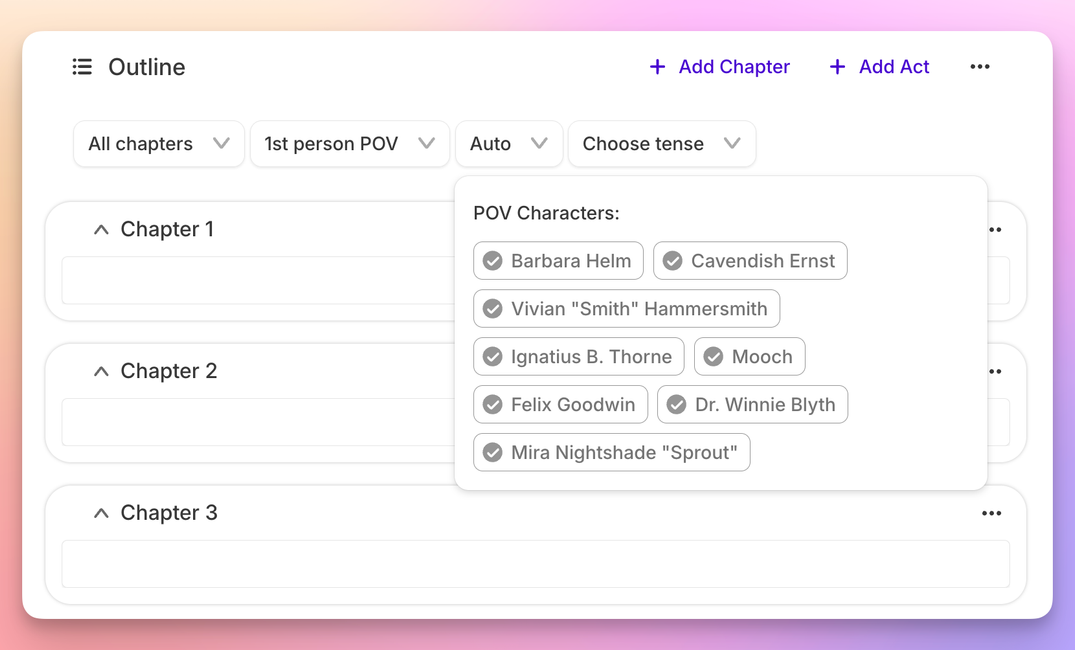
Hit the Outline button. Sudowrite's Muse model processes your Story Bible and produces a structured chapter breakdown with plot points, character beats, and pacing markers.
Stage 3: Edit and Expand
The outline is a starting point, not a prison. You can easily rearrange chapters, add scenes, adjust arcs. Sudowrite maintains Chapter Continuity across edits, so changes in chapter three ripple forward through chapter thirty.
Author Joe Vasicek found that Sudowrite's structural tools dramatically compressed what used to take weeks of planning into a fraction of the time—freeing him to spend more energy on the actual writing.
Getting Started: Outline a Novel in Sudowrite Step by Step
- Create a new project in Sudowrite and name your novel.
- Build your Story Bible: Add a synopsis (even a rough one), create character profiles, and note key world details. Use Braindump to paste in any existing notes—Sudowrite organizes them into structured entries.
- Generate your outline: Navigate to the Outline feature and let Sudowrite build your chapter structure from your Story Bible.
- Refine and customize: Reorder chapters, expand beats, merge or split sections. Use Canvas for a visual overview of your story's structure.
| Factor | Sudowrite Outline | Manual Outlining |
|---|---|---|
| Time to first draft outline | Minutes | Days to weeks |
| Story Bible integration | Automatic | Manual cross-referencing |
| Character consistency | Built-in continuity checks | Relies on memory and notes |
| Revision | Re-generate with edits | Start over or heavy rework |
| Chapter scalability | Handles any chapter count | Gets unwieldy past 20+ |
| Genre awareness | Adapts to your story's genre | Depends on writer's knowledge |
Best Practices for AI-Assisted Outlining
- Front-load your Story Bible. Outline quality correlates directly with input quality. Vague synopsis = vague outline.
- Don't skip characters. Sudowrite's outline improves dramatically when it understands your protagonist's goals and your antagonist's motivations.
- Iterate, don't just accept. Generate, review, tweak your Story Bible, regenerate. Each pass gets closer to what you need.
- Use it as scaffolding. Your outline will evolve as you write. That's not a bug—it's how novels work.
Common Outlining Mistakes
- Over-outlining: Planning every sentence before writing any of them kills spontaneity. Outline at the chapter or scene level, not the paragraph level.
- Under-outlining: "I'll figure it out as I go" works for about 10% of writers. The other 90% end up with an abandoned manuscript.
- Treating the outline as sacred: Outlines change. Characters surprise you. If your outline stops serving the story, change the outline.
FAQ
What is the best way to outline a novel?
There's no single best method. It truly depends on how you want to work. Three-Act Structure works for beginners, Save the Cat suits plot-heavy genre fiction, and Sudowrite's Outline feature works for writers who want AI-assisted structural planning built from their own story details.
Can AI write a novel outline?
Yes. Sudowrite generates chapter-by-chapter outlines from your Story Bible—your synopsis, characters, and worldbuilding. The output reflects your specific story, not a generic template.
How many chapters should a novel outline have?
Most novels run 20–40 chapters, but there's no rule. Sudowrite's Outline feature scales to any chapter count based on your synopsis length and story complexity.
Do I need to outline before writing a novel?
Not strictly, but writers who outline tend to finish more manuscripts and require fewer structural rewrites. If you've struggled to complete a draft, outlining is worth trying.
What's the difference between plotting and pantsing?
Plotters outline before writing; pantsers write by the seat of their pants. Most writers land somewhere between. Sudowrite supports both—use the full Outline feature or generate structure for just the next few chapters.
Is Sudowrite's outline feature good for a series?
Yes. The Story Bible carries across your project, maintaining character arcs, world details, and continuity whether you're planning one book or five.
Related Reading
Other craft-focused Sudowrite guides:
- Story Bible Template: How to Build One with Sudowrite — the foundation every feature in this guide depends on
- How to Write a Book Series Without Losing Track — Series Folder and cross-book continuity for multi-installment projects
- Best AI Writing Tool for Series Writers — Sudowrite vs. Scrivener + ChatGPT for writers building multi-book projects
- Co-Writing with AI: How Sudowrite Helps Without Taking Over Your Voice — staying in control of your creative process as you scale with AI
Key Takeaways
- Five classic outlining methods (Save the Cat, Three-Act, Snowflake, Hero's Journey, Scene-Sequel) each suit different writing styles and genres.
- No method is universally "best"—the right outline is the one you'll actually use.
- Sudowrite's Outline feature generates a chapter-by-chapter plan from your Story Bible, combining the thoroughness of detailed outlining with the speed of AI.