

Table of Contents
Your protagonist sounds exactly like your antagonist. Your side characters are interchangeable. And somewhere around chapter fifteen, your detective started using the same speech patterns as the barista from chapter three.
Knowing how to develop fictional characters is one thing — maintaining those characters across 80,000 words, an entire novel, is something else entirely. AI character development tools solve this by storing character traits, voice samples, and relationship maps, then referencing them during generation. The result: consistent characters from page one to page four hundred.
This guide covers how AI-assisted character tools work, why they matter for long-form fiction, and how to build characters that stay consistent across your entire manuscript.
What Are AI Character Development Tools?
AI character development tools are software features that let fiction writers create structured character profiles — personality traits, physical descriptions, speech patterns, backstories — and feed them directly into AI writing assistants. Unlike a static character bible sitting in a separate document, these tools actively inform AI-generated text. When the AI writes dialogue for your grizzled sea captain, it references his specific vocabulary, cadence, and emotional patterns instead of defaulting to generic prose.
The distinction matters: a character bible is reference material you consult. An AI character tool is reference material the AI consults — automatically, in real time, while generating text. This is the difference between remembering your character has a limp and having the AI remember it for you.
Why Character Consistency Matters in Long Fiction
When it comes to novel-length manuscripts, character drift is almost inevitable when you're writing manually. Research from the USC Narrative Intelligence Lab indicates that readers identify character inconsistencies within the first three paragraphs of a voice break — even when they can't articulate what feels "off."
Your subconscious characterization decisions in chapter two might contradict your subconscious decisions in chapter twenty-two. You won't catch it. Your beta readers might not catch it. Your editor (hopefully) will.
The Voice Drift Problem
The problem: Most writers maintain 3–7 distinct character voices in a novel. Over a 6–12 month drafting period, those voices blur. Your witty sidekick starts sounding sarcastic. Your stoic mentor starts cracking jokes. Readers notice. According to a 2023 Written Word Media survey, "inconsistent character voice" ranked as the #2 reason readers abandon a novel mid-series.
The solution: AI character tools store voice profiles that anchor each character's speech patterns, vocabulary range, and emotional register. Every time the AI generates text involving that character, it pulls from the same reference profile. Sudowrite's Characters feature does this through structured character cards linked directly to its writing engine.
How Sudowrite's Characters Feature Works
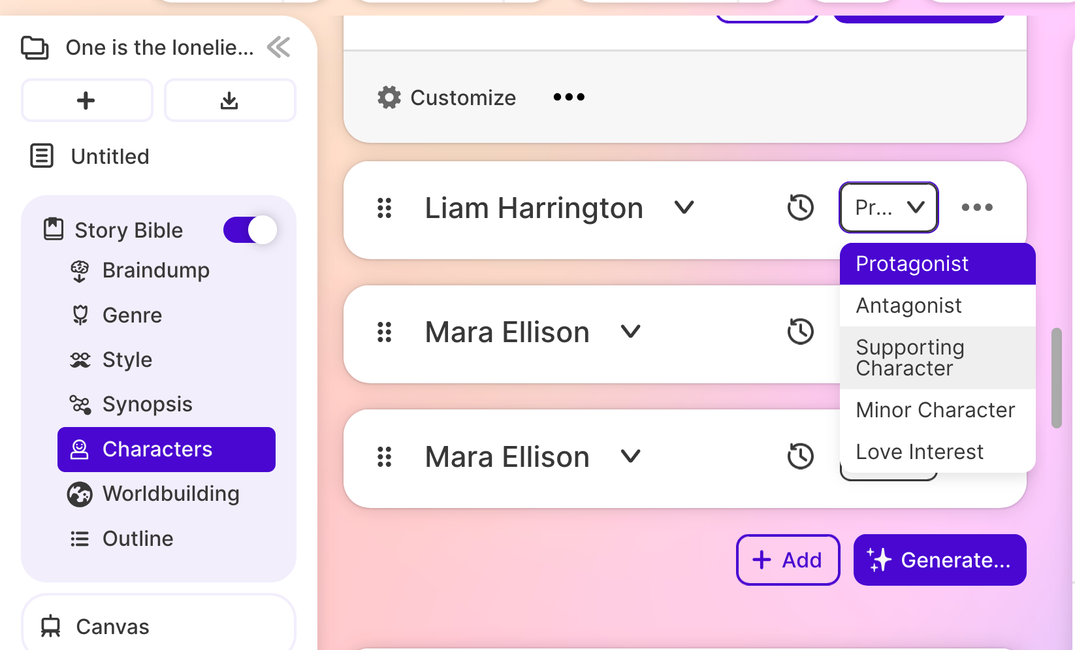
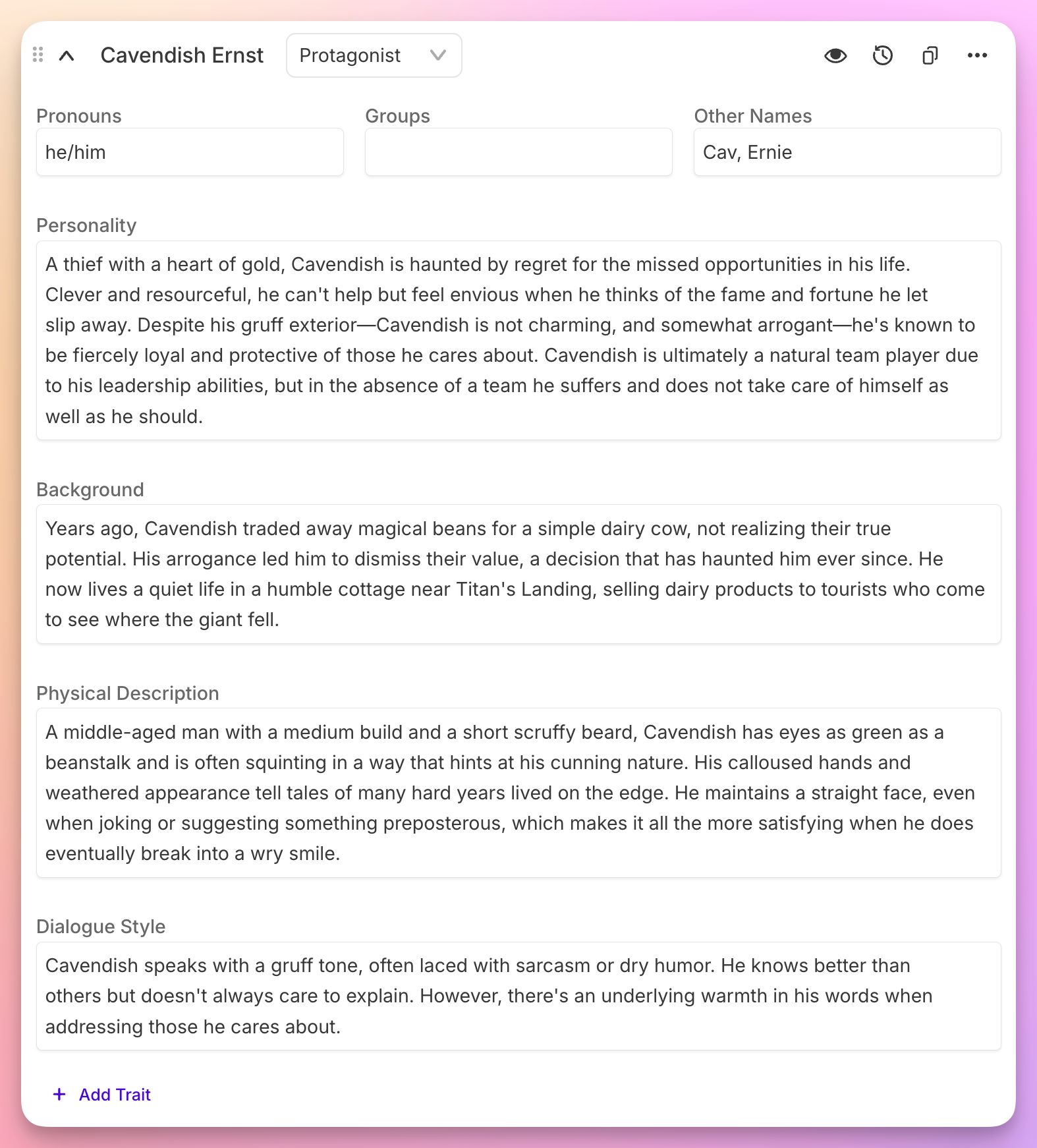
Sudowrite's Story Bible includes a Characters section where you build detailed character cards. Each card isn't just a bio — it's a set of instructions the AI follows when generating text for that character.
Character Cards: More Than a Bio
Francisco, a Sudowrite user writing literary fiction, puts it this way: "I love how it picks up on the subtle voice and phrasing of my characters." That's not accidental — it's architectural.
Each character card includes fields for personality, background, physical description, and dialogue style. When you add a dialogue sample showing how your character actually speaks, the AI uses that sample as a stylistic anchor.
The physical description field directly addresses a common criticism of AI fiction. The New York Times noted that AI-generated characters often default to generic body descriptions — "tall, dark-haired, attractive" with no specificity. Character cards solve this by letting you define exact physical details: the crooked nose from a childhood break, the callused hands, the specific shade of brown skin. The AI references these details instead of generating vague defaults.
Context That Spans Chapters
Imagine you're writing chapter eighteen. Your protagonist's estranged sister walks in. With manual methods, you'd flip back to chapter four to remember the sister's speech patterns, then check your spreadsheet for her physical tics. With Sudowrite, the Write feature pulls from a context window of up to 20,000 words across 25 linked chapters — plus the character card. The sister sounds like herself because the AI has her voice profile loaded.
Joe Vasicek, a science fiction author, saw his output increase from a book a year to a book a month after adopting this kind of AI-assisted workflow — partly because he stopped losing hours to manual consistency checks.
Build your characters free →
Getting Started: Building Your First Character Card
The problem: You've got a character in your head, but translating that into a structured profile feels like filling out a form instead of creating art.
The fix: Start with what you know, then let gaps reveal themselves. Open Sudowrite's Story Bible, create a new character, and begin with three essentials:
- Name and pronouns — Basic identification the AI uses for pronoun consistency throughout your manuscript.
- Personality in one paragraph — Not a trait list. Write how this character sees the world. "Elena trusts systems over people, orders her bookshelf by color because it annoys her roommate, and believes every problem has a spreadsheet solution" tells the AI more than "analytical, organized, stubborn."
- A dialogue sample — Paste 3–5 lines of dialogue you've already written for this character. This teaches the AI your character's rhythm better than any description could.
Once those three are in place, add physical description (be specific, for example: "scar along the left jawline" not "attractive"), background, and relationships. The card grows as your draft grows. You don't need everything on day one.
Best Practices for AI-Assisted Character Development
Show the AI, Don't Tell It
The most effective character cards include examples, not just descriptions. Writers who include 3+ dialogue samples per character report noticeably more consistent AI output than those relying on trait lists alone. The difference comes down to how language models process information — a sample of your character saying "Listen, sweetheart, I've buried better men than you" teaches tone, vocabulary, and attitude simultaneously. A trait list saying "tough, sarcastic, threatening" gives the AI permission to interpret those words however it wants.
Update Cards as Characters Evolve
Characters change. Your character card should change with them. After a major plot turning point, update the personality description. Add new dialogue samples reflecting the character's growth. A character who starts the novel timid and ends it commanding should have a card that reflects both states — with notes on when the shift occurs. This keeps AI-generated text aligned with the character's current arc position, not just their starting point.
Common Mistakes When Using AI for Characters
Picture this: you've built a detailed character card — rich personality, thorough backstory, specific physical description. Then you write a scene where two characters argue, and the AI makes both of them sound reasonable and articulate. Why? Because you didn't include conflict style in the card. Does this character shut down during arguments? Yell? Get coldly logical? Without that information, the AI defaults to balanced, articulate dialogue for everyone.
Other common missteps:
- Overstuffing the card with backstory the AI doesn't need for voice consistency
- Ignoring relationship dynamics — how Character A speaks to Character B should differ from how they speak to Character C
- Never revising the card after the first draft evolves the character beyond the original profile
Sudowrite vs. NovelCrafter vs. Manual Methods
| Feature | Sudowrite Characters | NovelCrafter Codex | Manual (Spreadsheets / Wikis) |
|---|---|---|---|
| AI-integrated character profiles | Yes | Yes | No |
| Auto-references during writing | Yes (Write feature) | Limited | No |
| Voice / dialogue samples | Yes | No (static notes) | No (static notes) |
| Cross-chapter context | Up to 25 linked chapters | Scene-level | N/A |
| Physical description enforcement | Yes (card fields) | Partial | Manual checking |
| Relationship mapping | Yes | Yes | Manual |
| Cost | Paid only | Paid only | Free |
Each tool has trade-offs. NovelCrafter offers strong worldbuilding codex features but lacks Sudowrite's dialogue-sample-driven voice consistency. Manual methods cost nothing but scale poorly past a single novel — and they never feed into the AI at generation time.
Frequently Asked Questions
Can AI character tools replace human character development skills?
No. These tools maintain consistency in execution — they don't generate compelling characters from nothing. You still design the character's psychology, contradictions, and arc. The AI remembers those decisions so you don't have to.
Do character cards work for non-fiction or memoir?
Voice profiles can maintain a consistent narrator tone in memoir, though the Character feature is designed primarily for fiction workflows with multiple distinct voices.
What happens if I change a character card mid-draft?
Future AI-generated text references the updated card. Previously written text stays as-is — you'll want to manually revise earlier chapters if the change is significant.
Related Reading
Other craft-focused Sudowrite guides:
- Story Bible Template: How to Build One with Sudowrite — the foundation every feature in this guide depends on
- How to Write a Book Series Without Losing Track — Series Folder and cross-book continuity for multi-installment projects
- Best AI Writing Tool for Series Writers — Sudowrite vs. Scrivener + ChatGPT for writers building multi-book projects
- Co-Writing with AI: How Sudowrite Helps Without Taking Over Your Voice — staying in control of your creative process as you scale with AI
Key Takeaways
- Character consistency across novel-length manuscripts requires structured profiles, not just memory
- AI character tools actively reference your profiles during text generation — unlike static character bibles
- Dialogue samples teach the AI voice patterns far more effectively than trait descriptions
- Update character cards as your characters evolve through the story's arc
- Specific physical descriptions in cards counter AI's tendency toward generic defaults
Build your characters free →