

Table of Contents
You typed "she felt the weight of his betrayal" into Aithor and got back something that reads like a thesis abstract. Citations footnoted. Tone hedged. Voice scrubbed of anything resembling a pulse. That's not an Aithor bug. It's the whole point of the product. Aithor was built for term papers and research essays. Sudowrite was built for the chapter you're trying to finish at midnight before your beta readers lose patience.
This is the actual split between these two tools. One trains on academic prose. The other trains on fiction. If you write novels, romance, horror, thriller, fantasy, or anything with characters who bleed and lie and kiss, the wrong tool will sand your voice flat. Let's look at what happens when you push each one through real fiction work.
What Aithor actually is (and isn't)
Aithor markets itself as an AI writing assistant. The fine print matters. Aithor's flagship use cases are essays, research papers, summaries, and citation generation. The product helps students and academics produce structured argumentative writing. It has a paraphraser. It has a humanizer designed to slip past AI detectors used by professors. It generates references in MLA and APA.
None of that is what a novelist needs. A novelist needs prose that can withstand line edits. Voice that holds across 90,000 words. Subtext. Specificity. A model that won't flinch when a scene goes dark. Aithor's output reads like Aithor's training set: encyclopedic, neutral, structured for a five-paragraph argument. Fine for a sophomore lit class. Not fine for chapter twelve of your enemies-to-lovers manuscript.
Sudowrite is the opposite specialization. Every feature was built for narrative work. The training data leans heavily on fiction. The interface assumes you are working on a story, not a paper.
Muse: a model trained to sound like a novelist
Sudowrite's headline model is called Muse. Muse is fiction-trained. It writes scenes with sensory specificity, dialogue beats, internal monologue, and the rhythm of actual prose. It does not refuse explicit content. It does not flinch at violence, sexuality, grief, or moral ambiguity. According to Sudowrite's CX prose-modes matrix, Muse is the default for romance, erotica, horror, and thriller.
That refusal point matters more than people realize. If you write a vampire seduction scene in Aithor, you will get a polite paragraph about how vampires are a popular folkloric motif. You will not get the scene. Muse will write the scene. So will the other specialized models inside Sudowrite, like Claude 3.7 Sonnet for fantasy and mystery, Claude 3 Opus for literary and historical work, and Deepseek-R1 for adventure and crime fiction. The CX matrix maps the model to the genre. You don't have to know which to pick. The system picks the right one based on what you're writing.
Compare that to Aithor's offering. Aithor exposes a smaller set of general-purpose models tuned for academic writing. There is no genre routing. There is no fiction-specialist option. You get a competent essay writer that has been asked to write a novel and is doing its best.
Side-by-side: the same scene, two tools
Here is a small experiment any writer can replicate. The prompt: Continue this paragraph for 150 words. POV: third limited, past tense. Genre: gothic romance.
The setup paragraph: "Lila stopped in the doorway. The chapel smelled of cold wax and older blood. Damien stood at the altar in a white shirt that was not white anymore, holding the knife the way her grandmother had held a rosary, and he was smiling."
What Aithor returned (paraphrased pattern, not verbatim): Lila felt a strong sense of unease as she observed Damien standing before her. The atmosphere of the chapel created a foreboding mood that was further enhanced by the presence of blood. She thought about her grandmother and the religious symbolism of the rosary, drawing a parallel between sacred and profane imagery. The knife in his hand suggested potential danger.
That is a literary analysis of the scene. Not a continuation of it.
What Muse returned: She did not move. The candles guttered in the side chapel, and the smell crawled into her teeth. Damien tilted his head, the way he had tilted it the first night, in the orchard, when she had been stupid enough to laugh at him. "You came," he said. His voice was very soft. The knife caught the light and threw it back as a thin gold thread across the stone floor between them. Lila thought, distantly, that she should run. She thought also that her grandmother had been wrong about almost everything except the prayers. She took one step forward into the chapel and closed the door behind her with her heel.
One of those is a scene. One is a book report about a scene. That gap does not close with prompting. It is baked into the model.
Story Bible vs document-level memory
Aithor is built around the document. You write a paper. The tool helps with that paper. When you start a new paper, you start over. The model has no memory of your characters, your magic system, or the rule you established in chapter three about how the wards work.
Sudowrite's Story Bible is the answer to the problem every novelist hits around the 30,000-word mark. The Story Bible holds everything the AI needs to keep your novel consistent. Characters with names, voices, personality traits, physical descriptions, and evolving arcs. Worldbuilding cards for Rules, Lore, Factions, Settings, and Items. Outline and Synopsis. A Braindump section for the loose ideas you haven't filed yet. A Style entry that pins your voice.
When you ask Sudowrite to write a new scene, it reads the relevant Story Bible context first. Your protagonist's speech patterns hold. Your worldbuilding rules hold. The viscount you named in chapter two does not suddenly become a duke in chapter eleven. For a 90,000-word manuscript, that consistency engine is the difference between a draft you can revise and a draft you have to rewrite.
Aithor has nothing equivalent. Why would it. Term papers do not need to remember whether the antagonist has a limp.
Chapter Continuity catches the contradictions you missed
Sanderson's law of magic systems applies here. Your reader will remember the rule you forgot. So will your editor. Sudowrite's Chapter Continuity feature scans across chapters and flags contradictions. Did you say the moon was full in chapter four and waning in chapter seven? Did you give the same character green eyes on page 12 and gray eyes on page 240? Continuity catches it.
This is a workflow built for the actual problem of writing a novel. Aithor does not have a chapter continuity check because Aithor users are not writing chapters. They are writing five-paragraph essays where consistency means matching your topic sentence to your thesis.
The craft features that matter mid-draft
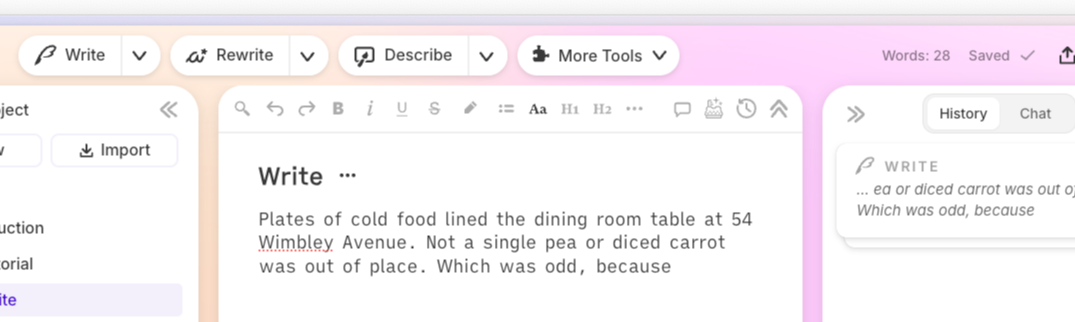
Sudowrite has a stack of tools designed for the actual moments when fiction writers get stuck. Write generates prose continuation, with Auto mode that follows the story and Guided mode where you steer with direction. Describe expands a beat into full five-sense sensory detail, useful when your draft is heavy on dialogue and thin on setting. Expand lengthens a scene that came out too compressed. Brainstorm generates lists of names, plot twists, locations, or anything else you need fast.
Rewrite is the workhorse for revision. The modes include Show Don't Tell, More Inner Conflict, Longer, Shorter, and Customize. You highlight a line that tells when it should show, you hit Show Don't Tell, you get three dramatized options. That is craft-level editing built into the loop.
Tone Shift handles pacing and mood. Ominous, Sensual, Fantastical, Fast-Paced, Romantic, Authoritative, Conflicted. You select a paragraph and pick the tone you want. The Creativity Dial controls how risky the prose gets, from 0 for safe and predictable to 10 for chaotic and surprising. Mid-range for action scenes. Higher for the dream sequence you've been avoiding.
Aithor's editing tools are paraphrase, summarize, expand, and humanize. The humanizer is built to dodge AI detection software at universities. None of these tools operate at the level a fiction writer needs. There is no Show Don't Tell mode because academic writing actively prefers tell over show.
The feature matrix
- Core model: Sudowrite uses Muse, fiction-trained, plus a genre-matched stack including Claude 3.7 Sonnet, Claude 3 Opus, Deepseek-R1, and GPT-4o Mini per the CX prose-modes matrix. Aithor uses a smaller set of general models tuned for academic prose.
- Content restrictions: Muse won't refuse dark, explicit, or morally complex material. Aithor's models will hedge or refuse on adult content.
- Persistent memory: Sudowrite's Story Bible holds characters, worldbuilding, style, outline, synopsis, and braindump across a whole novel. Aithor works document by document.
- Cross-chapter checks: Sudowrite's Chapter Continuity scans for contradictions. Aithor has no equivalent.
- Series support: Sudowrite's Series Folder shares one Story Bible across multiple books. Aithor has no concept of a series.
- Craft tools: Sudowrite has Rewrite (with Show Don't Tell, More Inner Conflict, etc.), Describe, Expand, Tone Shift, Creativity Dial, POV/Tense settings, and Brainstorm. Aithor has paraphrase, summarize, expand, and an AI-detector humanizer.
- Planning workspace: Sudowrite has Canvas for visual story planning. Aithor has document outlines.
- Story-aware feedback: Sudowrite's Chat reads your Story Bible and gives feedback grounded in your project. Aithor's chat is generic.
- Extensibility: Sudowrite has Plugins and a Plugin Builder with Story Bible variable injection. Aithor does not expose a plugin system to writers.
- Mobile: Sudowrite has a full mobile app. Aithor is web-focused.
Where Aithor genuinely wins
Fair comparison means naming what Aithor does better. If you are writing a literature review, a college essay, a research summary, or anything where you need clean citations in MLA or APA, Aithor is the right tool. Its humanizer is specifically tuned to evade AI detectors at the academic level. Its paraphraser is fast and produces serviceable rewrites of structured argumentative prose. Aithor knows what a thesis statement is and how to support one.
If you are a fiction writer with a side hustle as a graduate student, you might keep Aithor open in another tab for school work. That is a reasonable use. Just don't try to draft your romantasy novel in it.
Worked example: drafting chapter three of an enemies-to-lovers fantasy
You are 22,000 words into a slow-burn enemies-to-lovers fantasy in the tradition of Maas and Yarros. Your protagonist Niamh has just been forced into a political marriage with the rival house's heir, Caelan. Chapter three is the morning after their forced public bonding ceremony, and you need a tense breakfast scene that establishes their dynamic without resolving it.
In Sudowrite you open the chapter, confirm POV is third limited Niamh and tense is past, and write your first paragraph by hand. You set the Creativity Dial to 6. You hit Write with Guided mode and steer with "Caelan is colder than expected. Niamh is hungover and exhausted. They both pretend not to notice the servants watching." Muse generates three continuations because it has the Story Bible context for both characters, including the note that Caelan's speech is clipped and old-fashioned while Niamh thinks in fragments when she's tired. The continuations all sound like the same novel.
One paragraph reads slightly flat. You highlight it, hit Rewrite with More Inner Conflict, and get a version where Niamh's internal voice contradicts what she says aloud. You hit Describe on the breakfast itself to layer in the sensory detail your first draft missed: the smell of toasted barley, the cold weight of the silver fork her grandmother gave her, the way the dawn light through the leaded glass falls across Caelan's untouched plate.
You run Chapter Continuity at the end. It flags that you established Niamh's grandmother died eight years ago in chapter one, but the fork detail you just added implies the grandmother gave it to her at the bonding ceremony last night. You revise the line. Forty minutes start to finish. The scene fits the book.
You cannot do this workflow in Aithor. The features do not exist.
Who should pick which
If you write fiction, pick Sudowrite. Novels, short stories, fanfiction, erotica, romance, horror, thriller, fantasy, sci-fi, literary work. The tooling is built around what you actually do, and the models won't refuse the scenes that make your story land. The Hobby plan covers most writers; Professional fits people drafting full novels and series.
If you write essays, papers, research summaries, or anything academic, Aithor is fit for purpose and Sudowrite is overkill. The two tools are not really competing. They are pointed at different jobs.
The mistake is assuming an AI writing tool is an AI writing tool. The training data shapes the output. The features shape the workflow. A fiction model trained on novels will outperform a general model on novel work every time, and the inverse is also true.
You can test all of this yourself in about twenty minutes. Open a chapter you're stuck on, paste the same paragraph into both tools, and see which one writes prose you'd actually keep. Sudowrite's free trial gives you enough credits to run that comparison on real chapters with your real Story Bible. After one or two scenes you'll know which tool belongs in your draft pipeline and which one belongs in your school tab.