

Table of Contents
Noir lives in the gap between what your detective sees and what he's willing to admit. A rain-slick alley at 2 a.m. isn't atmosphere. It's a confession he hasn't made yet. Most AI writing tools flatten that gap into purple prose or generic crime beats, but the genre actually rewards a specific toolkit: hardboiled voice patterns, oppressive sensory work, and the patience to plant a clue in chapter two that doesn't pay off until chapter eighteen.
Sudowrite handles noir differently than it handles, say, cozy mystery or epic fantasy. Different models. Different settings. Different muscles. Here's how to actually write a Chandler-flavored detective novel without your AI partner turning your gumshoe into a motivational speaker.
Why noir breaks most AI writing tools
Noir is a voice genre first and a plot genre second. Strip the voice and you've got a procedural. Keep the voice and you can almost get away with a thin mystery, the way Chandler did when he stitched short stories into novels and stopped caring who killed the chauffeur in The Big Sleep.
The voice has rules. Short declarative sentences punctuated by one long, weary, observational sentence that pretends to be casual but isn't. Similes that double as character judgment. Metaphors that come from the street, not the library. A first-person narrator who lies to himself in the same paragraph he lies to the cops. An attitude that's tired without being whiny, cynical without being smug.
Most AI tools default to a polished, slightly cheerful third-person that reads like a magazine feature. That's the opposite of noir. You have to actively pull the prose toward grit, and you have to do it at the system level, not after the fact. That means picking the right model, building Style cards that teach the AI what hardboiled actually sounds like, and using Tone Shift to keep the mood from drifting into something brighter every time you ask for new prose.
Pick the right model for the job
Sudowrite's prose modes matrix maps genres to the models that handle them best, and noir detective work is a mystery-adjacent crime hybrid. That puts two engines at the top of the list.
- Claude 3.7 Sonnet for the mystery scaffolding. It tracks clues, keeps your suspect list coherent across chapters, and writes interrogation scenes with subtext. When you need a witness who's hiding something specific, this is the model that remembers what they're hiding by the time you draft chapter twelve.
- Deepseek-R1 for crime drafting. Faster, looser, and less polite. Good for the violent middle of a chapter where your detective gets pistol-whipped in a parking garage. It handles ugly moments without softening them into something more palatable.
You can switch between them mid-project. Use Claude 3.7 Sonnet for the slow-burn dialogue scenes where information leaks out sideways. Switch to Deepseek-R1 when somebody pulls a gun. The Creativity Dial matters too. Set it around 5 to 6 for noir. Lower and the prose gets safe. Higher and the metaphors start tripping over themselves, which is its own kind of failure mode.
If you're writing erotic noir, the kind James Ellroy slid into when his characters got desperate, switch to Muse. Muse is Sudowrite's fiction-trained model that won't refuse the dark or explicit material the genre sometimes demands. A scene where your detective sleeps with a witness he shouldn't trust doesn't need to be sanitized into innuendo.
Build Style cards that teach the AI hardboiled voice
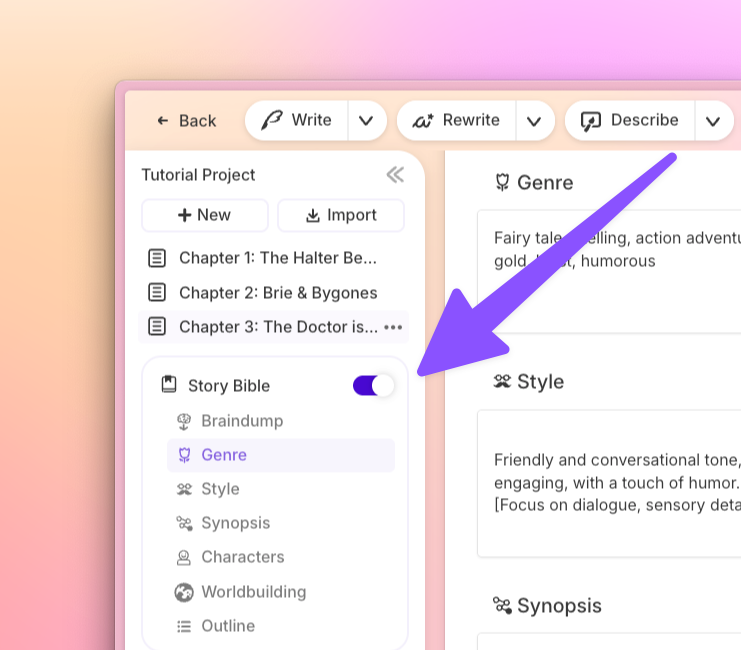
Style cards live in the Story Bible under Style. This is where you teach the model what your prose sounds like before it ever writes a sentence on your behalf. For noir, don't write abstract descriptors. Don't write "hardboiled, cynical, atmospheric." That's marketing copy. Write examples.
Drop in two or three short passages that nail the voice you want. Chandler's opening to The Big Sleep. Hammett's first paragraph in The Maltese Falcon. Maybe a paragraph of your own that hits the mark. The model reads these as targets, not as quotes to imitate, and the prose it generates starts pulling toward that register.
A working Style card for a Chandler-adjacent voice might include:
- A passage where weather does emotional work. Rain that means something. Sun that feels like an accusation.
- A passage with a metaphor that lands hard. "Dead men are heavier than broken hearts." That kind of weight.
- A passage of dialogue where two people lie to each other politely and both know it.
- A note on rhythm. Short sentence. Short sentence. Then a long one that earns its length by carrying an observation nobody else would make.
Skip the adjective dumps. "Gritty, dark, atmospheric, noir-influenced, hardboiled, cynical" is what you'd put on a query letter. It's not what teaches a model anything. Show it. Don't list it.
Use Tone Shift (Ominous) to keep the mood from drifting
Noir's mood is a slow tightening. Even when nothing is happening, something is about to. The lamp in the office is too bright. The phone rings once and stops. The secretary keeps her purse on her lap when she sits down.
Tone Shift handles this directly. Set it to Ominous and the AI starts seeding small dread into every scene. A description of a hallway becomes a description of a hallway that's wrong somehow. A handshake gets a beat of hesitation before it lands. You don't have to write "menacing" anywhere. The mood does the work.
Tone Shift also has a Conflicted setting, which is useful when your detective has to make a choice he doesn't want to make. Use Ominous for the world and Conflicted for the protagonist. Together they generate the specific noir feeling of being squeezed from two sides at once.
Don't leave Tone Shift on Ominous for every scene. The genre needs a few moments of relief or the dread stops registering. A scene at a diner where two cops eat pie and complain about their wives is noir too. It's just the kind that breathes. Drop Tone Shift back to default for those beats and let the contrast do the work.
Describe the city like a witness who's seen too much
Urban grit is half the genre. The city is a character. It has moods. It has bad neighborhoods and worse ones. It rains in a way that suggests something larger than weather. Describe is Sudowrite's 5-sense sensory expansion tool, and for noir, it earns its keep.
Take a thin sentence. "The bar was nearly empty." Run Describe and you'll get sight, sound, smell, touch, and taste expansions. For noir you don't need all five every time, but you do need at least three. The smell of stale beer and old cigarettes. The cough of a busted neon sign. The greasy feel of the bar top under your forearms. That's where the genre lives, in the texture nobody else writes about because nobody else stayed long enough to notice.
One craft note. Push Describe outputs through a quick rewrite to remove the words noir doesn't want. Strip anything that sounds like a brochure. "Inviting, charming, cozy, warm" all get cut. Keep "rancid, peeling, sweating, flickering." The vocabulary you allow yourself is the genre's first line of defense.
A working walkthrough: drafting the first chapter
Say you're opening a novel called The Last Honest Bookie. Your detective is Frank Sallis. Forty-eight, half a kidney short, two ex-wives, a habit of being right about the wrong things. The setup: a bookie named Eddie Mott has skipped town with twelve thousand of the wrong man's money, and Frank gets hired to find him before somebody worse does.
Step one is the Story Bible. In Characters, build Frank with specifics. Not "cynical detective." Voice notes: he uses "kid" when he's annoyed, "friend" when he's about to lie. He drinks rye, not bourbon, and he has opinions about why. He's afraid of dogs. He doesn't know he's afraid of dogs.
In Worldbuilding, build the city. Call it St. Albans. A river town that used to make steel and now mostly makes excuses. Three neighborhoods with their own rules. The cops are split between two old-money families who hate each other. Eddie Mott's bookie operation runs out of a laundromat on Ninth Street that hasn't washed a shirt since 1987.
In Style, drop in your Chandler and Hammett passages plus one paragraph of the voice you're trying to write yourself. In Synopsis, lay out the spine of the case. In Outline, the chapter beats.
Now you draft. Start with a thin paragraph in Write using Guided mode. Tell it: "Frank arrives at Eddie's laundromat at 4 a.m. The place is locked. Something is wrong." Set Creativity Dial to 5. Tone Shift to Ominous. Model to Claude 3.7 Sonnet.
What you might get back, after a generation or two:
"Eddie's place was dark in the way only an empty place gets dark, which is to say it was the kind of dark that had decided to mean something. The neon was off. The neon was always on. I stood across the street under an awning that smelled like wet rope and watched the door for ten minutes before I crossed. Nobody came in. Nobody went out. Nobody was supposed to be there anyway, but Eddie always was. That was the first thing wrong, and it wasn't going to be the last."
Run a Describe pass on the laundromat exterior. Strip the cozy adjectives. Keep the sour ones. Run a Rewrite on Frank's internal voice with the More Inner Conflict mode to push his second-guessing harder. By the end of a session you've got a draft of chapter one that sounds like you wrote it on a bad night with a good idea.
The long con: planting clues that pay off in chapter eighteen
Noir plots run long. A good one plants a detail in the opening that doesn't matter for two hundred pages. The lipstick on the cocktail glass. The chauffeur's missing finger. The phone call the secretary doesn't mention.
This is where Story Bible earns its rent. Every clue you plant goes into Characters or Worldbuilding or the relevant card. When you write chapter eighteen and your detective realizes the lipstick was the wrong shade for the victim's mother, the AI knows. It's not guessing. It's reading the same notes you wrote in week one.
Chapter Continuity is the other half of this. Run it after a draft session and it flags contradictions across chapters. The car that was a Buick in chapter four became a Chrysler in chapter twelve. The witness who said she was at her sister's became someone who said she was at her aunt's. Noir lives or dies on these details, and Chapter Continuity catches them before a reader does.
For longer series work, the Series Folder shares your Story Bible across multiple books. If Frank Sallis comes back for a second case in The Saint of Hollow Streets, his voice notes, his ex-wives, his half-kidney, and the rules of St. Albans all carry over. The model doesn't relearn your detective. He's already there.
Noir conventions worth honoring (and the ones worth breaking)
Genre conventions exist because they work. Break them on purpose, not by accident. A quick checklist of what noir detective fiction generally promises a reader:
- A morally compromised protagonist. Not evil. Just damaged in a specific way that makes him good at his job and bad at the rest of his life.
- A femme fatale or a fatale stand-in. Doesn't have to be a woman. Has to be someone the detective wants to believe and shouldn't.
- A case that's bigger than it looks. The missing dog leads to the missing wife leads to the missing senator.
- A city that matters. Not a backdrop. A character with weather and politics and a smell.
- A betrayal in the third act. Usually by a friend. Sometimes by the client.
- An ending that doesn't restore order. The case closes. The world doesn't get better. The detective is more tired.
Use these as load-bearing beams, not as a coloring book. Modern readers have read Chandler and Hammett and Ellroy and Megan Abbott. They've seen the femme fatale a hundred times. Build the convention and then twist it. The witness who plays the fatale is actually the most honest person in the book. The corrupt cop is the one telling the truth. The case isn't bigger. It's exactly the size it looks, and that's what's tragic.
The Brainstorm tool is useful here. Ask it for "twists on the femme fatale archetype" or "ways a noir case can be smaller than expected and still feel devastating." You'll get a list. Most won't fit. Two will spark something.
POV, tense, and the first-person trap
Most noir detective fiction is first-person past. "I walked into the office." "I knew she was lying before she opened her mouth." Sudowrite's POV/Tense settings let you lock this in at the chapter level so the AI doesn't drift into third-person omniscient halfway through a draft, which it will if you let it.
First-person present works for some modern noir. Megan Abbott uses it. So does Don Winslow in places. It's harder to sustain over a novel because it removes the retrospective wisdom of the older detective looking back. But it's tighter, more anxious, and worth trying for a short story or a novella.
Third-person noir exists too. Ellroy's L.A. Confidential and the Underworld USA trilogy. The voice gets even tighter in his hands, almost telegraphic. If you go third, build Style cards that capture that compression. Short. Sentence. Fragments. Verb-led. Adjective-starved.
Where the genre is now, and where you fit
Noir hasn't gone anywhere. It moved. Tana French wrote noir as Dublin police procedural. S.A. Cosby writes it as rural Virginia revenge. Steph Cha put a Korean American detective in modern Los Angeles. The bones of the genre carry across settings, cultures, and decades because the bones are about how people lie to themselves while looking for the truth in someone else.
Your job, if you're writing it now, is to bring a city nobody else has written and a voice that earns its own tired observations. The tools handle the mechanics. The Style cards hold the voice. Tone Shift keeps the mood. Chapter Continuity catches the contradictions. The model writes prose that doesn't smell like a brochure.
What you bring is the specific bruise. The reason your detective can't sleep. The neighborhood he won't drive through. The name he won't say out loud. Sudowrite is free to try, and a first chapter of The Last Honest Bookie, or whatever yours turns out to be called, takes about an evening. The rain in St. Albans is already waiting.