

Table of Contents
Twelve POV characters across four books. One of them is a thirteen-year-old assassin. Another is a sixty-year-old siege engineer with a stutter. By chapter forty of book two, you can't remember whether the assassin has met the engineer yet, and your beta reader just pointed out that both characters use the phrase "by the gods" in nearly identical ways. This is the structural nightmare of epic fantasy, and it's the exact problem Sudowrite's POV system and Series Folder were built to solve.
Multi-POV epic fantasy is the hardest structural challenge in fiction. Not the hardest prose challenge (literary fiction wins that one). Not the hardest emotional challenge either. But structurally? Nothing else asks you to maintain a dozen distinct voices, track interlocking timelines across a continent, and remember which character poisoned which prince in book one when you're three years deep into book three.
Why multi-POV epic fantasy breaks most writing tools
General-purpose AI tools fail at epic fantasy for predictable reasons. They lose track of who knows what. They homogenize voice so every character sounds like the same mildly verbose narrator. They forget that your dwarven artificer would never say "vibes" and that your half-elven ranger speaks in clipped sentences.
The problems compound across a saga. A standalone novel might juggle three POVs across 90,000 words. An epic series tracks eight to fifteen POVs across 400,000 to 1.2 million words. Each character needs to evolve while staying recognizable.
George R. R. Martin manages this with index cards and a famously chaotic process. Brandon Sanderson does it with a wiki his assistants maintain. Joe Abercrombie keeps everything in his head and his notebooks, which he openly admits causes problems.
You probably don't have an assistant or Martin's decade-per-book schedule. You need a system that holds continuity for you, generates prose that sounds like the character whose head you're inside, and catches the moment two characters share an idiom.
The POV and Tense system: per-chapter control
Sudowrite's POV and Tense settings work at the chapter level, not the project level. This matters more than it sounds. Most multi-POV epics rotate viewpoint by chapter: Daenerys in first person past, Tyrion in third limited past, Bran in third limited present for a vision sequence.
You set POV and Tense per chapter in the chapter settings. The system steers every generation toward those constraints. Draft Tyrion's chapter with the Write tool and the output stays in third limited past with access to Tyrion's interiority and only Tyrion's. Switch to Bran's present-tense vision chapter and the prose comes out present tense automatically.
This sounds small. It is not small. Multi-POV writers spend an embarrassing percentage of their drafting time fixing tense slips and POV violations. When your tool enforces the constraint at the chapter level, those slips stop happening upstream.
Common POV configurations for epic fantasy
- Sanderson-style limited third, past tense, rotating: Each chapter is a single POV in third limited. The Stormlight Archive uses this with five core POVs plus rotating interludes.
- GRRM-style limited third, past tense, named chapters: Each chapter is titled with the POV character. A Song of Ice and Fire uses this across eight to thirteen POVs per book.
- Abercrombie-style limited third with occasional close third hopping: The First Law trilogy stays in third limited but allows brief shifts within battle scenes.
- First-person multi-POV: Robin Hobb's Liveship Traders, Maas's later Crescent City books. Riskier because voice has to do more work to distinguish characters.
The POV and Tense system supports all of these. You configure each chapter once and the constraint persists.
Characters cards: where voice lives
Voice separates great multi-POV fantasy from competent. Sanderson's Kaladin sounds nothing like Shallan, who sounds nothing like Dalinar. Different sentence rhythms, different vocabularies, different ways of evading uncomfortable truths. A reader picking up a Stormlight chapter at random should know within three paragraphs which POV they're in.
Sudowrite's Characters cards, part of the Story Bible, are where you encode this. Each character gets a card. The card holds voice notes, personality traits, speech patterns, vocabulary preferences, and evolving traits across chapters and books. When you generate prose, the model pulls from that character's card.
For a multi-POV epic, your Characters cards should be heavier than for a single-POV novel. Working examples:
- Voice notes: "Sentences run short when angry, long and looping when philosophical. Avoids contractions in formal settings. Uses 'aye' instead of 'yes' only with family. Never swears in front of his mother, even in interior thought."
- Vocabulary preferences: "Military terminology comes naturally. Court etiquette terms feel stiff and foreign. Knows three words of Old Tongue and overuses them when nervous."
- Internal cadence: "Thinks in questions. Doubts every decision twice before acting. Self-deprecating humor when scared."
- Evolving traits: "Books 1-2: bitter. Book 3: numb after Sera's death. Book 4: dangerously optimistic for reasons he can't articulate."
The evolving traits field is the killer feature for series work. Your assassin at thirteen does not think or speak the way she does at twenty-six. Update her card per book or per arc, and the model uses the version appropriate to the chapter.
Claude 3.7 Sonnet: the right model for fantasy prose
Sudowrite uses different models for different subgenres. The CX prose-modes matrix maps each genre to the model that handles it best. For epic fantasy, mystery, and YA, that's Claude 3.7 Sonnet.
Why Sonnet for epic fantasy? It handles long-form coherence. It maintains character voice across long generations without homogenizing. It matches register, so a council scene with formal court language doesn't slip into modern idiom. And it produces clean third-limited prose that doesn't lean too purple, which matters in a subgenre where every other book threatens to over-describe its own breakfast.
For a romance subplot, switch to Muse for those chapters. Muse is Sudowrite's fiction-trained model that won't refuse explicit content and writes like a novelist. If your court intrigue book has a slow-burn romance that turns explicit in book three, draft those scenes with Muse and the political chapters with Sonnet.
When to override the default
The CX matrix is a starting point. You can override it. Some epic fantasy reads more literary than commercial and benefits from Claude 3 Opus, the matrix's pick for literary, historical, and sci-fi work.
Writing in the Guy Gavriel Kay register, where the prose does as much work as the plot? Try Opus on a chapter and compare. For grittier, plot-forward fantasy in the Abercrombie or Lawrence vein, Deepseek-R1 (the adventure and crime default) can produce sharper action prose.
Series Folder: the shared brain
Series Folder is a shared Story Bible across multiple books. This is the feature that makes a saga manageable.
Without shared continuity, every book is its own project. You copy Characters cards manually. You re-enter Worldbuilding cards. When you update a character in book three (say, the assassin gets a new scar and a new alias), you have to back-port that change to your reference docs for book four.
With Series Folder, you maintain one Story Bible that all books pull from. Update the assassin's card once and both book three and your book four draft reflect the change. Add a new faction while drafting book two and it's available when you start book three.
This solves the most common series-killing problem: contradictions you forgot you wrote. Did Lord Castan have green eyes or grey? Did the Mage Wars end seven hundred years ago or twelve hundred? Series Folder holds the canonical answer.
Chapter Continuity: catching the contradictions
Chapter Continuity is Sudowrite's cross-chapter consistency check. It scans your draft against your Story Bible and earlier chapters and flags contradictions.
For multi-POV epic fantasy, you'll run it often. The kinds of issues it catches:
- A character is in two places in the same chronological window.
- A character knows information they shouldn't have learned yet.
- A magical rule established in book one gets violated in book three.
- A character's stated age in chapter twelve doesn't match the timeline from chapter three.
- Two characters use a phrase or idiom that should be specific to one.
That last category is the silent killer. You spend a year drafting, your tired brain reaches for the same colorful expression twice (once for your soldier, once for your priestess), and the reader notices. Chapter Continuity catches it first.
A walkthrough: starting a Sanderson-scale epic
Here's how you'd set this up. Say you're starting a five-book epic with seven core POVs and three rotating interlude POVs.
Step one: Series Folder. Create the series before you create book one. This is non-obvious but critical. You want every book to feed from the shared Story Bible from day one.
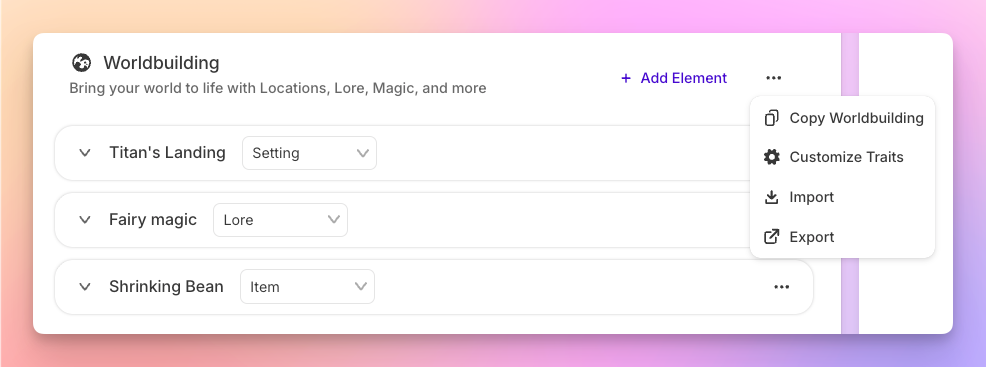
Step two: Worldbuilding cards. Before drafting a word, write cards for your Factions (the Stone Order, the Mercantile Houses, the Veiled Council), Settings (the capital, the border keep, the underground market), Rules (how magic works, what it costs), and Lore (the Mage Wars, the Sundering, the prophecy nobody believes). You don't need every detail. You need enough texture for the model to pull from.
Step three: Characters cards. Build cards for all seven core POVs first with heavy voice notes. Sketch lighter cards for the rotating interludes. Write at least one paragraph in each POV's voice in the card as a reference sample. The model will pattern-match against it.
Step four: Outline. Use the Outline section of the Story Bible to lay out book one. For Sanderson-scale work, this is often a beat sheet at the chapter level, with each chapter marked by POV.
Step five: Per-chapter setup. Set the POV character and tense for each chapter. Default to past tense unless you have a reason to break it. Assign Claude 3.7 Sonnet as the prose model. Note any override (Muse for explicit romance scenes in book three, Opus for the literary flashback in book one).
Step six: Draft. Write chapter one using Write (Guided mode is your friend for the opening). The model pulls from the POV character's card, your Worldbuilding cards, your Outline, and the chapter's POV/Tense settings. The prose comes out sounding like your character, in the right tense.
Step seven: Run Chapter Continuity. After each chapter, run the check. Fix any flagged contradictions before they ossify into the manuscript.
Voice differentiation in practice: a before and after
Here's what voice differentiation looks like when the Characters cards are doing their job.
Generic AI-generated paragraph (no character card):
Karis walked through the marketplace, taking in the various sights and sounds. The smell of spices filled the air. She thought about her mission and felt determined to succeed. The vendors called out their wares as she passed.
This is competent. It is also nothing. Any character could be having this experience.
Karis with a populated Characters card (former temple acolyte, observant, distrustful of crowds, thinks in religious metaphor):
The marketplace was a kind of profanity. Karis kept to the edges. Cinnamon and old fat and something burning that shouldn't be burning. She counted vendors the way she used to count prayer beads, one through forty, starting again at forty-one because the discipline of starting again was the discipline. The mission. Yes. The mission was still there, waiting.
Same scene. Different person in it. The Characters card produced sentence rhythm changes (the fragments, the trailing "Yes."), specific sensory detail filtered through her history (counting like prayer beads), and a worldview (the marketplace as profanity).
Now imagine the next chapter is from Branner's POV, a forty-year-old former soldier who thinks in tactical terms. His Characters card produces prose that scans the marketplace for exits, sightlines, and threat vectors. Same marketplace, different brain. The reader feels the shift in three sentences.
Managing arc evolution across the saga
Characters change across a saga. The thirteen-year-old assassin in book one is twenty-six by book five. Her voice has to evolve. Her vocabulary expands. Her certainties decay.
Use the evolving traits field in her Characters card. Update it per book or per major arc point:
- Book 1 (age 13): Short sentences. Direct. Trusts her handler completely. No interiority about the violence.
- Book 2 (age 16): Beginning to question. Asks more questions in dialogue than she answers. First flickers of moral interiority.
- Book 3 (age 19): Defected. Voice carries new uncertainty. Vocabulary picks up scholar-class terms from her months in the Library.
- Book 4 (age 23): Hardened in a different shape than the one she was forged into. Religious metaphor returns, ironic now.
- Book 5 (age 26): Quiet. Most of her sentences end in periods, never exclamation points. She has stopped explaining herself.
When you draft a chapter in book three, the model uses the book three notes. When you draft book five, it uses book five. Readers feel growth not because you tell them she has grown, but because her sentences are different shapes now.
Where Canvas and Plugins fit
Canvas is Sudowrite's visual story planning workspace. For a multi-POV saga, lay out your interlocking timelines, character meeting points, and political map. For overlapping arcs, it beats a spreadsheet.
The Plugin Builder lets you create custom plugins with Story Bible variable injection. Want a continuity check that runs your specific magic system rules? Build one. Most writers don't need this on day one. By book three, it matters.
The free-trial reality check
The honest test of any tool for epic fantasy is whether it survives a chapter draft of a real multi-POV scene without producing beige prose for every character. Set up two POV characters with proper Characters cards. Draft a scene from each, on the same fictional event, using Write with Claude 3.7 Sonnet.
Compare the prose. If your two characters sound different on the page, you have your answer. Try Sudowrite free and run the test on your own POVs before you commit.