

Sudowrite is the AI writing tool with its own fiction-trained model, Muse, and a Story Bible the model reads while it drafts, from $10 a month billed annually. The five tools writers most often consider instead are Novelcrafter, NovelAI, Squibler, ChatGPT and Claude. This page compares all six on price, memory, structure tools and adult fiction, and says where each alternative wins. We make Sudowrite. Prices are as of October 2026 and link to each company's own page.
TL;DR: Sudowrite is the only one of the six that combines a fiction-trained model, a Story Bible the AI reads on every generation, and planning and revision tools that work without prompts. Novelcrafter is the pick if you'd rather bring your own API key and plan in detail. NovelAI is the pick for unlimited generation at a flat $10 to $25 a month with no outlining tools. Squibler drafts a whole book from a premise. ChatGPT and Claude suit occasional help and refuse adult scenes.
The Five Alternatives at a Glance
| Tool | Price | AI included? | Remembers your book? | Outlining tools | Adult fiction | Best for |
|---|---|---|---|---|---|---|
| Novelcrafter | $4 to $20 a month | No. Bring your own key and pay the AI provider separately | Yes, through the Codex | Strong | Depends on the model you connect | Plotters who want control and already pay for an API |
| NovelAI | $10, $15 or $25 a month, no annual discount | Yes, its own models, unlimited text | Yes, through the Lorebook | None | Yes | Pantsers and worldbuilders who want a flat fee |
| Squibler | Free tier, then $15.83 a month billed annually ($29.99 monthly) | Yes, on credits | Partly | Yes, book and screenplay templates | Limited | Writers who want a full manuscript generated from a premise |
| ChatGPT | Plus is $20 a month | Yes | Only what fits in the conversation | None built for fiction | Refuses explicit scenes | Research, brainstorming, the odd paragraph |
| Claude | Pro is $20 a month ($17 annually) | Yes | Only what fits in the conversation | None built for fiction | Refuses explicit scenes | Long-document feedback and line edits |
| Sudowrite | $10, $22 or $44 a month billed annually | Yes, Muse plus 20+ other models | Yes, Story Bible and Series Folder, read by the AI while drafting | Yes, Canvas and Outline | Yes, Muse doesn't refuse | Novelists who want the model to know the book |
What Sudowrite Still Does That These Don't
Three things, and they're the reasons 33,000+ authors use it. The sections after this one cover each alternative and where it wins.
- A model trained for fiction that doesn't refuse. Muse is Sudowrite's own model, built for prose rather than emails, and it writes the romance, horror and explicit scenes general models decline.
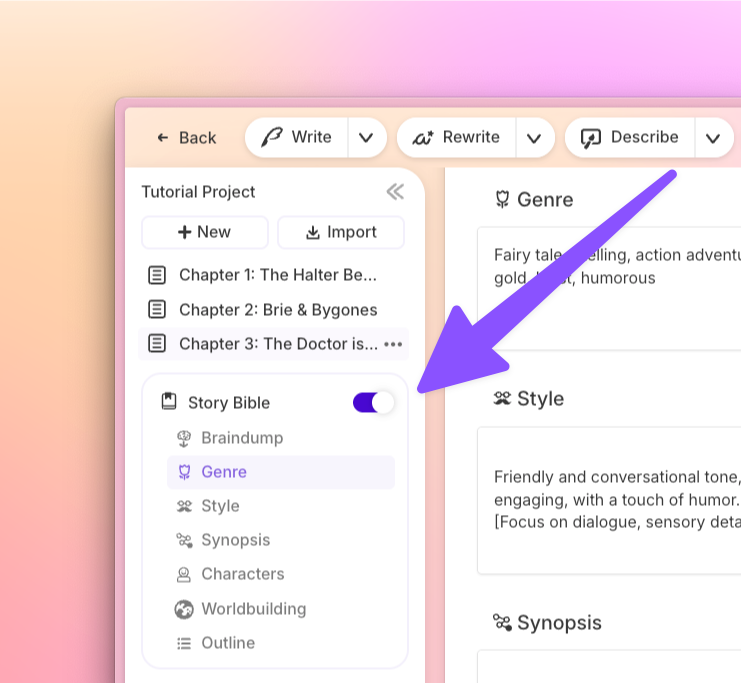
- A Story Bible the AI reads while it drafts. Characters, worldbuilding, outline and style travel into every scene, and the Series Folder carries them across books. Novelcrafter's Codex and NovelAI's Lorebook store your notes. Story Bible is read by the model on every generation, with up to 25 linked chapters behind it.
- No prompt engineering. Write, Rewrite, Describe, Expand and Brainstorm are buttons, not prompts. If you'd rather talk to the model, Chat is free on every plan and sees your whole Story Bible.
Every plan includes every feature. Plans start at $10 a month billed annually, and the free trial needs no card. If you want to see the prose before you decide, the free story generator runs on the same model.
Novelcrafter
Novelcrafter is a planning and drafting workspace that connects to an AI model you pay for separately. Plans run from $4 a month (Scribe, no AI) through $8 (Hobbyist), $14 (Artisan) and $20 (Specialist). Every AI plan is bring your own key, so the subscription buys the workspace and your OpenAI, Anthropic or OpenRouter bill buys the words. The trial is 21 days with no card.
Where it wins: control. The Codex holds characters, places and lore. Scene beats, chapter structure and series management are built in, and you choose the model for every call. If you already think in outlines and spreadsheets, it will feel like home.
Where it loses: there's no fiction-trained model of its own, so prose quality is whatever your connected model produces, and the setup takes an afternoon. Our full Sudowrite vs Novelcrafter comparison goes section by section.
NovelAI
NovelAI sells unlimited text generation from its own models for a flat monthly fee. Tablet is $10, Scroll is $15 and Opus is $25, and there's no annual discount. The tiers differ in how much of your story the model keeps in memory and in image generation allowances.
Where it wins: no credit meter, no refusals, and a Lorebook that can hold a very large world with keyword-triggered entries. Writers who generate tens of thousands of words a week and want to pay one price should look here first.
Where it loses: there are no outlining, plotting or revision tools. The interface is a text box and a wall of settings, and the quality of what comes out depends on how well you learn them. Our Sudowrite vs NovelAI comparison covers the trade-off in detail.
Squibler
Squibler generates whole books and screenplays from a premise, on a credit system. There's a free tier with 1,000 credits a month, Plus at $15.83 a month billed annually ($29.99 monthly) with 10,000 credits, and Pro at $49.17 a month billed annually with unlimited credits.
Where it wins: speed from idea to full manuscript, and screenplay formatting out of the box.
Where it loses: the drafting is more automatic than collaborative, so the voice is Squibler's unless you rewrite heavily, and it's a general model underneath. Our Sudowrite vs Squibler piece has the side-by-side.
ChatGPT
ChatGPT is a general assistant that can write fiction when you prompt it, for $20 a month on Plus. It's useful for research, for talking through a plot problem, and for a paragraph when you're stuck.
Where it loses for novelists: it remembers only what fits in the conversation, so by chapter twelve it has forgotten chapter two unless you paste it back in. It refuses explicit scenes. And it has no sense of your manuscript as a document, so every session starts cold. We wrote up how to write a book with ChatGPT and where it breaks.
Claude
Claude is the general assistant most novelists prefer for feedback, at $20 a month on Pro or $17 billed annually. It handles long documents well and gives useful line-level notes.
Where it loses: the same two things as ChatGPT. It refuses adult scenes, and it doesn't carry your story between sessions. Several writers use Claude for feedback and Sudowrite for drafting, which is why Claude models are also available inside Sudowrite's experimental panel. Our Sudowrite vs Claude comparison and can Claude write NSFW cover both points.
If You're Leaving Sudowrite Because...
- The credits ran out: NovelAI's flat rate removes the meter. Inside Sudowrite, the Max plan rolls unused credits over for 12 months.
- You'd rather pay the AI provider directly: Novelcrafter.
- You want more control over the model and its settings: Novelcrafter or NovelAI, in that order.
- You want a whole draft generated with little input: Squibler.
- You only need help now and then: Claude or ChatGPT.
Frequently Asked Questions
What is the best free alternative to Sudowrite?
ChatGPT's free tier for occasional help, or Squibler's free plan with 1,000 credits a month if you want to test book generation. Neither remembers your manuscript between sessions. Sudowrite's own free trial needs no card.
What is the cheapest Sudowrite alternative?
Novelcrafter's Hobbyist plan at $8 a month, plus whatever your API usage costs. NovelAI's Tablet at $10 is the cheapest all-in price with unlimited text.
Which alternative is best for adult fiction?
NovelAI, which doesn't refuse and has no meter. Sudowrite's Muse doesn't refuse either. ChatGPT and Claude do.
Can I use Claude or ChatGPT inside Sudowrite?
Yes. Sudowrite's experimental panel includes Claude, GPT, Gemini, DeepSeek and more than 20 models in total, alongside Muse.
Does Sudowrite own my writing?
No. You own everything you write, and Sudowrite doesn't train on it.