

Table of Contents
A romance author publishing six books a year cannot afford to fight her AI tool. She needs prose that does not fade to black when the bedroom door opens, a memory system that remembers her hero's scar from book two, and a draft engine fast enough to keep her release schedule on Amazon's 30-day cliff. ChatGPT keeps refusing the spicy scenes. Sudowrite does not.
That is the short version of why indie romance has become one of Sudowrite's most loyal genres. The long version involves Muse, Series Folder, the Story Bible, and a small mountain of trope consistency that romance readers will absolutely notice if you mess it up.
The indie romance machine runs on volume
Indie romance is not a hobby market. It is the largest fiction category on Amazon by a wide margin, and the authors who win it publish on a rhythm that would make a traditional publisher faint. Four to twelve books a year is normal. Mailing lists drive launches. Kindle Unlimited page reads pay the bills. A romance author with a five-book series and a Bookbub feature can clear a year's salary in a week.
That speed creates a specific stack of problems. You need to write fast without writing slop. You need continuity across a series because your readers will email you about a side character's eye color changing in chapter eleven. You need open-door scenes that actually deliver, because your reviews depend on it. And you need a tool that does not lecture you about content guidelines when you ask it to write a morally gray duke who ruins a governess in a study.
ChatGPT can do many things. Those four things, all at once, are not its strengths. Sudowrite was built for fiction first, and the difference shows up in places that matter to working romance authors.
Muse writes through the scene instead of fading to black
The single most common complaint from romance authors who try ChatGPT is the refusal. You set up two characters with chemistry. You write 4,000 words of slow-burn tension. You hit the moment where she finally pulls him into the alcove behind the ballroom. And the model writes "they shared a passionate moment" before pivoting to morning light streaming through the windows.
Romance readers do not want morning light. They want the alcove.
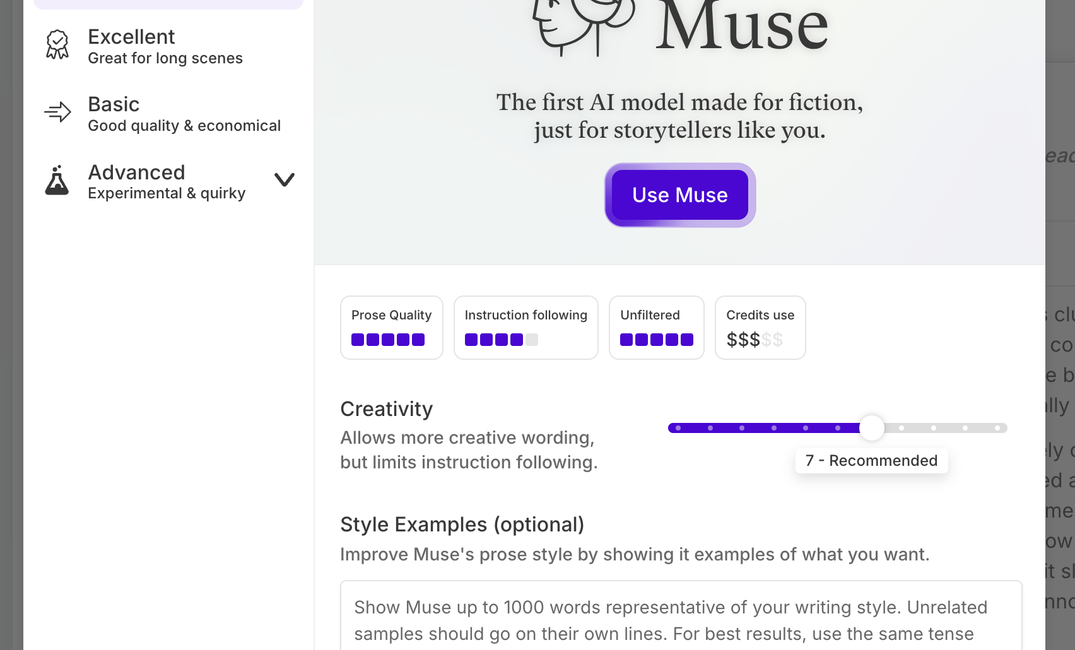
Muse is Sudowrite's fiction-trained model, and it is the default for romance work in the Prose Modes matrix. It was trained on prose. It writes like a novelist. It does not refuse explicit content, dark content, or morally complicated content, because adult readers can decide what they want to read. For contemporary romance, dark romance, monster romance, romantasy with open-door spice, Muse is the workhorse.
What that looks like in practice. You write the lead-in. You hit Write with Auto, and Muse continues your scene in your voice, not in some generic erotica template. The metaphors stay yours. The character voices stay distinct. If your heroine has been snarky for 200 pages, she is still snarky during the sex scene, which is exactly how good romance writing works.
You can pair Muse with the Creativity Dial to dial the riskiness up or down. Some authors keep it at a five for first drafts and push to a seven on the climax scenes. Others write the buildup at a three and dial up only when they want unexpected imagery.
Series Folder is the closest thing to a romance writer's brain
Every working series author has the same problem. Book three references something from book one. Your hero's mother died in chapter two of the first book. Was it cancer or a car accident? You wrote it eighteen months ago. You cannot remember. You search the document, but you used a euphemism, so the search fails. You guess. A reader emails you a week after launch.
Sudowrite's Series Folder solves this. It is a shared Story Bible across multiple books in a series. Your Characters, Worldbuilding, Style, Outline, and Synopsis live in one place that every book in the series can read. When you start book four of your small-town hockey romance series, your goalie hero already has his backstory loaded. His mother's death is in the Characters card. His arc across the previous three books is in the Story Bible. Your fictional town's coffee shop is in Worldbuilding with its menu, owner, and the specific way locals refer to it.
Compare that to ChatGPT. You can paste your series bible into the context window. You can build a custom GPT. You can use Projects. None of those persist the way an actual series brain needs to. Conversations fade. Context windows fill. You end up copy-pasting character sheets into prompts every time you start a new chapter. It works, but it eats hours.
Series Folder is the difference between starting book four with a fresh mind and starting book four already inside the world.
The Story Bible keeps your tropes honest
Romance is a trope-driven genre. Enemies to lovers. Forced proximity. Only one bed. Marriage of convenience. Grumpy/sunshine. Fated mates. Touch her and die. Readers buy by trope. They put trope tags in their TikTok reviews. They write one-star reviews when a book is mis-marketed.
The Story Bible is Sudowrite's persistent project memory, and it is where trope discipline lives. You put your trope list in the Style section. You put your protagonist's grumpy/sunshine archetype in the Characters card. You put the forced-proximity setup in the Synopsis. Every time Sudowrite generates prose, it reads the Story Bible. The output respects your tropes by default.
A practical example. You are writing a hockey romance with a touch-her-and-die hero who is also her brother's best friend. You start a coffee shop scene. You hit Write. ChatGPT would write a polite scene where they exchange pleasantries. Sudowrite, with the Story Bible loaded, writes a scene where the hero stiffens when another man approaches her at the counter, makes a quiet remark to her brother, and orders her drink before she has to ask, because he memorized it three chapters ago. The tropes are doing work on the page because the Story Bible knows what tropes you signed up for.
You can also use Chat, Sudowrite's story-aware feedback feature, to pressure-test a chapter against your trope promises. Ask Chat whether your most recent scene delivers on the grumpy/sunshine premise. It will read the Story Bible, look at the chapter, and tell you where the grump softened too early or where the sunshine got too bratty.
Claude 3.7 Sonnet for drafts that need elegance
Not every romance subgenre wants Muse. Historical romance, regency, gothic, and the more literary corners of romantasy often want prose with a different texture. Sudowrite's Prose Modes matrix puts Claude 3.7 Sonnet on duty for fantasy, mystery, and YA, but a lot of regency authors run it for drafting because it handles 19th-century cadence cleanly.
Switching models takes a click. You write your beat sheet for a regency scene. You set Sonnet as the prose mode for that chapter. You let it draft a 1,500-word ballroom encounter. Then you swap to Muse for the bedroom scene later that night, because Sonnet will sometimes get squeamish about consummation while Muse does not.
This is the move ChatGPT cannot really replicate. ChatGPT is one model with one personality. You can prompt it into different voices, but you cannot swap engines mid-chapter without losing context. In Sudowrite, the Story Bible and your manuscript stay constant. Only the engine changes.
A walkthrough: drafting a chapter at indie pace
Here is what an average drafting session looks like for an indie romance author on a four-book-a-year schedule.
It is Monday morning. You are on chapter eleven of book three in a small-town romance series. Your goal is 3,000 new words today. You open Sudowrite. The Series Folder is loaded. Your Characters cards for the hero, heroine, the meddling grandmother, and the rival are all in place. Your Outline tells you this chapter is the dark night of the soul.
You write the opening paragraph yourself. You always write the first paragraph. It sets the voice for the model. You write 80 words: the heroine sitting on her porch, the rain starting, her phone on the railing with the unanswered text from the hero glowing on the lock screen.
You hit Write with Auto. Muse continues for 300 words. The rain gets specific. Sudowrite picks up the porch detail from your prose and adds the smell of wet wood and the sound of a screen door across the street. It pulls the heroine's internal voice from your Characters card. She is dryly funny even when she is hurting, which is who you set her up to be.
You like 250 of those 300 words. You delete the last 50. You hit Write again. Another 300 words. The hero arrives in the rain. You wanted that, but the dialogue is a little flat. You highlight his first line and hit Rewrite with More Inner Conflict. Muse rewrites it with the subtext you wanted. He is apologizing without saying sorry, which is exactly the grumpy hero move you have been setting up for two books.
By 10 a.m. you have 1,500 words. You break for coffee. You come back, run Describe on the porch scene to add sensory texture you missed. Two sentences about the way her sweater smells like the diner she just left. Three sentences about the way the rain sounds different on a tin roof than on shingles. You keep half of it and cut the rest.
You write the kiss scene yourself, the first 100 words, because you want the rhythm to be yours. You hit Write. Muse picks it up and writes through. No fade. No "they kissed and the world melted away." It writes the actual scene, in your voice, with the specifics of where his hand goes and how she pulls back and what she says into his collarbone.
By 1 p.m. you have 3,200 words. You run Chapter Continuity to check the chapter against the previous ten. It flags one issue. The hero's truck was blue in chapter four and gray in chapter nine. You pick blue. You move on.
You publish four books a year because you can do that on Mondays through Thursdays and take the weekend off. That is the indie romance machine running on Sudowrite.
What authors are actually saying
The testimonials that show up in Sudowrite's user community follow a pattern. Romance authors talk about three things. Speed, refusals, and series memory.
A dark romance author on a six-book-a-year schedule said the switch from ChatGPT cut her drafting time roughly in half because she stopped fighting her tool over content. A paranormal romance author with a thirteen-book series said Series Folder was the first system that actually remembered who her secondary characters were across books. A regency author said the model-switching ability between Muse and Sonnet let her write courtship in one register and the wedding night in another without rewriting the whole chapter.
Production speed is the metric that matters most for indie romance. Authors who track their words-per-hour with Sudowrite versus ChatGPT consistently report a 30 to 50 percent gain. Not because the AI writes faster. ChatGPT is plenty fast. The gain comes from cutting out the refusals, the context re-pasting, the regenerations to get past content filters, and the manual continuity checking. Sudowrite handles those at the system level.
Where ChatGPT still has a role
Honesty is part of the smart-friend tone. ChatGPT is not bad. It is a useful tool for the surrounding work that romance authors do. Marketing copy. Blurb drafts. Amazon A+ content. Newsletter subject lines. Trope analysis. Reader avatar work. ChatGPT is fine to great at all of that.
The split most working romance authors land on. Sudowrite for fiction. ChatGPT for the business of being an indie author. The two tools play different positions on the team.
The Mobile App and the writing-when-you-can life
Indie romance authors are often parents, day-jobbers, or both. The Sudowrite Mobile App matters because the writing windows are small. Twenty minutes in a school pickup line. Forty-five minutes on a lunch break. The full Story Bible is in your pocket. You can run Brainstorm to crack a scene problem while you are waiting at the dentist. You can use Tone Shift to push a flat passage into something more sensual or more ominous, depending on what the scene needs.
You can also use Canvas, Sudowrite's visual story planning workspace, when you need to map a series arc across five books. Romance series live or die on the slow build of side-character pairings that pay off two books later. Canvas is where you keep that map visible.
The compounding case for indie romance authors
None of these features matter in isolation. Muse not refusing is nice. Series Folder is nice. Story Bible is nice. The case for switching is that they compound. You can write a 20,000-word week without re-pasting your character bible. You can switch between subgenres without losing your prose voice. You can publish a five-book series in fourteen months because your tooling holds the world together while you write the chapters.
ChatGPT is a generalist who learned fiction as a side project. Sudowrite is the fiction-specific stack, and the romance authors who are switching are doing it because the math on their production schedule starts working.
You can try Sudowrite free, write a few scenes, set up a Story Bible for the book you are working on, and see how the drafting feels in your actual voice on your actual project. The romance authors who switch usually decide within the first chapter.