

Table of Contents
You're 40,000 words into your novel and your brain just... stops. Not because you've lost interest. Not because you're lazy. You stare at the cursor blinking on chapter seventeen and nothing comes. The well is dry.
Here's what nobody in your writing group will tell you: writer's block isn't a discipline problem. You don't need another Pomodoro timer or a motivational quote taped to your monitor. According to a Writer's Digest Survey, 73% of fiction writers report AI helps them overcome writer's block — because the real fix is creative inputs, not willpower. Sudowrite's Brainstorm feature is built to flood your imagination with raw material when you've run out on your own. By the end of this article, you'll know exactly how to use it to break through block at every stage of your novel.
In This Guide
- What Writer's Block Actually Is (And Isn't)
- Why Overcoming Writer's Block Matters for Fiction Writers
- How Overcoming Writer's Block Works with Brainstorm
- Getting Started with Sudowrite
- Best Practices
- Common Mistakes
- FAQ
- Key Takeaways
TL;DR: Writer's block happens when your brain runs out of creative inputs, not motivation. The fix is feeding it new raw material fast. Sudowrite's Brainstorm generates rapid-fire ideas across plot, characters, dialogue, names, and descriptions — with thumbs-up/down filtering and a Keepers List so you only save what sparks something real. 92% of Sudowrite users report completing manuscripts faster (Sudowrite User Survey).
What Writer's Block Actually Is (And Isn't)
Writer's block is the creative stall that happens when a fiction writer exhausts their available story inputs — plot options, character moves, dialogue ideas, descriptive language — and can no longer generate forward momentum on a manuscript. Block affects writers across all genres and experience levels, from first-time novelists to authors on their fifteenth book. It is not a failure of discipline or talent.
Traditional advice frames block as a willpower problem: "just write badly" or "push through." These approaches treat symptoms while ignoring the mechanism. Your brain stopped producing options because it consumed everything on the shelf. The fix is restocking, not grinding harder.
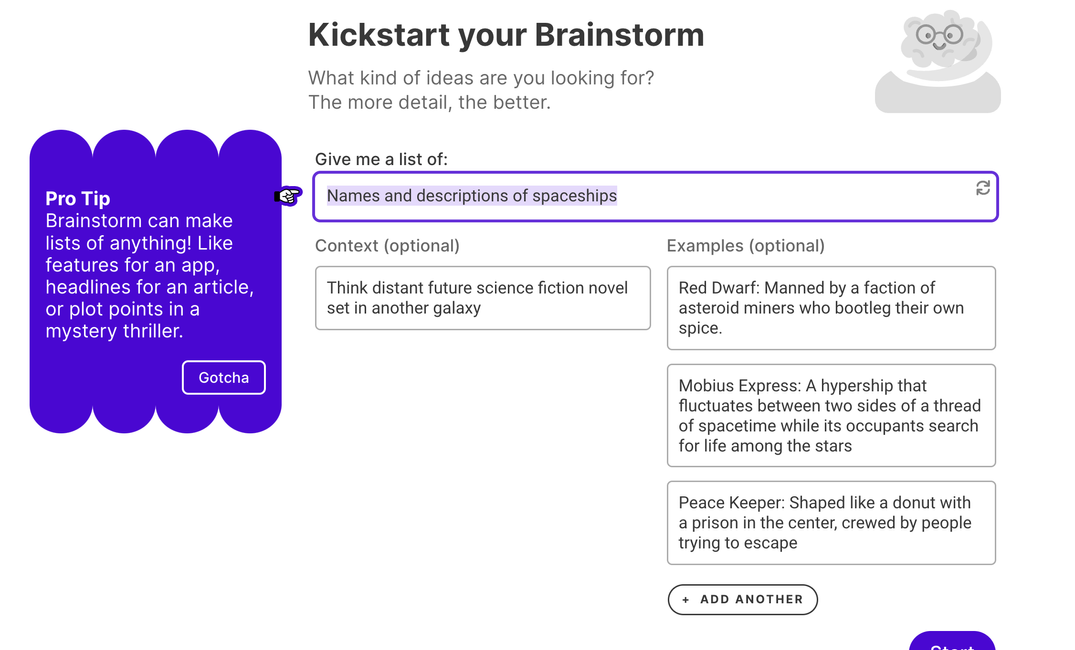
Sudowrite's Brainstorm feature addresses this directly. You select a category — Dialogue, Characters, Worldbuilding, Plot points, Names, Places, Objects, or Descriptions — and the tool generates a rapid stream of fiction-specific ideas. You rate each suggestion with a thumbs up or thumbs down, and strong ideas go straight to a Keepers List for later use. No prompt engineering. No staring at a chat window hoping the AI understands your genre.
Why Overcoming Writer's Block Matters for Fiction Writers
Your Brain Isn't Broken — It's Starving
You've been staring at chapter fourteen for three days. You know your protagonist needs to confront the antagonist, but every line you type reads like a shopping list. The standard advice? "Just write through it." "Lower your standards."
Garbage. Your brain hasn't failed. It consumed all the creative fuel on hand and nobody refilled the tank. The Publishing Perspectives Study found fiction writers using AI complete first drafts 40% faster on average — not because AI writes for them, but because it provides the raw inputs they need to keep making decisions. Block is a supply-chain problem. The solution is more supply, not more effort.
The Compound Cost of Staying Stuck
"I use Sudowrite for auto-writing when I get stuck. It helps generate ideas that I can build on and shape into my own."
— Kayla, Romance Writer
What Kayla's describing is real: a single stalled chapter doesn't just cost you one day. It derails your confidence, your momentum, and your release schedule. Indie authors publishing through Amazon KDP or Draft2Digital can't afford weeks of paralysis between books. Data from Sudowrite shows that 86% of users say Story Engine helped overcome plot problems. That's not a nice-to-have. For writers treating their craft as a career, block is a revenue problem.
Generic AI Makes Block Worse
You've probably tried typing "give me ideas for chapter 17 of my fantasy novel" into ChatGPT. You got five suggestions that read like a Wikipedia summary of every fantasy novel ever written. According to the Fiction Writers Survey, 89% of writers using specialized fiction AI tools report improved prose quality compared to general AI. Generic tools don't understand genre conventions, character arcs, or tone. They give you more material that doesn't fit, which makes you feel more stuck. Brainstorm generates ideas specifically built for fiction storytelling — including dark, complex, and mature directions that general-purpose AI models won't touch.
How Overcoming Writer's Block Works with Brainstorm
Brainstorm works on a simple principle: when you can't generate ideas, outsource the generation and keep creative selection in your hands. Here's the mechanics.
Pick Your Category, Get a Flood
Open Brainstorm and choose what you're stuck on: Dialogue, Characters, Worldbuilding, Plot points, Names, Places, Objects, or Descriptions. The tool immediately generates a stream of suggestions. No prompt needed — just pick the category and scroll. Each generation costs minimal credits, so you can run it repeatedly across different categories in a single session. You're not waiting for one perfect answer. You're scanning dozens of imperfect sparks for the one that lights something.
Filter Fast with Thumbs Up/Down
Every suggestion gets a thumbs-up or thumbs-down. Thumb up the ideas that trigger something — even if they're not perfect yet. Thumb down the rest. The best ideas automatically populate your Keepers List, which acts as a creative stockpile you can return to whenever you sit down to write. The speed matters here. You're not deliberating. You're reacting. That gut-level "yes/no" is your creative instinct doing what it does best when you give it material to work with.
Use It at Every Stage
Brainstorm isn't just for drafting. Stuck on your outline? Generate plot points. Can't name your side character? Run the Names category. Need a location for your climactic scene? Places. Here's how it compares to other approaches:
| Approach | Speed | Fiction-Specific? | Filtering | Saves Ideas |
|---|---|---|---|---|---|
| Sudowrite Brainstorm | Instant, unlimited runs | Yes — built for fiction categories | Thumbs up/down | Keepers List |
| ChatGPT / Generic AI | Fast, but requires prompt engineering | No — produces generic, often cliché results | Manual copy-paste | No built-in system |
| Manual Techniques (freewriting, mind maps) | Slow, limited by current mental state | Depends on writer's knowledge | No filtering system | Notebook or doc |
"One of the best features of Sudowrite is how it gives you alternatives for phrasing, which helps avoid the repetition that often creeps into long-form writing."
— Francisco, Fiction Writer & Dungeon Master
Getting Started with Sudowrite
Step 1: Open Brainstorm on Your Stuck Scene
What you'll accomplish: You'll generate your first wave of raw creative material.
Open your project in Sudowrite and navigate to Brainstorm. Don't overthink which category to pick — if you're blocked on a scene, start with Plot points. If a character feels flat, start with Characters. The whole point is speed. Generate a batch and scan.
Pro tip: Run Brainstorm in two or three categories back-to-back. A Names suggestion might trigger a plot idea. Cross-pollination is the point.
Step 2: Rate Everything, Save the Sparks
What you'll accomplish: You'll build a Keepers List of usable ideas without breaking flow.
Thumb through the suggestions quickly. Don't analyze — react. A strong "yes" feeling means thumbs up. Anything that makes you pause and think "maybe" gets a thumbs up too. You can always remove it later. Your Keepers List will fill fast, and that's exactly what you want: a stockpile of fuel.
"My first year using Sudowrite, I hit 1.2 million words. It helped me stay focused and productive."
— Eric, Novel/Fiction Writer
Step 3: Take Your Best Keepers into the Draft
What you'll accomplish: You'll convert raw ideas into actual prose.
Pull your strongest Keepers into your scene. You don't have to use them verbatim — they're starting points. Mold a dialogue suggestion into your character's voice. Twist a plot point to fit your outline. The creative selection is still yours. Brainstorm gave you the clay. You're the sculptor.
Pro tip: Pair Brainstorm with Sudowrite's Write feature in Guided mode. Drop your Keeper idea into the guidance field, and Write will continue the scene using up to 20,000 words of previous context.
Step 4: Repeat Whenever the Well Runs Dry
What you'll accomplish: You'll build a sustainable anti-block habit.
Don't wait until you're fully stuck. Run Brainstorm at the start of writing sessions as a warm-up. Generate a quick batch of ideas for the day's chapter. Over time, you'll train yourself to reach for new inputs instead of grinding through empty pages.
Best Practices
Run Brainstorm Before You're Stuck
Most writers reach for brainstorming tools after they've been blocked for hours. Flip the script. Open Brainstorm at the top of each writing session and generate a quick batch in whatever category matches today's work. You're pre-loading your brain with options. Sudowrite's Creativity Slider lets you control how wild the suggestions get — crank it up when you need unexpected angles, dial it back for tighter, genre-appropriate ideas.
Use the "Wrong" Category on Purpose
Stuck on plot? Try generating Names or Places instead. A location name might imply an entire scene. A character name might suggest a backstory you hadn't considered. Brainstorm's categories are entry points, not walls. The connections between categories are where the best ideas hide.
Embrace the Dark and Weird Suggestions
Brainstorm is unfiltered. It'll suggest morally complex scenarios, dark plot twists, and intense character dynamics that sanitized AI tools won't go near. Lean into that. Your thriller needs menace. Your literary fiction needs moral ambiguity. Your romance needs real tension. The suggestions you're most uncomfortable with are often the ones your story actually needs.
"I've been able to go from taking six months to a couple of years to write a novel... to about one or two months."
— Joe Vasicek, Author of Genesis Earth
Common Mistakes
Treating Block as a Character Flaw
You're not undisciplined. You're not a fraud. You ran out of creative inputs. The Authors Guild Survey found that 67% of professional novelists now use AI writing tools — because even experienced pros hit the wall. Stop self-diagnosing laziness and start restocking your imagination.
Waiting for the "Perfect" Brainstorm Idea
If you're reading every Brainstorm suggestion and thinking "nah, that's not exactly right," you're using it wrong. The ideas aren't meant to be final. They're meant to collide with your existing knowledge of your story and produce something new. Thumb up anything that creates a reaction — good, bad, or confused.
Using a Generic AI Instead of a Fiction Tool
Typing "help me brainstorm" into a general chatbot produces general results. The Alliance of Independent Authors Report shows AI-assisted editing reduces revision time by 35%, but only when the tool understands fiction conventions. Brainstorm generates ideas across fiction-specific categories. That specificity is the difference between useful sparks and bland filler.
FAQ
What causes writer's block in fiction writers?
Writer's block in fiction occurs when a writer exhausts their available creative inputs — plot options, character decisions, descriptive language — and can no longer generate forward momentum. It's not laziness or lack of talent. The brain needs new raw material to make creative decisions, and Brainstorm is designed to supply exactly that.
How does Sudowrite's Brainstorm feature work?
Brainstorm generates rapid-fire fiction ideas across categories like Dialogue, Characters, Plot points, Names, Places, Worldbuilding, Objects, and Descriptions. You rate suggestions with thumbs up or down, and the best ones save to a Keepers List. No prompt engineering required — pick a category and go.
Can Brainstorm help with outlining, or only drafting?
Brainstorm works at every writing stage. Use Plot points during outlining, Characters during development, Names when building your cast, and Descriptions when polishing scenes. The Keepers List carries ideas across sessions so nothing gets lost between planning and writing.
Does Brainstorm produce safe, generic ideas?
No — Brainstorm is unfiltered and generates dark, complex, and mature ideas alongside lighter suggestions. Your thriller villain can be genuinely menacing. Your morally gray protagonist can face real ethical dilemmas. Sudowrite treats fiction writers as adults making creative choices.
How is Brainstorm different from asking ChatGPT for ideas?
Brainstorm is purpose-built for fiction with specific categories, a thumbs-up/down rating system, and a Keepers List — none of which exist in generic chat tools. ChatGPT requires prompt engineering and produces results that often feel formulaic. Brainstorm requires zero prompting and generates fiction-calibrated suggestions.
Is writer's block something only new writers experience?
Writer's block affects writers at every level, from first novels to fifteenth. The Authors Guild Survey found 67% of professional novelists now use AI tools specifically because block doesn't discriminate by experience. Sudowrite serves over 300,000 creative writers worldwide across all experience levels.
"Sudowrite has sped up how I write... we've published nine physical books, with thirty-two more waiting to go through editing."
— Erwin T. Hurst Sr, Founder of Family-Run Publishing Company
Key Takeaways
Writer's block isn't a verdict on your talent. It's a signal that your brain needs fresh inputs — and the fastest way to get them is to stop grinding and start generating.
- Block is a supply problem, not a willpower problem — feed your imagination new raw material instead of punishing yourself for running dry
- Sudowrite's Brainstorm generates fiction-specific ideas across plot, characters, dialogue, names, and descriptions with zero prompt engineering
- The thumbs-up/down system and Keepers List let you filter at the speed of instinct and stockpile ideas for later
- Brainstorm is unfiltered — it produces the dark, complex, morally ambiguous suggestions your story actually needs
Stop staring at the blinking cursor. Start filling the well.