

Table of Contents
Most dystopian first drafts fail in the same place. The author builds a totalitarian government in chapter one, then forgets how it actually controls the trash collection in chapter twelve. Readers smell the gap. They put the book down.
Dystopian fiction lives or dies on internal consistency. Not the shiny chrome of your monorail. The boring bureaucracy underneath it. Who issues ration cards. How dissent gets reported. What happens to the kid who asks the wrong question in school. That stuff. The texture of oppression, not the silhouette of it.
This is where AI tools designed for fiction earn their keep. Sudowrite was built for novelists, and its Story Bible structure forces you to define the load-bearing pieces of your world before you start writing scenes that depend on them. Below is a working method for building a dystopia that holds together under pressure.
Why most dystopian worldbuilding collapses
The genre has a specific failure mode. Writers treat the regime as set dressing. They borrow the surface details from 1984 or The Handmaid's Tale, paint them onto a new coat of dystopian wallpaper, and assume readers will fill in the rest. They won't.
Look at the three reference points your brief suggests, and notice what they actually share. None of them invented dystopia from scratch. Each one extrapolated from a real anxiety in the author's actual present.
- 1984: Orwell took 1948 Stalinism and Britain's wartime rationing and pushed both forward thirty-six years. Big Brother is the NKVD with better cameras.
- The Handmaid's Tale: Atwood famously refused to include anything in Gilead that hadn't already happened somewhere. The Republic is a collage of real theocratic practices, real reproductive coercion, real American Puritanism.
- The Hunger Games: Collins layered reality TV culture onto Roman bread-and-circuses, then added post-war American class stratification. Panem is Rome with sponsors.
The lesson is not that dystopia must be derivative. The lesson is that the convincing ones critique something specific. A regime that critiques nothing is just an aesthetic. Aesthetic dystopias read as costume parties.
Set up your Story Bible like a political analyst
Before you write your protagonist's first scene, open Story Bible and treat it less like a writing tool and more like an intelligence briefing on a country that does not exist yet. You are about to define the operating system of an entire society. Sudowrite's Story Bible holds Characters, Worldbuilding, Style, Outline, Synopsis, and Braindump. For dystopian fiction, Worldbuilding is where most of your real work happens.
Create Worldbuilding cards for the systems that actually run the world. Not the cool ones. The boring ones. These are the cards that should exist before you write chapter two:
- The ruling apparatus: Who has formal power. Who has actual power. How those two diverge. The Inner Party of 1984 is the model here.
- The economic engine: What does this society produce. Who does the producing. Who consumes it. Panem's districts each have one industry. That is structural, not decorative.
- The surveillance layer: Cameras, informants, social pressure, religious confession, mandatory check-ins. Specify the mechanism. Gilead used the Eyes, neighborhood reporting, and ritual humiliation. All three. Layered.
- The enforcement arm: Police, militia, religious guard, private contractors, or some hybrid. Who carries weapons in public. Who is allowed to be armed at home.
- The information ecosystem: State media, banned media, the underground press, what gets taught in schools, what gets rewritten in textbooks.
- The credentialing system: How status gets assigned at birth. How it can be earned or lost. Hunger Games districts. Brave New World castes. The Capitol versus the rest.
- The ritual calendar: Holidays, parades, public executions, prayer schedules, mandatory celebrations. Regimes love rituals because rituals make compliance feel like community.
- The official lie: Every dystopia has a founding story it tells about itself. Panem's was the Treaty of Treason. Gilead's was the rescue of women from chaos. What is yours.
Fill each card with two layers. The official version, which is what the regime claims. And the actual version, which is what your protagonist will eventually discover. The gap between those two layers is where your plot lives.
Why Claude 3 Opus is the right pick for the prose
The prose mode you pick matters more in dystopian fiction than in most genres. You are asking the model to produce text that is doing two jobs at once. It needs to deliver the scene. It also needs to imply a worldview through diction and rhythm. Cold prose for a cold regime. Bureaucratic flatness when describing horror. Tonal control is the whole game.
Per Sudowrite's prose modes matrix, Claude 3 Opus is the default for sci-fi, literary, and historical fiction. That is the right pick for most dystopian work. Opus tends toward longer sentences, more measured cadence, and the kind of vocabulary that handles institutional language without making it sound like a tech demo. It will write a paragraph about a tribunal in a register that feels like the tribunal actually exists.
You might switch modes for specific passages. Muse handles intimate scenes well, including the dark ones, and dystopian fiction has plenty of dark intimate scenes. The torture room in 1984. The Ceremony in Gilead. If your scene is doing emotional or sexual work, switch to Muse for the duration, then return to Opus for the political scaffolding around it.
Tone Shift is your political climate dial
Tone Shift gives you seven presets: Ominous, Sensual, Fantastical, Fast-Paced, Romantic, Authoritative, Conflicted. For dystopia, Ominous and Authoritative are the workhorses. Ominous adds dread in the negative space. Authoritative tightens the prose around institutional moments.
A practical use. You have written a scene where your protagonist walks home past a wall of execution announcements. The first draft reads neutral. The character notices the names. Fine. You highlight the passage, run Tone Shift on Ominous, and now the same scene leans into the wrong-ness of how normal this all feels. The cobblestones. The lamp posts. The way nobody slows down to read.
Use it sparingly. Tone Shift works best on individual passages, not entire chapters. Apply it where the political weight needs to land. Then leave the surrounding prose alone so the shift registers.
Characters who live inside the system
The mistake most writers make with dystopian protagonists is treating them as outside the regime from page one. Already enlightened. Already resistant. That removes the most interesting work, which is showing a person who is the regime's product slowly noticing the cracks.
Winston Smith works at the Ministry of Truth. He rewrites history for a living. He is good at it. The horror of 1984 is partly that he was complicit before he was a rebel. Offred was a normal woman with a normal job and a credit card. Then the credit card stopped working. Katniss has been hunting in the woods illegally for years. She knows the system is rigged because she has been quietly working around it.
In your Character cards, define three things for every major character:
- How the regime serves them. Even oppressed characters get something. Stability. Identity. A scapegoat. Specify what.
- What they have already had to do to survive. The compromises they made before the story started. Use these as ammunition for later guilt scenes.
- The specific moment of doubt. Not the moment they joined the resistance. The earlier moment. When something they had explained away stopped being explainable.
Then use Sudowrite's Chat to pressure-test these. Open the project, ask Chat something like "Given this Story Bible, what is the most likely small contradiction my protagonist would notice in week one of the story." Chat reads the bible. It will surface friction points you missed because you were too close to your own worldbuilding.
A short walkthrough: building the regime of Concordia
Let's run a concrete example. You are writing a dystopian novel set sixty years from now in a post-water-crisis North American successor state. You want it to feel as inevitable as Atwood and as ritualized as Collins.
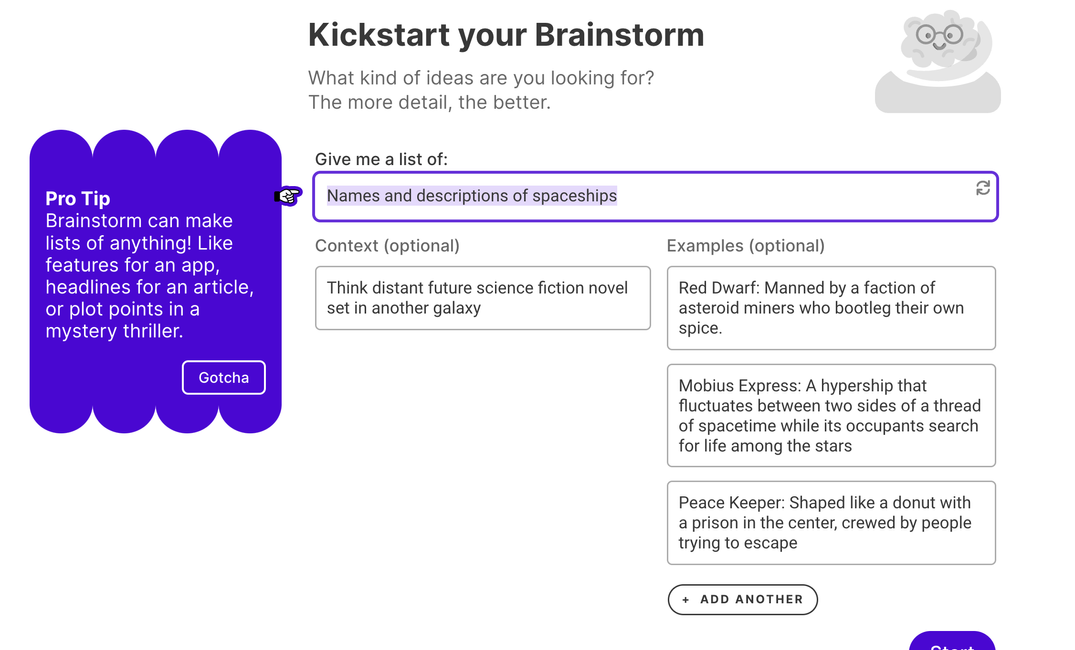
Open a new Sudowrite project. Name it Concordia. Go to Worldbuilding and create the following cards. You can do this fast because Brainstorm will help you generate variants you can refine.
Card: The Allocation. Concordia distributes water by household credit, awarded based on Contribution Score. Contribution is calculated from labor hours, civic participation, fertility, and "moral alignment," which is a vague category that explicitly invites abuse. Official line: fair distribution prevents waste. Actual function: structural reward for compliance.
Card: The Recitation. Every morning at 06:30, citizens are required to listen to the Civic Address through their household speaker. The speakers cannot be turned off. They can only be muted, which is logged. Three muted Recitations in a month triggers a wellness visit. Official line: keeping the community informed. Actual function: presence checks, conformity, and a constant low-grade reminder of who is watching.
Card: The Trade Roster. Citizens are assigned a Trade at age fifteen based on aptitude testing. Reassignment is theoretically possible but functionally rare. The roster determines housing block, partner pool, and water credit ceiling. Official line: efficient placement. Actual function: hereditary caste with a meritocratic veneer.
Now you have three cards. They reinforce each other. The Allocation creates the incentive structure. The Recitation provides the surveillance layer. The Trade Roster locks in the inequality. None of them are flashy. All of them are load-bearing.
Open Write in Guided mode. Direction: opening scene, protagonist Lior wakes up two minutes before the Recitation, watches the speaker, and thinks about whether to mute it. With Claude 3 Opus selected as the prose mode, you will get something that handles the institutional tone correctly. The scene will sound like it understands the system because the system is now defined in the Story Bible the model is reading.
You can then run Tone Shift on Ominous over the speaker-watching paragraph, and the dread will sharpen without you forcing it through adjectives.
Cross-chapter continuity is non-negotiable
Dystopian readers are alert. They notice when your protein-ration calorie count changes between chapter four and chapter eleven. They notice when the Allocation thresholds drift. They notice when a character who could not read in chapter two reads a poster in chapter nine.
Sudowrite's Chapter Continuity feature checks for these contradictions across chapters. Run it after every major draft pass. It will surface the kind of small inconsistencies that, in worldbuilding-heavy fiction, are the difference between believable and laughable.
Pair this with Worldbuilding cards that include the specifics. Calorie counts. Curfew times. Population numbers. The cards are the source of truth. Continuity is the audit.
Structural comparison: how the classics build their stakes
Worth mapping your own outline against the structural choices these three novels make, because each one solves the stakes problem differently.
- 1984 is single-protagonist interior. The regime is unassailable. The arc is psychological collapse. Stakes are about what happens inside Winston's head. Outline this if you want a tragic, claustrophobic story where the system wins.
- The Handmaid's Tale uses memory against present horror. Offred remembers the world before constantly. The contrast is the engine. Outline this if your dystopia is meant to feel recent, recognizable, and traumatic in a specifically intimate way.
- The Hunger Games externalizes the conflict into a literal competition. Katniss has visible objectives. The regime is concrete enough to fight. Outline this if you want propulsive plot mechanics and a story that escalates toward open revolt.
Drop your chosen structural model into the Outline section of Story Bible. Then build your beat sheet around it. Save the Cat works for the Hunger Games model. The 1984 model demands a more literary structure with descent as the through-line. The Handmaid's Tale model often uses fragmented timelines that earn their fragmentation by mirroring the protagonist's dissociation.
Avoid the tech-porn trap
Newer writers love the gadgets. Sleek surveillance drones. Neural implants. Holographic propaganda. None of this is inherently bad. All of it becomes bad when it replaces the social texture.
The drone is interesting only because of who operates it and who fears it. The implant matters only because of what it does to relationships, work, and the inside of a person's head. Cut the spec sheet. Keep the consequence.
A useful rule. For every paragraph of technology description, write three paragraphs of how that technology has reorganized daily life. If you cannot write the three paragraphs, the technology is decoration. Cut it or move it.
Use the Creativity Dial deliberately
The Creativity Dial in Sudowrite runs from 0 to 10. For dystopian fiction, the sweet spot is usually 3 to 6. Lower settings produce prose that reads competent and controlled, which suits the genre's institutional voice. Higher settings can produce more striking imagery but also raise the risk of tonal slips that break the cold register.
Try this. Generate the same passage at 3, at 5, and at 7. Read all three. The version that most sounds like the world you have built is the one to keep. Often it is the middle one. Sometimes the lower setting wins because dystopian prose rewards restraint.
The political question you need to answer before chapter one
Dystopia is a social-critique genre. That is its load-bearing wall. If you are not critiquing something specific, you are writing aesthetic, not dystopia.
Write a single sentence in the Synopsis section of your Story Bible. "This novel is about what happens when [real present-day pressure] is allowed to continue for [time horizon]." Fill in the brackets. Concordia might be about what happens when water privatization combines with social-credit scoring is allowed to continue for two generations. 1984 was about what happens when wartime propaganda apparatus is allowed to continue for forty years.
That sentence is your compass. Every Worldbuilding card, every Character arc, every Tone Shift should point toward it. When you get stuck, you are usually drifting from that sentence. Return to it. Adjust the scene to bend back.
The genre is in a strong moment right now. Readers want dystopia that reflects what they are actually anxious about, not warmed-over Cold War metaphors with new chrome. Sudowrite's Story Bible, prose modes, and continuity tools give you the scaffolding to build a regime that holds together for four hundred pages. The political imagination is yours. You can try the whole stack free and see what your dystopia looks like when the worldbuilding actually loads.