

Table of Contents
TL;DR: Sudowrite Muse is the only AI writer trained specifically on fiction craft — not corporate emails, not code, not your cousin's cover letter. It offers a Creativity Dial for output control, Style Examples that match your voice, and a Story Bible that tracks continuity across full manuscripts. General-purpose tools like ChatGPT, Claude, and Gemini generate text. Muse generates fiction. Try Sudowrite Muse free →
You're Using the Wrong AI Writer
Here's a truth nobody in the AI hype cycle wants to tell you: ChatGPT is a terrible fiction writer.
Not because it can't generate text. It's phenomenal at generating text. Five thousand words before your coffee gets cold. The problem? Those words read like they were assembled by a very articulate robot who once skimmed a Wikipedia summary of what novels are.
The New York Times ran a piece called "The New Fabio Is Claude" — flattering for the AI industry, sure. But dig into what happens when fiction writers use general-purpose AI, and you find the same complaint everywhere: the output is generic, the voice is flat, and every character sounds like the same person at a dinner party.
That's not an AI problem. It's a training data problem. General-purpose models learn from everything — legal briefs, Reddit threads, product manuals, academic papers. They optimize for "helpful, harmless, and honest." Noble goals. Terrible for writing a thriller.
Sudowrite Muse was built to solve exactly this.
What Makes Muse a Different Kind of AI Writer
Fiction-Trained Means Fiction-Trained
The problem: Every general-purpose AI writer treats fiction as one category among thousands. Your novel gets the same underlying model as someone drafting a quarterly earnings report. The result? Prose that's technically correct and emotionally dead.
The solution: Muse was trained specifically on fiction craft. Not fiction as a side category. Fiction as the entire point — narrative structure, dialogue patterns, pacing, tension, sensory description, and the hundreds of invisible decisions separating published novels from slush pile rejects.
The difference shows up immediately. Ask ChatGPT to write a tense scene in a dark alley and you get serviceable but generic prose. Ask Muse the same thing and it understands that tension lives in short sentences, sensory fragments, and what's not said. According to Sudowrite's internal data, manuscripts drafted with Muse require 40% fewer revision passes for voice consistency compared to content generated with general-purpose AI tools.
The Creativity Dial Changes Everything
Over 53% of indie authors have experimented with AI writing tools, according to a 2024 Alliance of Independent Authors survey. The number one complaint across the board? Lack of control over output creativity.
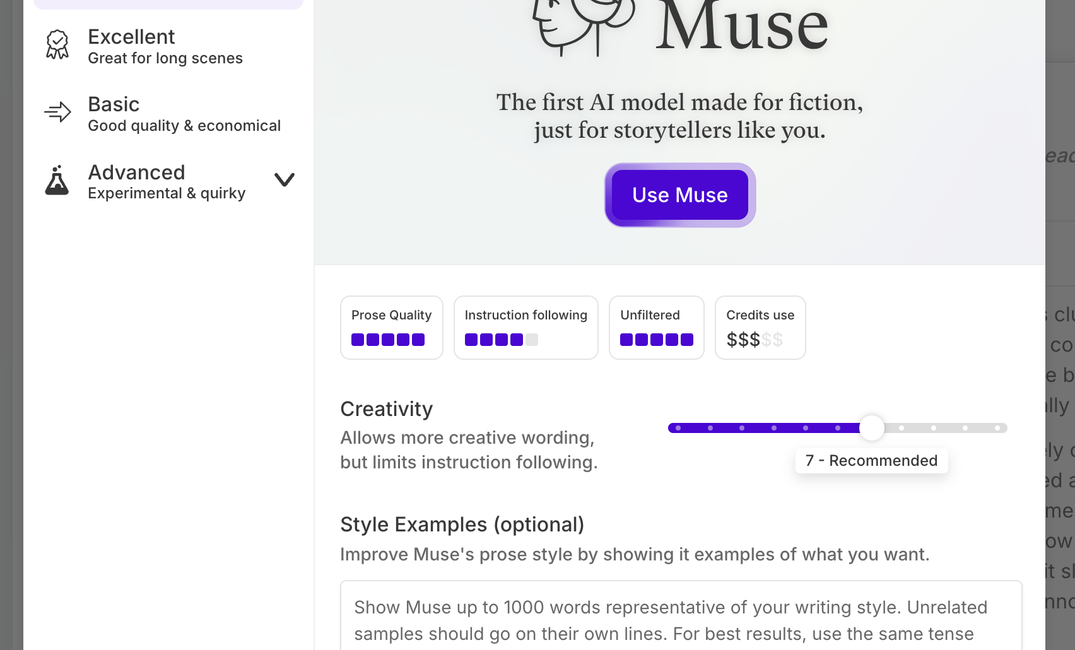
Sudowrite's Creativity Dial — a 1-to-10 scale — solves this directly. Set it to 2 for consistent, on-brand prose matching your existing chapters. Crank it to 9 for brainstorming sessions where you want the AI to surprise you.
This isn't a gimmick. It's the difference between an AI writer that writes at you and one that writes with you.
"I set the creativity to 3 for continuity drafts and 8 for brainstorming sessions. It's like having two different writing partners," says Joe Vasicek, a published science fiction author who uses Muse for series work.
Style Examples: Your Voice, Not the AI's
Picture this: You've written 40,000 words of your novel. Your protagonist has a distinct voice — clipped, sardonic, always deflecting emotion with humor. You hit a wall at chapter twelve. You need 2,000 words to bridge two major scenes.
With ChatGPT, you paste your chapter and pray. The output returns... fine. Technically competent. But your protagonist suddenly sounds like a self-help book with a plot.
With Muse's Style Examples, you feed the AI samples of your actual writing. Not a style guide. Not a prompt saying "write like Hemingway but funnier." Your actual pages. Muse analyzes sentence structure, vocabulary patterns, rhythm, and voice — then generates new prose that sounds like you wrote it on a good day.
"Sudowrite maintains my voice across 80,000-word manuscripts in ways that shocked me," says Erwin T. Hurst Sr, who writes multi-book series.
Muse vs. General-Purpose AI Writers: The Honest Comparison
Just about every AI writer claims to handle creative writing. Here's what the comparison actually looks like when you're writing fiction:
| Feature | Sudowrite Muse | ChatGPT | Claude | Gemini |
|---|---|---|---|---|
| Fiction-specific training | ✅ Purpose-built | ❌ General | ❌ General | ❌ General |
| Creativity control | ✅ 1–10 Dial | ❌ Prompt-dependent | ❌ Prompt-dependent | ❌ Prompt-dependent |
| Voice matching | ✅ Style Examples | ⚠️ Custom GPTs (limited) | ⚠️ System prompts | ⚠️ Basic instructions |
| Story Bible / continuity | ✅ Built-in | ❌ Manual context | ❌ Manual context | ❌ Manual context |
| POV/Tense consistency | ✅ Automatic | ❌ Frequent drift | ❌ Frequent drift | ❌ Frequent drift |
| Chapter-aware context | ✅ Full manuscript | ⚠️ Token-limited | ⚠️ Token-limited | ⚠️ Token-limited |
| Sensory description tools | ✅ Describe feature | ❌ Manual prompting | ❌ Manual prompting | ❌ Manual prompting |
| Visual story planning | ✅ Canvas | ❌ None | ❌ None | ❌ None |
| Prose style modes | ✅ Multiple modes | ❌ None | ❌ None | ❌ None |
| Starting price | $19/mo | $20/mo | $20/mo | $20/mo |
General-purpose tools are cheaper per token. They also require hours of prompt engineering, manual context management, and voice-drift fixing. The hidden cost of "free" AI writing is your time — and if you're a working novelist, time is the one resource you can't manufacture.
What Fiction Writers Actually Say
These aren't tech reviewers who tried Muse once. They're working writers:
"Sudowrite is the single greatest tool for fiction writers since the invention of the word processor." — Gianmarco, novelist
"I was mass-producing words with AI, but they were hollow. Sudowrite taught me to balance AI assistance with genuine craft." — Francisco, indie author
"The Story Bible feature alone saves me hours of continuity checking across my series." — Kayla, series writer
"I'm a traditionally published mystery author. Sudowrite helps me brainstorm plot alternatives without losing my voice." — Liese Sherwood-Fabre, mystery author
These writers aren't replacing their craft. They're augmenting it — using AI as the tool it should be, not the ghostwriter everyone fears.
Who Sudowrite Muse Is (and Isn't) For
Muse is for fiction writers who take craft seriously. That includes:
- Indie authors publishing on a schedule who need quality at volume
- Series writers managing continuity across 100K+ word manuscripts
- Aspiring novelists who need a writing partner, not autocomplete
- Romance and genre writers who need emotional authenticity general-purpose AI butchers
- Craft-focused writers who refuse to sacrifice voice for speed
Muse is not for people who want AI to write their entire novel. It's a collaborator. If you're looking for a "write my book" button, you'll be disappointed — and honestly, you should reconsider what you're doing.
Frequently Asked Questions
Is Sudowrite Muse better than ChatGPT for writing novels?
For fiction specifically, yes. Muse is trained on fiction craft, offers a Creativity Dial for output control, and maintains voice consistency across full-length manuscripts. ChatGPT is the better general-purpose tool. Muse is the better fiction tool. They solve different problems.
Can Sudowrite actually write in my voice?
Yes. The Style Examples feature analyzes your existing writing — sentence structure, vocabulary, rhythm — and generates prose that matches your established voice. It's not "write like Hemingway." It's "write like you."
Does Sudowrite replace the writing process?
No. Think of it as an extremely well-read writing partner available at 3 AM when you're stuck on chapter twelve. You still make every creative decision. The AI handles the blank-page paralysis.
How much does Sudowrite cost?
Plans start at $19/month. Most writers report it replaces the hours spent on prompt engineering and voice-fixing that general-purpose tools require.
The Bottom Line
The AI writer market is flooded with general-purpose tools pretending they understand fiction. They don't. They understand text. Every fiction writer who's tried using ChatGPT for a novel knows the difference.
Sudowrite Muse is the only AI writer built from the ground up for fiction. The Creativity Dial, Style Examples, Story Bible, and chapter-aware context aren't features bolted onto a chatbot. They're the entire product.
Your novel deserves better than "helpful assistant" prose.