

Table of Contents
You've got one protagonist and four love interests. Each one needs a distinct voice, a unique dynamic with the MC, and their own emotional arc that doesn't just echo the guy before him. Oh, and they all need to interact with each other in ways that feel real, not like you're shuffling cardboard cutouts through a scene rotation.
That's the core challenge of reverse harem romance. RH demands more from a writer's organizational brain than almost any other subgenre, and when things slip, when Kael suddenly has Dorian's backstory or Luca's scar migrates to Ash's jaw, readers notice immediately. Circana BookScan 2025 shows U.S. romance print sales reached nearly 44 million units in 2025, up 3.9%, and reverse harem is one of its fastest-growing corners. The readers here are sharp, dedicated, and they will absolutely call you out in a review.
Here's the thing: AI can actually help with this. Not by writing your book for you, but by doing the unglamorous tracking work that keeps four simultaneous love stories from collapsing into one.
TL;DR: Reverse harem romance multiplies every tracking problem in fiction by the number of love interests you're juggling. Sudowrite's Story Bible character cards, relationship matrices, and Chapter Continuity keep 4+ love interests distinct across your whole manuscript. According to BookBub Trend Watch 2025, romance readers rank character consistency among their top priorities when choosing series to follow.
What Reverse Harem Romance Actually Demands from Writers
Reverse harem (RH) romance features a single protagonist in a committed relationship with three or more love interests simultaneously. Unlike love triangles where someone eventually gets picked, RH ends with everyone together. The subgenre spans contemporary, paranormal, fantasy, sci-fi, and dark romance, and it's exploded across platforms like Kindle Unlimited where readers devour entire series in days.
The Tracking Nightmare Nobody Warns You About
The core problem isn't writing one romance. You can do that. The problem is writing four or more parallel romances that each hit their own beats while sharing page time, escalating at different rates, and never feeling redundant. Love interest #1 can't have the same conflict as #3. The jealousy scene in chapter 8 can't echo the jealousy scene in chapter 14. Each character's voice in dialogue must be distinguishable without name tags.
According to BookBub Trend Watch 2025, romance readers consider character consistency a top priority when rating a series. For RH specifically, that consistency challenge multiplies by every love interest you add.
Why Multi-Character Tracking Makes or Breaks Your Reverse Harem
What Happens When Tracking Fails
Readers in RH communities on Reddit and Facebook track details obsessively. They notice when a love interest's eye color changes. They notice when a dynamic that was established in book one vanishes by book three. They will make spreadsheets about your characters and post them publicly. Your tracking has to be at least as good as theirs.
Picture Your Current Process
You're 60,000 words into your RH fantasy romance. You open a new chapter, a group scene where all four love interests and the MC are present. Who stands where? Who hasn't spoken in two chapters and needs page time? What's the current tension level between Kael and Dorian after the fight in chapter 12? What nickname does Luca use for the MC that the others don't? If you're hunting through previous chapters to answer these questions, you've already lost an hour of writing time.
How AI Keeps Your Love Interests Straight
Character Cards as Your Relationship Foundation
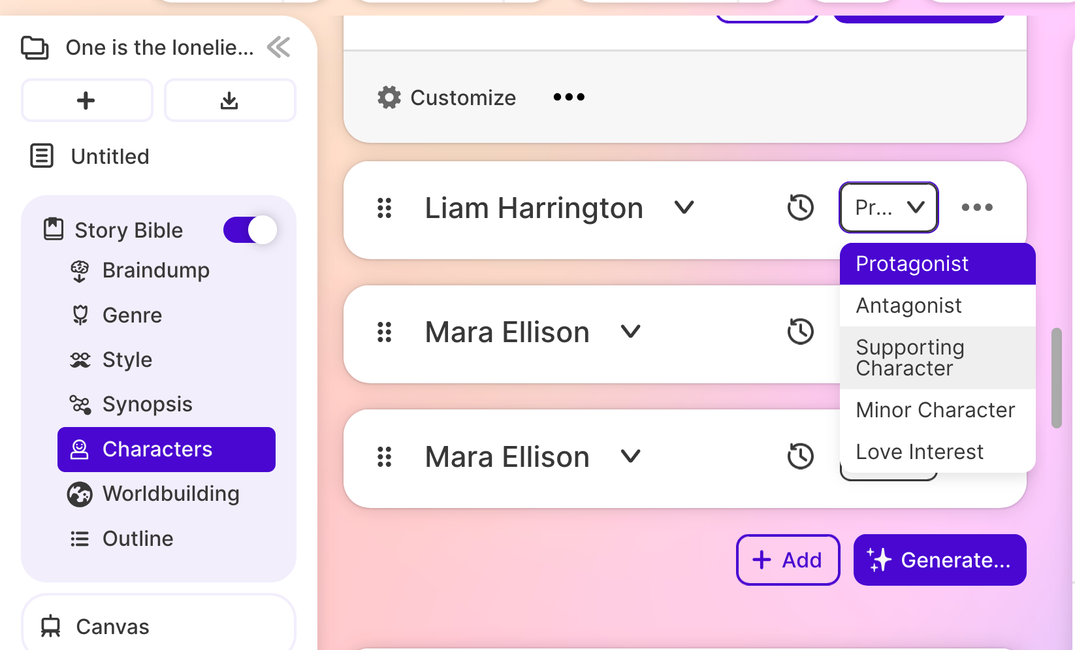
The key to AI-assisted RH writing isn't generating prose first. It's building your reference architecture. In Sudowrite's Story Bible, the Characters feature lets you create detailed cards for each love interest that the AI actually references when generating or suggesting text.
Each card holds physical descriptions, personality traits, speech patterns, backstory, and (critically) relationship dynamics with every other character. When you then use Muse, Sudowrite's fiction-trained AI model, to draft a scene, it pulls from those cards. Kael stays brooding and monosyllabic. Luca stays flirtatious and warm. The AI isn't guessing. It's reading your bible.
The Relationship Matrix Approach
Beyond individual character cards, tracking relationships between characters requires a matrix. Here's a sample for a 4-love-interest setup:
| MC (Lyra) | Kael | Dorian | Luca | Ash | |
|---|---|---|---|---|---|
| Kael | Protective, slow-burn | — | Rivalry, grudging respect | Distrust | Mentorship |
| Dorian | Intellectual tension | Rivalry | . | Friendly competition | Indifferent |
| Luca | Playful, fast attraction | Distrust | Friendly | . | Brotherhood |
| Ash | Quiet devotion | Respects | Indifferent | Brotherhood | , |
Store this in the worldbuilding section of your Story Bible. When Sudowrite generates dialogue or scene suggestions, these dynamics inform the output. Dorian and Kael don't suddenly become best friends because you told the AI they have a rivalry.
Your 4-Love-Interest Setup: A Step-by-Step Walkthrough
Here's exactly how to set up a reverse harem project that won't fall apart at 80,000 words.
Building Your Harem from Scratch
Step 1: Create your MC's card first. Define her personality, goals, flaws, and what she needs emotionally from each relationship. This is the anchor.
Step 2: Build each love interest card with differentiation baked in. For each LI, define:
- Archetype (protector, trickster, intellectual, quiet strength)
- Communication style (three adjective tags for dialogue voice)
- Physical distinguishing features
- The specific emotional need they fulfill for the MC
- Their conflict source (internal and with other LIs)
Step 3: Map your relationship matrix. Use the table format above. Every LI-to-LI dynamic should be defined in two words or fewer. Store it in Worldbuilding.
Step 4: Establish your scene rotation. In the Story Bible, note your POV plan, who gets focus in which chapters. Use Series Folder if this is a multi-book RH series to maintain continuity across installments. Sudowrite's Chapter Continuity feature ensures the AI remembers what happened in previous chapters, not just the current one.
Step 5: Draft with guardrails. Use Write Guided to steer multi-POV scenes. When you're writing a group dinner scene and need Luca's voice specifically, Write Guided lets you direct the AI's output toward that character's established patterns rather than generating generic dialogue.
Best Practices for AI-Assisted Reverse Harem Writing
Steering Multi-POV Scenes Without Losing Control
The biggest risk with AI in RH isn't bad prose. Muse handles fiction-quality writing. The risk is homogenization: all your love interests starting to sound alike because the AI defaults to a median voice.
Combat this by:
- Front-loading character cards with dialogue samples (3-5 example lines per LI)
- Using one LI per scene for drafting, then layering in group dynamics
- Running consistency checks chapter by chapter. Does this dialogue line sound like Ash or like Generic Love Interest #3?
- Adjusting the Creativity Slider to dial up unpredictability for your wildcard characters and pull it back for your steady, grounded LI
According to the Written Word Media 2025 Indie Author Survey, indie romance authors using AI-assisted tools for consistency tracking publish significantly faster without sacrificing reader satisfaction scores. Speed matters in RH, where readers expect regular series installments.
Mistakes That Tank Your Reverse Harem
The Clone Problem
The single most common failure in AI-assisted RH writing is the clone problem: all love interests converge into one voice because the writer didn't build distinct enough character foundations before generating. The AI is only as differentiated as your inputs.
Other critical mistakes:
- Skipping the relationship matrix. Without LI-to-LI dynamics, group scenes feel flat.
- Ignoring the POV rotation. If one LI dominates page time, readers notice and get frustrated.
- Not using Series Folder for multi-book arcs. Character drift across books is the #1 complaint in RH series reviews.
Frequently Asked Questions
Can AI write spicy scenes with multiple characters without it getting awkward?
Sudowrite's Muse is specifically trained on fiction, including intimate scenes. With character cards established, it maintains who's doing what and keeps voices distinct. The Describe and Expand tools help you control pacing and detail level in these scenes.
How do I keep the AI from favoring one love interest over others?
This comes down to your scene rotation plan and using Write Guided intentionally. The AI responds to what you've built. If one character card has more detail, that LI will naturally feel more developed in output. Balance your cards.
Does this work for why-choose that isn't strictly romance (e.g., dark, bully, monster)?
Yes. The Character and Story Bible system is genre-agnostic within fiction. Whether your love interests are fae princes, college bullies, or literal monsters, the tracking mechanics are identical. Define the dynamics, and the AI follows.
Key Takeaways
- Reverse harem romance multiplies the tracking complexity of standard romance by every love interest you add
- Character cards with distinct voice tags, archetypes, and relationship dynamics are essential before drafting
- A relationship matrix mapping every character-to-character dynamic prevents flat group scenes
- Sudowrite's Story Bible, Characters, Muse, Write Guided, and Series Folder form a complete RH writing system
- The clone problem, where all LIs sound alike, is preventable with differentiated inputs and creativity slider adjustments
Your harem is only as strong as the system holding it together. Build the cards, map the dynamics, and let the AI handle the recall so you can focus on the chemistry.
Start building your reverse harem character system in Sudowrite